IThe portrait
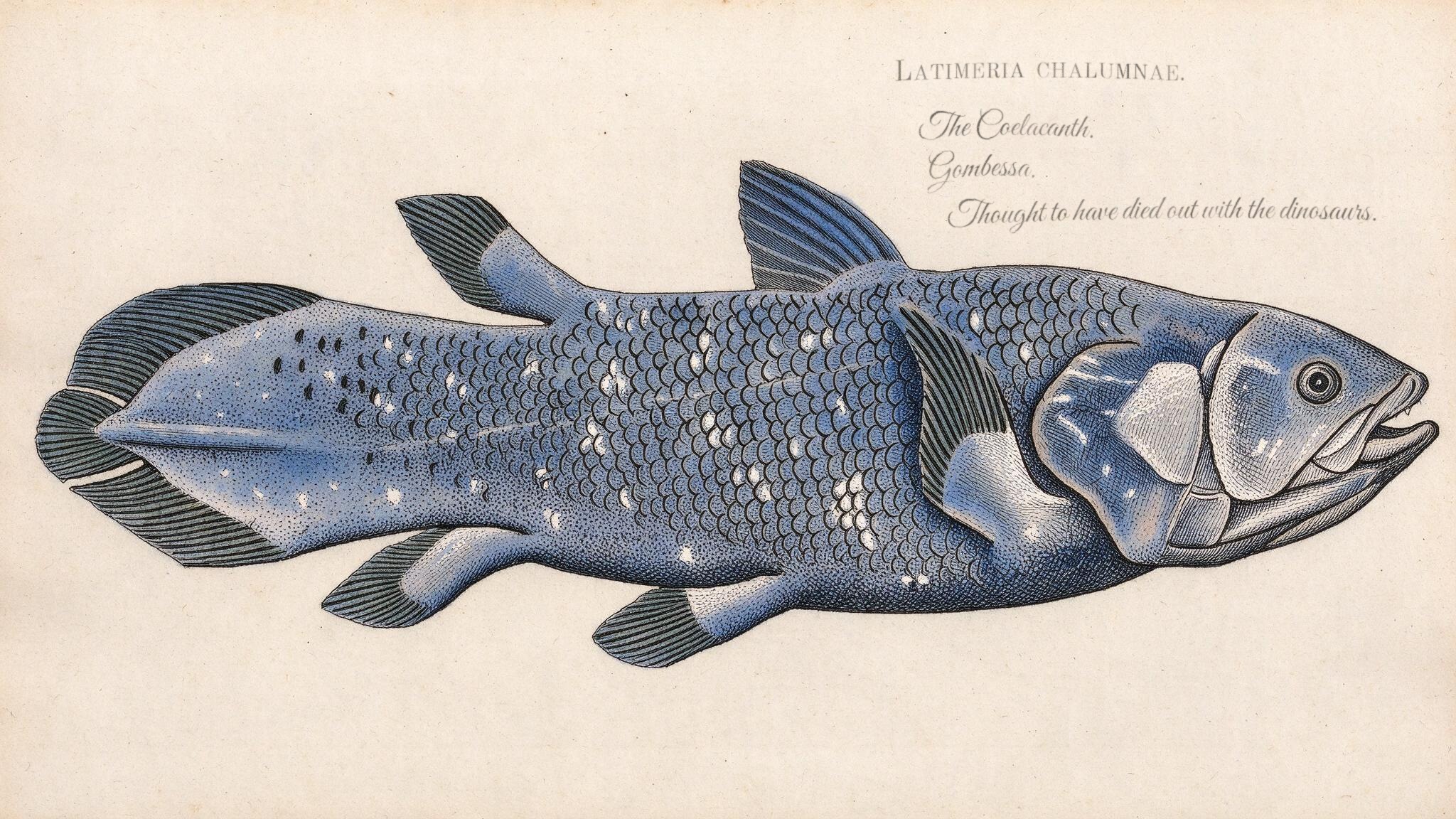
The coelacanth is a large, heavy fish up to two metres long, dark blue with small white spots, by which scientists tell each fish apart. Its scales are thick as armour, its head encased in bony plates.
But what matters most is the fins. The pectoral, pelvic, second dorsal and anal fins sit on fleshy “stalks” with bones inside, like a limb. The tail is broad and diamond-shaped, and from its middle sticks out one more small lobe, like a little brush. No other fish on Earth is built like this.
The coelacanth is a lobe-finned fish, from the same ancient branch that once gave rise to the first four-legged animals on land. It is not their ancestor but a distant relative: closer to us, as its genome showed, are the lungfishes. Yet it swims the way lizards walk: the left pectoral fin moves with the right pelvic, and the right with the left — crosswise.
It lives slowly and long. In 2021 scientists counted the annual rings on its scales and found that the coelacanth lives to a hundred, females mature only after fifty, and the young are carried for about five years — one of the longest pregnancies of any animal known. The coelacanth does not spawn eggs into the water: its young are born alive.
Above the entry is a drawing generated by AI, which reworked into the manner of an old plate a drawing by Robbie Cada, a FishBase artist: there are no old pictures of a living coelacanth, since no one saw one alive before 1938.
IIWhere she holds
drag to turn · ctrl + wheel to zoom · a mark is a water of the atlas — click to open it
The coelacanth lives in the western Indian Ocean. Its main home is the Comoros, the islands between Madagascar and Africa: off Grande Comore, by estimates, there are no more than three or four hundred fish. Coelacanths are also found off South Africa, Mozambique, Madagascar, Tanzania and Kenya.
By day they rest in caves on the steep underwater slopes of volcanoes, a hundred and fifty to two hundred and fifty metres down, sometimes several fish to a cave. At night they come out and drift slowly along the slope, hunting fish and squid. Scientists in submersibles have watched a coelacanth hang in the water head-down — why, they are still guessing.
And in 1997, at the other end of the ocean, a second species was found in a market in Manado, Indonesia — the Indonesian coelacanth, brown with golden flecks. The two species are ten thousand kilometres apart.
IIIHow she is taken
For the visiting angler
The coelacanth is not fished for — it can only be seen, and only by a few. In order:
Catching it is forbidden. The species is critically endangered, listed in CITES Appendix I, protected in the Comoros and South Africa. One caught by accident is released; if the fish has died, scientists are told — every such fish counts.
Where to see one alive. In South Africa, in the canyons off Sodwana Bay, about a hundred metres down. In 2000 three divers saw coelacanths here with their own eyes for the first time. Dives to them are for technical divers only, under the marine park’s special rules.
Where to see the very first. The East London Museum in South Africa holds that coelacanth of 1938 — mounted, because at the time there was no other way to keep it.
By the trade
There is no fishery for the coelacanth and never was: its flesh is oily and unpleasant, and the Comorian fishermen, who called it gombessa, caught it only by accident, at night, on a handline, while fishing for other fish.
Today the main threat is nets. Since the 2000s coelacanths have been caught off Tanzania in deep-set shark nets, and several dozen died within a few years. For a species counted in hundreds, that is a great many.
IVSecrets of the craft
Each one by its face. Every coelacanth’s white spots are its own and do not change with the years. From photographs of the spots scientists recognise the same fish many years later.
Not an ancestor, a relative. The coelacanth is not “a fish that became a lizard” but a surviving branch beside the one that came ashore.
Not quite a “living fossil”. Today’s coelacanth is not an ancient fish preserved in time but a species of its own that changed like all others. It just changed more slowly than most.
It senses rather than sees. In the coelacanth’s head is a special organ that picks up the faint electric fields of prey — in the dark of the deep, more useful than eyes.
VStories about her
This is one of the most famous finds in the history of science, and it has its heroes.
Fossil coelacanths had been known since 1839, when the Swiss naturalist Louis Agassiz named the genus Coelacanthus — “hollow spine”. The youngest fossils were some sixty-six million years old, and everyone believed the coelacanths had died out with the dinosaurs.
On 22 December 1938 the trawler Nerine, under Captain Hendrik Goosen, came back into East London, South Africa, with a catch from off the mouth of the Chalumna River. The young curator of the local museum, Marjorie Courtenay-Latimer, came to see whether there was anything of interest — and saw among the fish a blue one with white spots and fins like limbs. No cold store large enough for the fish could be found, so it had to be mounted, and the insides were lost.
Courtenay-Latimer sent a sketch to the ichthyologist James Leonard Brierley Smith. He arrived only in February 1939 — and knew at once what he was looking at. He named the fish Latimeria chalumnae — after the curator and the river.
Smith searched for a second coelacanth for fourteen years. He sent leaflets along the coast promising a reward of a hundred pounds. And in December 1952, off the island of Anjouan in the Comoros, a fisherman named Ahmed Hussein caught a coelacanth on a handline. Smith could find no plane and telephoned the Prime Minister of South Africa, Daniel Malan — who sent a military Dakota for the fish. And in the Comoros it turned out that the local fishermen had always known this fish. To science it was a miracle; to them it was gombessa, a poor-tasting fish that now and then came up at night.
IUCN Red List — Latimeria chalumnae, critically endangered; CITES Appendix I. · Mahé et al., 2021, Current Biology — lifespan up to 100 years, gestation about 5 years, female maturity after 50. · NOAA Fisheries — African coelacanth: depths, population estimate off Grande Comore. · East London Museum, Knysna Museums, Biodiversity Heritage Library — the 1938 discovery, M. Courtenay-Latimer and J. L. B. Smith. · The second find of 1952 on Anjouan and the Dakota flight. · The Indonesian coelacanth — M. Erdmann, Manado, 1997. · Coelacanths at Sodwana Bay, 2000. · Coelacanth bycatch in shark nets off Tanzania. · Drawing by Robbie Cada, FishBase (public domain) — the model for the cover.