IHistory
The Florida Keys are an arc of coral and limestone islands, some seventeen hundred of them, large and tiny. It runs south-west from the tip of Florida to Key West and beyond, to the empty islands of the Dry Tortugas. On one side of the arc lie Florida Bay and the Gulf of Mexico, shallow, warm and green. On the other is the Straits of Florida, where the Gulf Stream passes close by. And along the outer edge, a few kilometres offshore, runs a reef two hundred and seventy kilometres long: the third-largest barrier reef in the world.
Before the Europeans the Calusa and the Tequesta lived here — peoples who fed on the sea: fish, turtle, shellfish. In 1513 Juan Ponce de León sailed past. From afar the rocky islets looked to him like suffering men, and he named them Los Mártires — “the Martyrs”. The far large island the Spaniards called Cayo Hueso; the English bent that to their own ear into Key West.
The Martyrs lived up to the name. The reef lies right beside the channel by which the Spanish fleets carried silver home, and ships broke on it century after century. Out of that grew the islands’ first trade — wrecking. The wreckers watched the reefs, raced to a ship when she struck, took off people and cargo, and a court set their share. On this Key West became the largest town in Florida, and a prosperous one. Then came sponges, cigars and turtling, but the fame of the wrecks stayed: in 1985, off the Marquesas Keys, searchers raised the treasure of the galleon Nuestra Señora de Atocha, lost in the hurricane of 1622.
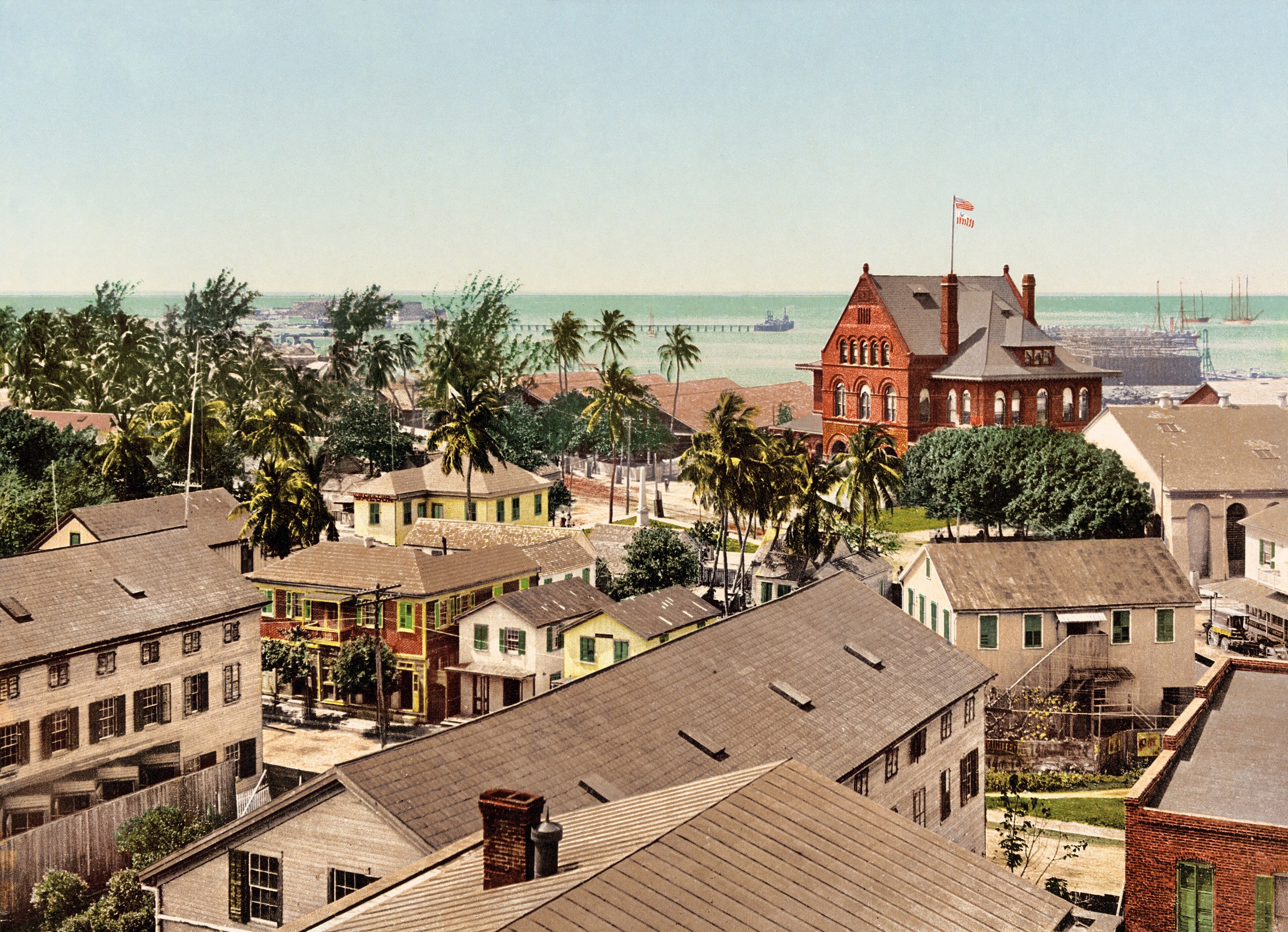
Above the entry is Key West in 1900: the red-brick custom house, palms, a pier, sailing ships in the roads. It is a photochrom by the Detroit Publishing Company: a black-and-white negative was transferred to lithographic stone and the colour printed from several stones, one for each ink. This is how turn-of-the-century America looked at its resorts on postcards.
Twelve years after this picture, on 22 January 1912, the first train arrived in Key West. Henry Flagler, Rockefeller’s oil partner, had carried a railway along the islands and across the sea between them — the papers called it “Flagler’s Folly”. The line lived twenty-three years: the Labor Day hurricane of 1935 washed out the embankments and killed more than four hundred people. It was never rebuilt. The bridges were given to a road, and in 1938 cars drove to Key West on the Overseas Highway. The longest of the bridges, the Seven Mile, runs almost eleven kilometres over the water.
IIWhat is there now
Today the islands are one road, forty-odd bridges, and water on both sides as far as the eye can see. And almost everything the Keys live by is bound up with that water.
Hemingway. In the spring of 1928 Ernest Hemingway and his wife Pauline first came to Key West — on John Dos Passos’s advice. By day he wrote, and in the evenings he went out with local fishermen after tarpon in the harbour. “Caught the biggest tarpon they’ve had down here so far this season,” he wrote in a letter at the time, “sixty three pounds.” He lived on the island for more than ten years, went out from here into the Gulf Stream after marlin, and here wrote To Have and Have Not — a novel of Prohibition Key West, in which a fishing boat runs rum and men.
The sanctuary. In 1990 the waters around the islands were declared a national marine sanctuary — almost ten thousand square kilometres, from mangrove bays to the reef. Fishing is allowed almost everywhere in it, but not everywhere: on the reef there are zones where fish are not touched at all, marked with buoys. The reef is ailing — the coral bleaches in the heat — and it is being restored by planting out corals grown in nurseries.
The bridges. The old railway bridges stand beside the new ones, and people fish from them: in places the old span has been kept as a fishing pier. Under the bridges at Bahia Honda, Long Key and the Seven Mile the tide runs through the narrow passes between the islands, and fish hold in it — above all the tarpon.
And Islamorada. The town in the upper Keys calls itself “the sportfishing capital of the world”. The name is a slogan, but not an empty one: here in the mid-twentieth century the poled flats fishing described below took shape, and guides who teach it still go out from here. Islamorada also has a marina where tarpon are fed by hand — there are more than a hundred of them, and it all began, as the owners tell it, with one injured fish.
IIIWhat is taken here
Tarpon — the silver king, the fish people come here for in spring. Under the bridges at night, on the flats by day; it is released only.
Bonefish — silvery, almost invisible over pale sand, it feeds on the flats in the shallowest water with its tail in the air. Shy and fast: once hooked it runs so hard the reel sings. Release only as well.
Permit — tall, flat, with a sickle tail; it eats crabs on the flats and around wrecks. The most capricious fish of the flats: you can see it for weeks and not catch one. Tarpon, bonefish and permit in a single day make the flats “grand slam”, the dream of everyone who fishes the fly.
Reef fish — yellowtail and mangrove snapper, groupers, jacks. They are fished on the reef and over wrecks, and they go to the table.
Open water — beyond the reef, in the Gulf Stream: dolphinfish, sailfish, tuna, marlin. That is where Hemingway went.
And not fish, but there are no Keys without them: the spiny lobster, which here is simply called the “bug”, and the stone crab, from which one claw is taken and the crab let go — the claw grows back.
IVHow it is taken
Recreational fishing
In the Keys there are three ways to fish, and each has its hour.
First, the rules. Saltwater fishing requires a Florida licence, and for visitors it is a must; it is bought online. Tarpon and bonefish are release only in Florida. A tarpon over forty inches must not be taken out of the water, not even for a photograph. One tarpon a year may be kept only with a special tag — and only in pursuit of a state or world record. The sanctuary has zones where nothing is fished; they are on the charts and marked with buoys.
Under the bridges, at night. The Keys classic. The boat is anchored up-current of the bridge, and the bait — a live crab or a mullet — is let out so that the tide carries it along the line between the light of the lamps and the shadow under the span. The tarpon lies in the shadow, head into the current, and comes out for whatever the water brings. The hook is a circle hook; the fish is hooked in the corner of the mouth.
On the flats, from the pole. The finest fishing of the islands. A flat-bottomed skiff comes onto the flat, the motor is cut, and the guide climbs onto a platform over the stern and pushes the boat with a long pole — quietly, like a gondolier. From that height the guide sees fish from far off: the shadows of tarpon moving in a string, bonefish tails above the water. The angler on the bow waits for the word and lays the fly ahead of the fish, not on it. A metre wrong, and the fish leaves without a backward look.
On the reef and in the Gulf Stream — ordinary sea fishing: snapper and grouper on the bottom by the reef and the wrecks, dolphinfish and sailfish trolled beyond it. The state sets its own seasons and sizes for reef fish, and they are checked before going out.
When. The great tarpon run is in spring and early summer, from April to June: the fish move along the islands, and boats wait for them under every bridge. In winter the flats of Florida Bay and the warm backwaters see you through.
The trade
The trade of the Keys is, first of all, not fish but lobster and crab. The spiny lobster is taken in trap cages, and its season opens in August; just before it, at the end of July, the state opens a two-day “mini-season” for amateurs, and the islands fill with divers. Stone crab is also trapped: the claw is broken off and the crab returned to the sea.
On the reef and over the wrecks commercial fishermen take snapper and grouper on hooks. And off the Dry Tortugas a bed of pink shrimp was found in the mid-twentieth century, and for some decades Key West became a shrimp port.
Tarpon is not caught for sale: in Florida it is a rod-only fish. Its value lies in the guides, boats and hotels that live off its spring run.
Florida Keys National Marine Sanctuary (NOAA) — area, designation on 28 December 1990, no-take zones, coral restoration. · The Florida Reef — length, rank among the world’s barrier reefs. · Ponce de León and the name Los Mártires, the Calusa and Tequesta, the Key West wrecking trade — from histories of the Florida Keys. · Florida State Parks — the Flagler railroad, first train 22 January 1912; the 1935 Labor Day hurricane; the Overseas Highway, 1938. · John F. Kennedy Presidential Library (Hemingway collection) and Hemingway’s 1928 letters — tarpon in Key West harbour. · Florida Fish and Wildlife Conservation Commission (FWC) — tarpon and bonefish release only, the forty-inch rule, the tarpon tag, lobster and stone crab seasons. · Robbie’s of Islamorada — the history of hand-feeding tarpon since 1976. · Library of Congress — the photochrom “Custom House and harbor, Key West”, Detroit Publishing Co., 1900.