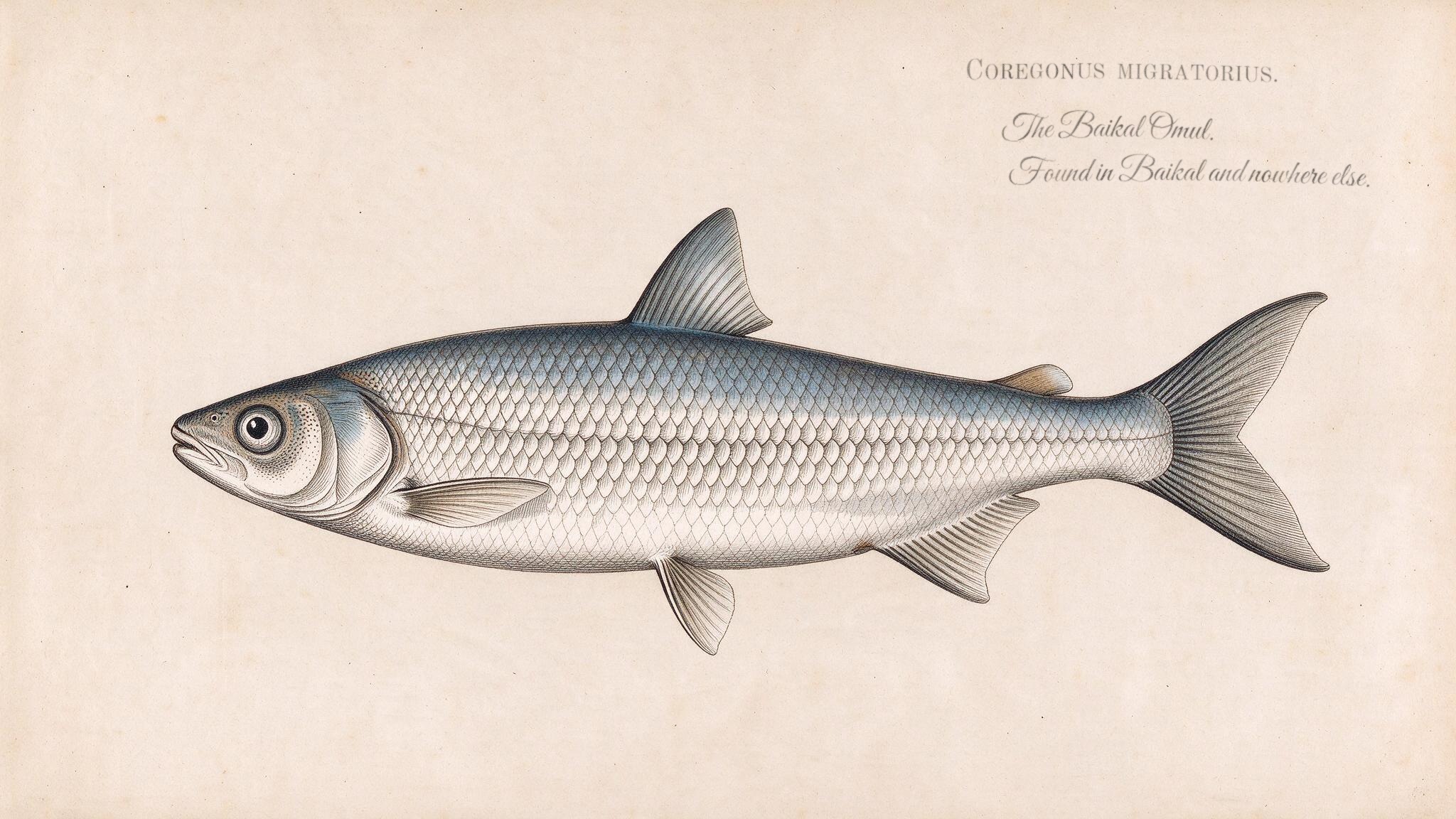
IThe portrait
The Baikal omul is a whitefish, kin to the whitefish proper, the inconnu and the vendace. The body is long and silver, with large scales and a dark blue-brown back. The head is small, the mouth small, there is a single fin on the back, and nearer the tail a small rayless adipose fin, as in all the salmon family.
An omul is usually thirty to forty centimetres long and weighs up to a kilogram. It feeds on small crustaceans drifting in the water column and on small fish — young sculpins and golomyankas.
Scientists long counted the Baikal omul a subspecies of the Arctic cisco, which lives in the mouths of northern rivers and in the sea. Today it is recognised as a species of its own. The omul is thought to have come into Baikal from the north long ago and over thousands of years made the lake its own. Its scientific name was given by Johann Gottlieb Georgi, who studied Baikal in the 1770s.
Above the entry is a drawing generated by AI, not an old plate: we found no scientific images of the Baikal omul in the public domain. The drawing was made from the species’ features and checked against photographs.
IIWhere she holds
drag to turn · ctrl + wheel to zoom · a mark is a water of the atlas — click to open it
The omul lives only in Lake Baikal and in the rivers that run into it. It exists nowhere else in the world.
In summer it keeps to the open water, in the upper layers, where the crustaceans are plentiful. In autumn, in September and October, the omul goes up the rivers to spawn: the Selenga, the Barguzin, the Upper Angara and others. By where the fish go to spawn, several stocks are told apart — the Selenga, the Barguzin, the North Baikal and others.
The omul lays its eggs on the stony beds of the rivers, and the fry drift down into the lake in spring. Some of the young are released by fish hatcheries on Baikal’s shores to help the stock recover.
IIIHow she is taken
For the visiting angler
With the omul today the main thing is the rules. In order:
The fishery is closed. Commercial omul fishing has been banned since 2017. The Federal Fisheries Agency expects the ban to be lifted no earlier than 2027–2029, once the stock recovers.
Angling only where and when allowed. The places and seasons for angling omul are set out in a separate annex to the Baikal basin fishing rules, and outside them omul may not be caught. There is a daily limit. The rules are revised; check the current ones before every season.
The spawning closure. In autumn, when the omul runs up the rivers, fishing for it is banned; in Irkutsk region in 2026 — from 20 August to 20 November.
How it is fished. In winter through the ice, on a rig of several small flies jigged in mid-water — the omul holds not on the bottom but above it.
Poaching. Omul is dear, and it is netted in secret. Buying omul under the counter means feeding the poachers.
By the trade
For more than two hundred years the omul was Baikal’s main fish. It was taken with seines and set nets, salted in barrels, smoked and dried and carried all over Siberia. Salted omul “with a tang” and hot-smoked omul at the Trans-Siberian stations — that was the taste of Baikal.
In the 2010s the stock shrank several times over: overfishing, poaching, changes in the lake itself. In 2017 the fishery was closed. Scientists believe the ban helped avoid a collapse, and are now waiting until there are enough fish to catch them again.
IVSecrets of the craft
Not on the bottom. The omul swims in mid-water after crustaceans. The flies are jigged above the bottom, sometimes just a few metres under the ice.
Don’t confuse it with whitefish. The whitefish has a small mouth set low, under the snout; the omul’s is at the tip, in front. And the omul is slimmer.
Rules first, then the hole. The places where anglers may take omul are listed by name. A hole in the wrong place is an offence, even if the omul bit of its own accord.
Omul spoils fast. It is salted or smoked at once — hence the barrels, and the famous smoked omul.
VStories about her
The omul has something almost no fish in the world has: a folk song of its own.
In the middle of the nineteenth century the teacher and poet Dmitry Davydov wrote verses about a runaway convict making his way home across Baikal. The people reworked them in their own way, and the song “Glorious sea, sacred Baikal” spread across all Russia: “A glorious ship — an omul barrel.” The runaway needs no boat: an empty omul barrel and a wind at his back are enough.
The barrel in the song is not invented. Omul barrels were everywhere on Baikal: the fish was salted in them and carried in them, and empty barrels lay on every shore. The song of freedom turned out to be a song of Siberia’s great fish as well.
Today the story has a new verse. The fish that filled the barrels grew so scarce that catching it was banned. And Baikal waits for the omul to return — just as the runaway in the song waited for a fair wind.
Baikal Museum and scientific summaries — Coregonus migratorius: size, diet, spawning stocks. · The Federal Fisheries Agency — the omul fishing ban since 2017 and its expected lifting in 2027–2029; studies of stock dynamics during fishing and the ban. · Fishing rules for the Baikal fishery basin (Russian Ministry of Agriculture order no. 226 of 24 April 2020, as amended), annex 6. · Irkutsk region’s seasonal restrictions for 2026. · D. P. Davydov, verses on a runaway on Baikal, mid-19th century; the folk song “Glorious sea, sacred Baikal”. · Cover generated by the Seedream 5.0 model (BytePlus); the prompt is kept in the entry’s record.