IHistory
The Grand Banks are a submarine plateau off the southeastern coast of Newfoundland: 282,500 km² of shallow water in an ocean that is otherwise kilometres deep. Depths here are generally less than a hundred metres.
Everything this place became was made by two currents. The cold Labrador Current runs down from the north, the warm Gulf Stream up from the south, and they meet directly over the Banks. Hence the famous Newfoundland fog: warm air over cold water. Hence the fish, too. Where the currents meet, water is turned over from below and carries nutrients up into the light — the plankton bloom feeds everything else.
In 1497 John Cabot reached Newfoundland. What was seen in the water there comes down to us not from him but from a letter written by the Milanese diplomat Raimondo de Soncino to the Duke of Milan on 18 December 1497:
…the sea is covered with fish, which are caught not merely with nets but with baskets, a stone being attached to make the basket sink in the water.
Raimondo de Soncino to the Duke of Milan, 18 December 1497
It should be said plainly: these are not Cabot’s words. This is a diplomat’s retelling, taken from men who had come back from the voyage, and the word “cod” appears nowhere in it. Yet this sentence became the formula for the Grand Banks for five hundred years.
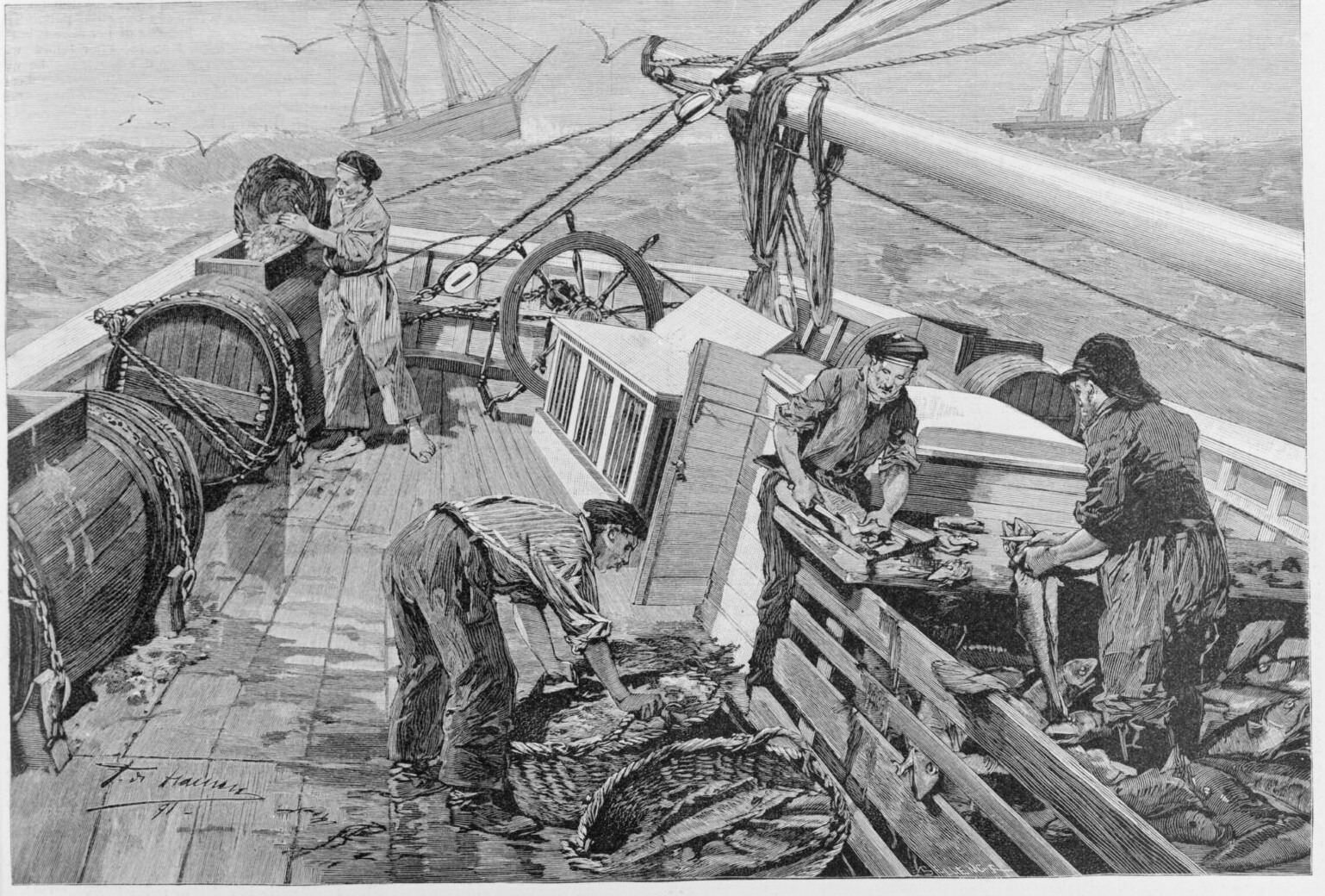
Then came the work. Portuguese, Basque, French and English crews crossed the Atlantic every summer. They fished by hand from rowing dories and salted the catch aboard or dried it ashore. Over 103 years, from 1647 to 1750, roughly eight million tonnes of cod were taken from the Banks. The figure is enormous — but it was spread across four generations, and the stock held.
In the middle of the twentieth century the factory freezer trawlers arrived: a vessel that needs no shore to process its catch, and very little weather to keep working. What the sailing fleet had taken in one hundred and three years, the trawlers took in about fifteen.
The peak came in 1968 — 810,000 tonnes of northern cod in a single season. After that the curve turned down, and it fell fast. By 1992 the spawning biomass had dropped by 99%: the population stood at roughly one per cent of its historic level.
On 2 July 1992 fisheries minister John Crosbie declared the moratorium. Some 30,000 people in Newfoundland and Labrador lost their work in a single day — about 12% of the province’s entire workforce. It remains the largest single-day layoff in Canadian history. Over the following decade the province’s population fell by roughly a tenth; whole outports emptied.
IIWhat is there now
On 26 June 2024 Canada announced the lifting of the moratorium. Minister Diane Lebouthillier set a total allowable catch of 18,000 tonnes of northern cod.
Before celebrating, three things are worth understanding.
The moratorium never meant a total ban. The inshore fleet fished cod in most years from 1998 onward, and recreational fishing has been permitted since 2006. The ban applied to the commercial offshore fishery, and lifting it was a change of status, not the opening of a sealed door.
The 2024 decision does not rest on fish alone. In October 2023 the department revised its stock assessment model and lowered the boundary between the “critical” and “cautious” zones. The stock moved into a different category partly because the line was moved.
The numbers are more modest than the headline. The northern cod stock is estimated at roughly 340,000 tonnes — about 12% of its 1960s level and about 24% of its 1980s level. Researchers at Memorial University of Newfoundland put the probability of the stock falling back into the critical zone at 62–76%.
The quotas, meanwhile, are climbing quickly: 13,000 tonnes in 2023, 18,000 in 2024, 38,000 for the 2025–26 season and 59,000 for 2026–27. A four-and-a-half-fold rise in four years.
IIIWhat is taken here
Cod has returned to the news, but not to the economy. The fishery on the Banks today is not held up by fish.
Snow crab is the main business. For 2026 the quota in area 3LNO — the Grand Banks proper — stands at 47,141 tonnes.
Northern shrimp accounts for roughly 40,747 tonnes across fishing areas SFA 4–7. Area SFA 7, the one lying on the Banks, is open again in the 2026–27 season after a closure that had held since 2015.
Northern cod — 59,000 tonnes for 2026–27, a substantial share of it taken by the inshore fleet rather than by large vessels. It is the same fish that comes up on a visitor’s jigger: one stock.
Beyond these: Greenland halibut, yellowtail flounder and redfish.
IVHow it is taken
Recreational fishing
The important thing first, so there is no disappointment: a visiting angler cannot fish the Banks themselves. They begin roughly a hundred kilometres offshore and run five hundred kilometres further out. Vessels go there, not pleasure boats.
That does not mean there is nothing to catch. The cod taken from inshore boats and straight off the Newfoundland shore is the same northern 2J3KL stock. Same fish — simply not in the place where the trawlers work.
It is called the food fishery, and by Canadian standards the rules are surprisingly relaxed.
The permitted days depend on the area. In 2J3KL — the north and east coasts — summer fishing runs seven days a week. In areas 3Ps and 4R3Pn it is three days only, Saturday to Monday. Worth checking before booking a flight.
The limit covers all groundfish together, not cod alone. Five fish means five fish, flounder and everything else off the bottom included.
Going out with an operator works differently. Tour boats certified by Transport Canada have a separate voluntary programme: two fish per passenger per day, but seven days a week, with mandatory tagging and catch reporting. For a visitor without a boat this is usually the only real way to get out on the water — charters run from the Avalon Peninsula, out of the harbours near St. John’s.
Dates are set afresh every year. The figures above are for 2026. Check the DFO public notices for the Newfoundland and Labrador region before travelling: seasons do move.
The trade
Briefly, for a sense of scale. For four hundred years the work was done by handline from a dory — line, lead, baited hooks. The nineteenth century brought the longline: a groundline carrying hundreds of hooks at once, and the first sharp jump in catches. The twentieth brought the bottom trawl, a bag dragged across the seabed that takes not only the fish but the ground they live on. That is what emptied the Banks.
Today the backbone is pots: crab is taken in fleets set along the bottom and marked with buoys. Flounder and halibut come to gillnets and Danish seine.
Fisheries and Oceans Canada (DFO) — decision to lift the moratorium, 26 June 2024; fishery management plans for 2025–26 and 2026–27; public notices on 2026 recreational groundfish season dates for Newfoundland and Labrador. · The Canadian Encyclopedia, “Grand Banks” — area and boundaries at the 200 m isobath. · Raimondo de Soncino, letter to the Duke of Milan, 18 December 1497. · Memorial University of Newfoundland — estimate of the risk of return to the critical zone.