IHistory
The Bali Strait is a slot. At its narrowest, between Ketapang on Java and Gilimanuk on Bali, the far shore is two thousand four hundred metres away — a distance you take in at a glance. The average depth is sixty metres. Through this slot the Indian Ocean communicates with the Bali Sea, and the water goes through it as water goes through any narrow place: in the northern throat the current runs up to thirteen kilometres an hour. Faster than a man runs.
The Balinese explain the strait differently. The Brahmin Sidi Mantra, ruined by a gambling son, drew a line on the ground with his staff to set himself apart from Manik Angkeran. Water came into the line, the line became a strait, and father and son have been on separate islands ever since. We will set the tale down separately; what matters here is only that in it the strait is not a geographic accident but a border drawn on purpose.
The fish that brought people here is called lemuru. Pieter Bleeker, the Dutch physician who described more fishes of the Indies than anyone before him, took the local word in 1853 and made Latin of it: Sardinella lemuru. An oily sardine — in English it is called the oil sardine for exactly that reason.
Ashore it has not one name but four, and they are names for size rather than for fish. Under eleven centimetres it is sempenit. Eleven to fifteen, protolan. Fifteen to eighteen, lemuru proper. Over eighteen, lemuru kucing, the cat’s lemuru. A man who spends his life looking into a hold distinguishes centimetres rather than species: the centimetres decide where the fish will go.
And it goes four ways: into the can — mostly for Middle Eastern markets — into feed pellets for aquaculture, into organic fertiliser for Japan, and into bait for the tuna longliners.
It is taken by purse seine; here the gear is called slerek. The boats work in pairs: one holds the light, the other shoots the net. At night the strait stands in lamps. Zainullah Baijuri, a Madurese elder, went into this work in the late seventies — a pair of boats took forty tonnes a trip then.
The high-water mark people name in Muncar is March 2010. For six days running, a hundred and seventy-five tonnes of fish a day were thrown away: the processors were full and there was nowhere to put the catch.
IIWhat is there now
Then the sardine ran out.
By 2014 the whole fleet of the strait was lifting under thirty tonnes a day — less than had been thrown away in a single day four years earlier. Of a peak fleet of a hundred and ninety boats, seventy-eight were still working. A boat’s takings for a night had fallen below two hundred dollars: half of what it costs to put a seiner to sea.
2017 and 2018 were the worst in eleven years — monthly production never rose above three hundred tonnes. The cause is given as double: overfishing through 2014–2017, and a change in the water itself — temperature, salinity, the depth of the thermocline.
But the exact measure of what happened is not in tonnes landed; it is in the shipping papers. In the second half of 2013 the Pasific Harvest cannery, standing on this shore, imported 118,560 kilograms of sardine from Pakistan and the Czech Republic and 37,000 kilograms of mackerel from China — about half of all its raw material. The Czech Republic has no sea at all. A cannery on the strait where sardines were taken by the thousand tonnes was buying sardines from a landlocked country.
There is worse. In a 2010 doctoral thesis Eny Buchary went through half a century of Muncar’s statistics, 1950 to 2001, and showed that between a half and two thirds of what was landed ever reached the official figures. The stock was managed on numbers that were never complete. Her conclusion: for the fishery to hold, effort would have to be cut by half against the 2001 fleet.
Two of every three men in Muncar live by the fishery or by trades attached to it; the crew of a pair of seiners is around fifty-five. People leave for work elsewhere and pawn their wives’ jewellery. Baijuri, who once bought four boats and was ruined by them, puts it shortly:
We must leave the Straits and head to the Indian Ocean if we want to land fish.
Zainullah Baijuri, fisherman, Muncar
The comparison makes itself. On the Grand Banks the cod was taken out and the fishery closed for thirty-two years. At Lofoten the same cod was divided by quota in advance, and it still runs. The Bali Strait is a third case, in between: nothing was brought down at a stroke, and nothing was agreed in advance. Java and Bali still sit down to negotiate the fishery afresh every year.
IIIWhat is taken here
Lemuru is the reason for everything, and not a fish for a rod. It is taken by net, in shoals, by the tonne; nobody goes after it alone.
For the angler the strait is interesting for another reason — and precisely the reason it is awkward. The current that carries the boat away packs the small fish into a seam. And where the small fish are packed, the hunters stand.
Giant trevally. The headline fish here for anyone who comes with tackle. It strikes on the surface, takes a popper, and breaks gear rated for something more modest. It works all year, but by the water rather than by the calendar.
Dogtooth tuna. Holds by the drop-offs, deep. Not a tuna in the strict sense but a relative, with the teeth it is named for. Reached by vertical jig.
Spanish mackerel — tenggiri by its local name. It runs in the seam and takes on the move. With it, wahoo, a relative in looks and in habit both.
Yellowfin and skipjack tuna. Yellowfin runs from August to November.
Deeper and rarer: amberjack, ruby snapper and barracuda.
IVHow it is taken
Recreational fishing
Boats go out from both shores. On the Bali side: Gilimanuk, Labuan Lalang, Pemuteran; on the Java side, Ketapang and Banyuwangi. The best corner is reckoned to be Bali’s north-west with Menjangan island — the run to the fish is minutes from there, not hours.
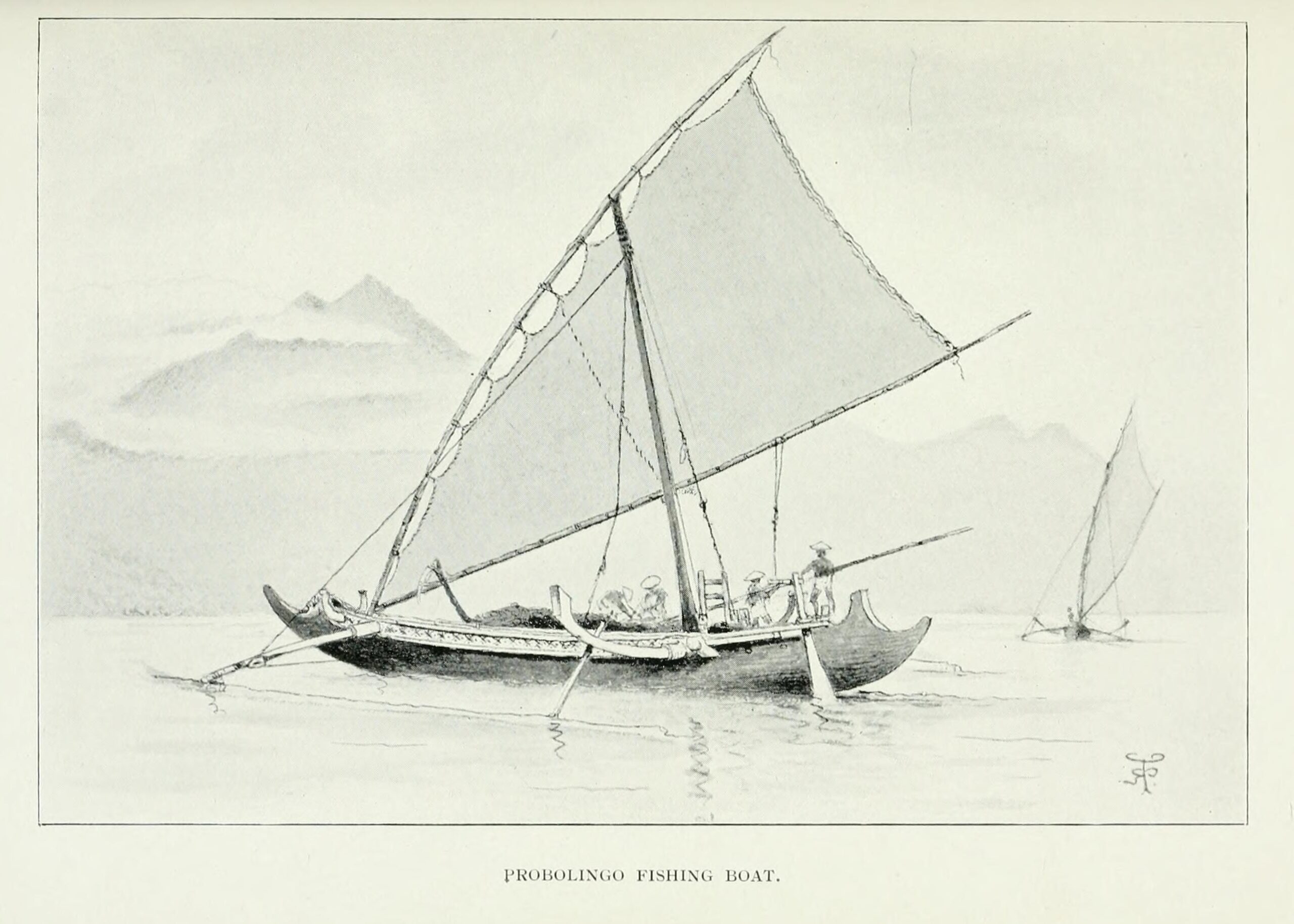
The boat comes in two kinds. The jukung is the Balinese outrigger: a narrow hull with two bamboo floats out on either side, a device older than any tackle used here. And the ordinary powered launch. On a jukung you are nearer the water and it is clearer what the water is doing.
There are essentially two methods. Trolling — drawing a lure along the seam and along the drop-offs, which takes mackerel, wahoo and tuna. And the jig — a heavy piece of metal worked vertically over a drop-off, which reaches the dogtooth and the deep snappers. For trevally on the surface, the popper.
But all of that is secondary to the one thing, and the one thing is what visitors learn last. Here you plan by the tide, not by the clock. Thirteen kilometres an hour is the speed at which an anchor does not hold, a jig never reaches bottom, and the boat is off the mark before you finish a cast. The strait has windows: short stretches around the turn of the water when fishing is possible. A boatman who grew up on this shore knows those windows by heart. A schedule built around the hotel pick-up has nothing to do with them.
Season. The best stretches are late March into April, and September to November. Yellowfin comes through from August to November.
And a border you cannot see from the water. Bali’s north-west is taken up by West Bali National Park — some 190 square kilometres of land and sea, with Menjangan inside it. The marine part is cut into zones: a marine protection zone, and a traditional zone left to local fishermen. The drop-off you liked may lie in either, and nothing on the water says which.
No separate permit is needed for sea angling in Indonesia as a visitor: what limits you is not paperwork but the zones and the current. Daily catch limits per boat have appeared in recent years and are changing, though — which is exactly the question to put to the operator before setting out rather than after.
The trade
The purse seine accounts for about ninety-three per cent of all lemuru taken. The boats work in pairs, at night, on the light. Two ports receive the fish: Muncar on the Java shore and Pengambengan on Bali’s.
The run rests on upwelling. In the south-east monsoon, winds off Australia push the surface water away from the coast and cold, rich water comes up in its place — a bloom begins, then zooplankton, then sardine. The peak of the run falls about a month and a half after the peak of the monsoon. The fishery moves with the water: in April the boats are in the northern part of the strait, by September they have shifted south.
Every seven to twelve years El Niño intervenes and stretches the mixing into November and January. Then comes a windfall year. “All small pelagic fish do well in El Niño years,” says the oceanographer Alan Koropitan. He also explains why a windfall is dangerous: fleet and factories are built to the size of the good year, and that capacity then has to be fed through the lean ones. It is fed out of the stock.
And one small thing that shows the state of the fishery better than any statistic. There are now so many lights on the water, and they are so bright, that skippers can no longer make out a shoal with their eyes. The shoal is now found by hearsay: by text message and by radio.
Width, depth and current speed in the strait from navigational descriptions. · Sardinella lemuru Bleeker, 1853; the size classes sempenit / protolan / lemuru / lemuru kucing from Indonesian research on the Bali Strait fishery. · Melati Kaye, Mongabay, “Boom but mostly bust: fighting over sardines in Indonesia’s Bali Strait” (2014): March 2010 and 175 tonnes a day, 78 boats of 190, Pasific Harvest raw-material imports from Muncar port records, the words of Zainullah Baijuri and Alan Koropitan — citing Abidin, head of the district fisheries office at Muncar. · Eny Buchary, doctoral thesis, University of British Columbia (2010): completeness of the 1950–2001 statistics and the estimate of excess fishing effort. · The 2017–2018 decline and the purse seine’s share of the catch from reviews of the lemuru fishery. · Upwelling, the south-east monsoon, ENSO and the Indian Ocean Dipole from oceanographic studies of the strait. · Marine zoning from the West Bali National Park authority (Balai TNBB). · Angling seasons and methods from the practice of local fishing operators. · The tale of Sidi Mantra and Manik Angkeran is Balinese folklore; it will be set down separately.