IHistory
Hawaiians did not wait for fish in the sea. They built it a house.
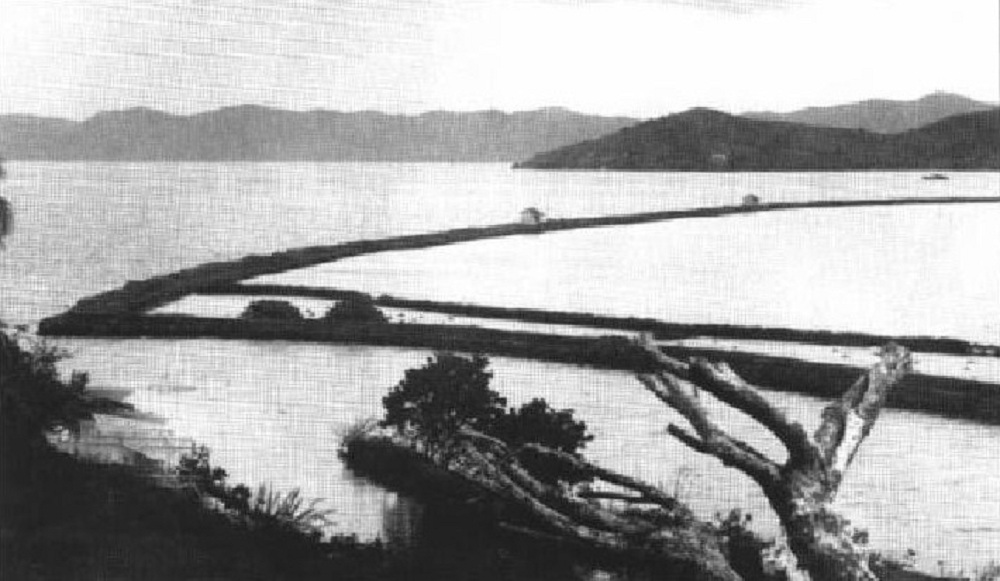
Such houses are called loko iʻa — fishponds. There were several kinds: ponds behind a sandbar, freshwater ponds in the valleys, ponds combined with taro fields. But the most perfect were the loko kuapā: a wall of lava and coral stone was laid straight across the reef, from one point of land to another, in a half-circle, and a piece of the sea became a pond.
The great trick is in the wall. It was left with openings fitted with grates, the mākāhā, and such grates were made nowhere else in the world but Hawaiʻi. On the flood tide seawater came into the pond through the grate, and with it the young fish. Inside, they fed on algae, grew, fattened — and could no longer get back out through the same bars. The pond filled itself.
The fish raised in it were those that eat algae: first of all mullet, ʻamaʻama, and milkfish, awa. Raising predators would have made no sense — they would have had to be fed on fish.
The best ponds belonged to the chiefs. They were run by the konohiki — stewards who knew the life of every fish. A konohiki could lay a kapu, a prohibition, on any species at any time: when a fish grew scarce, or when it was the wrong season. Poaching or fouling a pond was punished severely.
Heʻeia, on the eastern shore of Oʻahu, is one of those ponds. Its wall runs about two kilometres, three and a half to four and a half metres wide, and encloses some thirty-six hectares of brackish water. It was built by hand six to eight centuries ago.
IIWhat is there now
In the nineteenth and twentieth centuries the ponds were abandoned one after another. They silted up, their walls crumbled. At the start of the twentieth century red mangrove was brought to Hawaiʻi, and it choked many ponds entirely: where there had been water stood a forest on stilt roots.
Heʻeia has been under restoration since the late 1980s. The work is done by a non-profit, Paepae o Heʻeia: clearing the mangrove, relaying the wall, setting the grates again. The pond works once more as it worked under the chiefs — the fish come in by themselves and stay by themselves.
This is no museum work. The pond has become a school: volunteers, schoolchildren and scientists come here, and anyone may lay a stone of their own in the wall. The same is happening across Hawaiʻi: communities are bringing back ponds that had stood dead for nearly a century.
The meaning goes deeper than it looks. A pond was not just a holding tank. It was part of an ahupuaʻa, a land division that ran from the mountain to the reef: the forest above held the water, the water came down through the taro fields into the pond, and the pond fed the people. To bring back the pond is to bring back that chain as well.
IIIWhat is taken here
Mullet, ʻamaʻama, is the chief fish of the ponds. Hawaiians had four names for it by size: the fry, pua ʻamaʻama; up to fifteen centimetres, kahaha; up to thirty, ʻamaʻama; larger, ʻanae.
Milkfish, awa, is the ponds’ second resident, a silver fish that also eats algae.
Moi — the threadfin, fish of the chiefs: in old times commoners were forbidden to eat it.
Beyond the wall, in Kāneʻohe Bay, are bonefish, ʻōʻio — the fish of the flats, which anglers call the grey ghost — and young trevally, papio.
IVHow it is taken
Recreational fishing
Hawaiʻi has arranged sea fishing so that locals need no papers and visitors do. In order:
Visitors aged 15 and over need a licence. For non-residents it has been compulsory since 2 May 2024 — from the shore, from a boat, on a charter, anywhere at sea. It costs 20 dollars for a day, 40 for a week, 70 for a year, and is bought online. State residents need no licence for sea fishing.
Mullet is closed from December to March in most places: it is the spawning time.
Nobody fishes inside the ponds without permission. A pond is someone’s farm and someone’s work. Fishing is done outside the wall, in the bay.
What to take in the bay. Bonefish on the flats — light spinning or fly, on the flood tide, when the fish come in to feed. Papio — on small lures by the reef and along the walls.
And see the pond. Paepae o Heʻeia holds work days for volunteers: you can lay a stone yourself in the wall of a six-hundred-year-old pond. It is perhaps the best fishing on Oʻahu, where the fish is not caught but raised.
The trade
The ponds do not fish commercially in the old sense: this is not a fish farm for sale but a community’s economy brought back. Fish grown in the pond is taken in measure and shared — as it was under the konohiki.
Hawaiʻi Sea Grant — types of Hawaiian fishponds, the wall and the mākāhā grates, the role of the konohiki and kapu. · Paepae o Heʻeia — length and width of the wall, area and age of the pond, restoration. · Hawaiʻi Department of Land and Natural Resources, Division of Aquatic Resources — the non-resident licence (rules from 2 May 2024, fees) and the December–March closure on mullet. · Hawaiian dictionaries — names of the mullet by size. · Old photograph of Heʻeia fishpond, Bishop Museum collection.