IHistory
Every sea has a shore. This one has none.
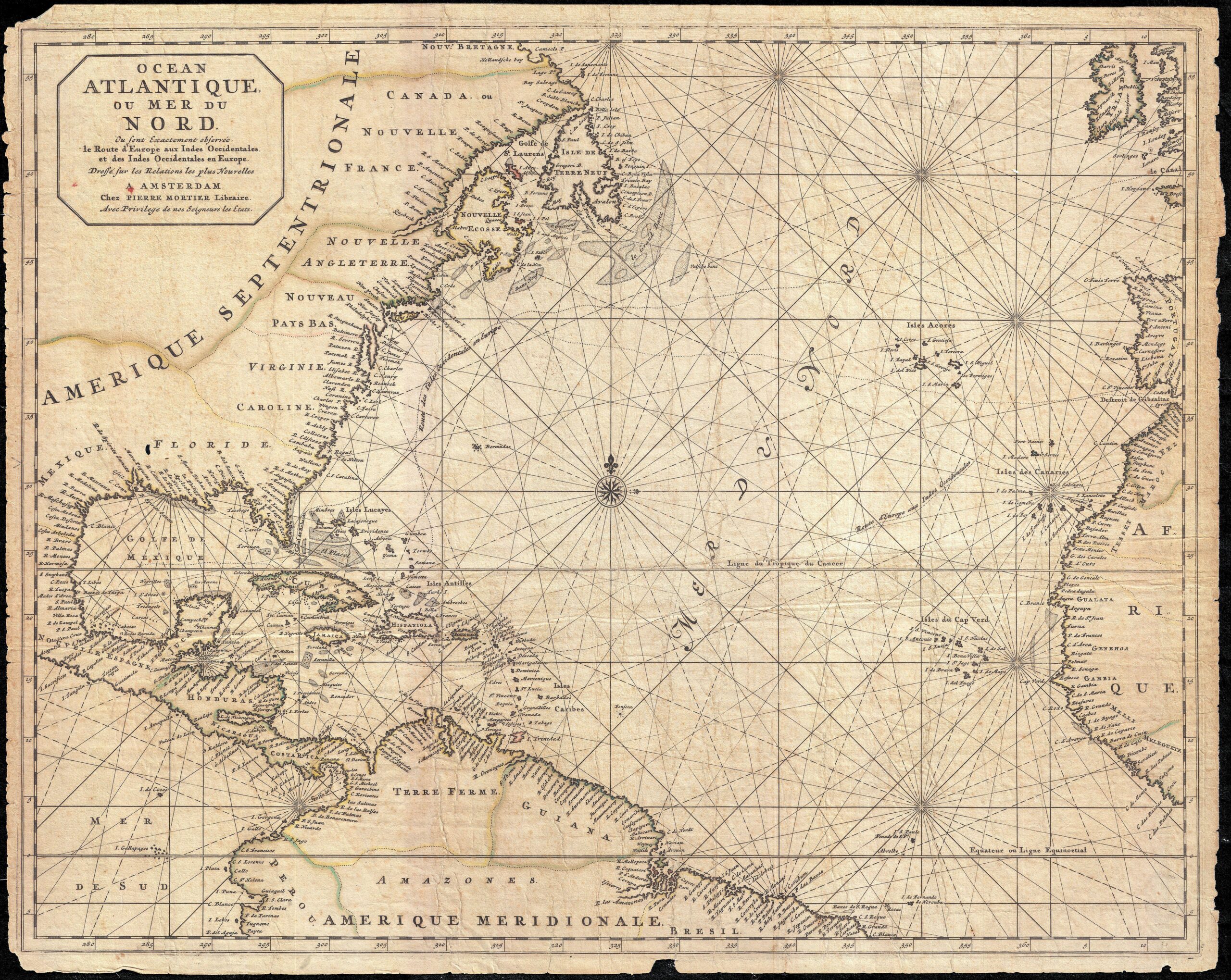
The Sargasso is the only named sea on the planet without a scrap of land along its edge. Its boundaries are held by four currents running in a circle: the Gulf Stream to the west, the North Atlantic Current to the north, the Canary Current to the east and the North Equatorial Current to the south. Inside that ring the water stands almost still, and so it is warm here, salty and astonishingly clear.
The first European to describe it was Christopher Columbus. On 16 September 1492 he recorded that the ships had entered fields of floating weed. The crew decided a shoal lay ahead and land was near. There was no land.
From this came what was told for the next four hundred years: that the weed holds ships, that in the middle of that field stand vessels which never got out, and that on their decks there is nobody. They called it the sea of lost ships.
The real answer proved more interesting than the invention, and it was found for the sake of a fish. From 1920 to 1922 the Dane Johannes Schmidt worked the Atlantic aboard the Dana, trawling the deep and steering toward wherever the eel larvae were smaller. The road brought him here. In 1922, south of Bermuda, he caught the smallest larvae anyone had seen, and named the Sargasso Sea as the place where the European eel is born.
IIWhat is there now
A sea without shores belongs to nobody, and that is its misfortune.
Almost all of it lies beyond anyone’s territorial waters — on the high seas, where there is no owner and nobody to forbid. The single step that has been managed is the Hamilton Declaration, signed in Bermuda on 11 March 2014.
Of it one thing must be said plainly: it is a political statement, not a law. It creates no obligations, imposes no bans, provides no penalties. The signatories agreed to meet and to cooperate voluntarily, and for that they established the Sargasso Sea Commission. For the high seas this was still a step forward — simply a small one.
What is happening to the sea itself is hard to state precisely. The ring of currents gathers more than weed: plastic from across the North Atlantic is carried here too, and this part of the ocean has long been known as an accumulation zone. Separately, researchers note that the northern part of the sea now holds markedly less sargassum than historical measurements recorded.
The overall picture is this: the place where a critically endangered fish is born is not, in any real sense, protected.
IIIWhat is taken here
Here the order this section usually keeps has to be broken.
The Sargasso Sea is not a fishing ground. It is a nursery.
The main thing that happens here is birth. The European eel comes here to spawn, having covered five to ten thousand kilometres — and does not go back. The American eel comes here too. From here the larvae of both disperse toward two different continents.
The floating sargassum is not an obstruction to ships but a habitat. It lives afloat its whole life and never once attaches to the bottom, and in its thickets the young feed and hide: fry, seahorses, crabs. Sea turtles hatch on American beaches and go into this weed for years.
Adult fish here pass through rather than live. Tuna, marlin and swordfish cross the ring on their own roads, without stopping.
IVHow it is taken
Recreational fishing
Honestly, straight away: you cannot come here. There is no shore, and the nearest land is Bermuda, lying at the sea’s north-western edge.
All that is open to an angler is a boat out of Bermuda into the open ocean. Fishing is by trolling along the sargassum lines: small fish hold under the weed field, and larger fish come for the small. Wahoo, dorado, tuna, occasionally marlin.
The weed itself is worth understanding. The sargassum lines on the surface are not rubbish and not an obstruction but a marker: the fish are found by them. Which is exactly why they should not be torn up or scattered.
There is no eel fishery here and there cannot be. Nobody knows how to take it in the open ocean, and nobody has seen it spawn.
The trade
The trade here is in transit: longliners cross the ring, taking tuna and swordfish on their migration routes.
And here is what matters most. The high seas belong to nobody, the Hamilton Declaration creates no obligations, and so longlining in the nursery where a critically endangered fish is born is not, in any serious sense, restrained.
Hamilton Declaration on Collaboration for the Conservation of the Sargasso Sea, Bermuda, 11 March 2014 — text at the Sargasso Sea Commission. · 2011 assessment of the sea’s boundaries and area: 22°–38°N, 43°–76°W, centred 30°N 60°W. · The journal of Christopher Columbus, entry of 16 September 1492 — public domain. · J. Schmidt, “The Breeding Places of the Eel”, 1922 — public domain. · NOAA — sargassum and North Atlantic accumulation zone.