IHistory
The Nagara runs from the mountains of Gifu prefecture into Ise Bay, and the Japanese count it among the three clearest rivers in the country. Its water lets you see the stones on the bottom at a man’s height of depth — and for what is done here, clarity is everything.
Here fish are caught with birds.
The first mention is in a household register of Mino province for the second year of the Taihō era — that is, for 702. The document is kept in the Shōsōin, the imperial treasure-house at Nara, and in it appears a person of the ukaibe — the order of cormorant fishermen. Thirteen centuries have passed since, and the work has not been broken off.
In the sixteenth century Oda Nobunaga, who then held Gifu Castle above this very river, gave the masters the title of usho — “master of cormorants”. Nowhere else in Japan does the title exist: only on the Nagara.
In the summer of 1688 Bashō came here. He stayed in Gifu more than a month, watched from the bank as the boats with their fires went by, and wrote one of his best-known haiku:
Delightful, and then — sad. The cormorant boats.
Matsuo Bashō, 1688. Literal translation
Delightful — for the fires, the splashes, the birds. Sad — because the fires go out and the river is dark and empty again. Bashō wrote with an eye to the old Noh play “Ukai”, and behind his line stands the shade of a fisherman drowned for fishing in forbidden waters.
The twentieth century added one unexpected spectator to the story. Charlie Chaplin came to watch the ukai in 1936, on his honeymoon, and was so taken with it that he came back in 1961.
IIWhat is there now
Ukai on the Nagara goes on every night from 11 May to 15 October. The boats stay in on two occasions: when the water has risen after rain — and at the harvest full moon. Under a full moon the river is bright, and fire in it means nothing.
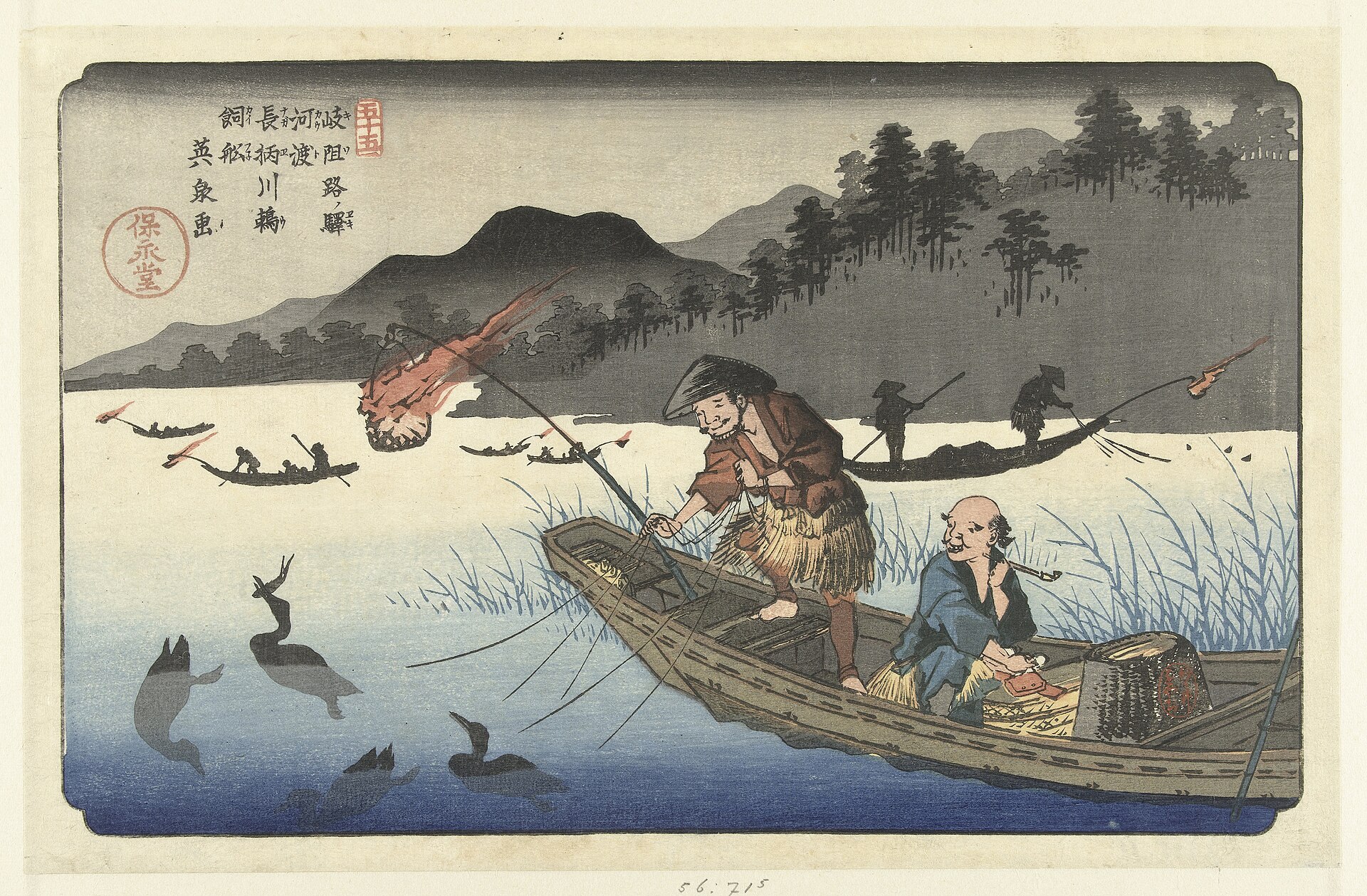
How it works. The boat drifts downstream. At the bow, on a long pole, hangs an iron basket, the kagari, full of burning split pine: pine catches easily and burns bright. The fire lights the bottom and stirs the fish.
At the bow stands the usho. He wears a dark robe, a straw skirt and the kazaori-eboshi, a cap folded from a single piece of hemp cloth so that sparks will not singe his hair. In his hand are the leashes, and on them ten to twelve cormorants.
The birds dive and swallow ayu whole. But each has a snare round its neck: small fish pass, a large one sticks in the throat. The cormorant is drawn to the side and the master takes the catch. The cormorants are wild sea birds, caught on the coast at Hitachi in Ibaraki prefecture and trained for two or three years.
There are six masters in Gifu, and the title is hereditary, father to son. Formally they are employees of the Imperial Household Agency: eight times a season they go out on the goryō-ukai, the imperial fishing, and the catch of those nights goes to the court. Only the masters of Gifu and neighbouring Seki hold such a rank.
In 2015 the FAO listed the Nagara river system and its ayu among the Globally Important Agricultural Heritage Systems. What was recognised is not the fish on its own but the whole chain: clean water, the forest in the headwaters that feeds it, the fish, the fishery and the custom — and the fact that the chain still works.
But the river bears a scar. In 1995 a barrage was completed at its mouth, the Nagaragawa Estuary Barrage — one of the most disputed works in the country’s history: it had been planned since 1959, and fishermen fought it for decades, fearing for the ayu and for the shijimi clam. The barrage was built, but the defeat became a turning point: after the Nagara, Japan began to move away from concrete river engineering towards restoring rivers to their natural course.
IIIWhat is taken here
Ayu is the river’s chief fish and the reason for everything else. The cormorants catch it, anglers come for it, every inn on the bank serves it. The headwaters, the Gujō district, are famed for their ayu: in 2008 Gujō ayu took the grand prize at the all-Japan contest for the taste of the fish.
Satsukimasu. The sea-run form of the amago, a Pacific salmon, which goes down to the sea and returns to the river at the start of summer — in the fifth month of the old calendar, satsuki, hence the name. The Nagara is one of its principal rivers, and it is one of the hardest fish in Japan to take on a rod.
Amago. The river form of the same fish, with red spots along the flanks. It lives in the headwaters, in cold tributaries.
Further down, in slow water, there are crucian carp and carp, but nobody comes to the Nagara for them.
IVHow it is taken
Recreational fishing
A Japanese river does not belong to all comers. Each stretch is held by its own fishing cooperative, which stocks the river and sells the right to fish it. In order:
You need a ticket, a yūgyoken. For the day or the year, from the cooperative whose stretch it is. The Nagara is divided among several cooperatives: the headwaters belong to Gujō, the middle course to the Nagaragawa-Chūō cooperative, and so on. Cross the boundary of a stretch and you need another ticket.
Buy the ticket in advance. You can pay the warden on the water, but with Nagaragawa-Chūō that costs an ayu angler 2,000 yen more. An annual ticket needs a photograph.
The cooperative announces the opening date, a different one each year and a different one on each stretch. Ayu fishing opens at the start of summer; before that the river is closed to it.
How it is done. The main method here is tomozuri, “fishing with a friend”: a live decoy ayu is put on the line, and the owner of the ground rushes to drive it off. More on it in the entry on ayu. The rod is eight or nine metres long, and you wade to the waist. The live decoy, the otori, is sold at shops along the river — where they will also tell you where the fish are taking today.
And separately — the ukai. It is a spectacle rather than fishing, but it is what people come for. You watch from pleasure boats that run alongside the masters’ boats; places are booked in advance and in season they go fast.
The trade
The fishery on the Nagara is first of all ayu: cooperatives, stocking, fishing and selling along the whole valley. Today the ukai earns more by spectacle than by catch, but the catch is used too — the imperial one and the ordinary one.
Since the barrage at the mouth, the run of fish has been kept up by fish passes and by rearing young ayu and amago artificially.
Imperial Household Agency of Japan — goryō-ukai, the imperial fishing on the Nagara. · Gifu City and Gifu Prefecture — the ukai season from 11 May to 15 October, nights without fishing. · Shōsōin — household register of Mino province, 702. · FAO — “Ayu of the Nagara River System”, Globally Important Agricultural Heritage Systems, 2015. · Nagaragawa-Chūō Fishing Cooperative — ticket terms and prices. · Gujō Fishing Cooperative — Gujō ayu. · Matsuo Bashō, haiku “Delightful, and then sad…”, 1688; travel notes. · History of the Nagara estuary barrage — from studies of the dispute over its construction and its consequences for Japanese river policy.