IHistory
Baikal holds records on every count. It is the deepest lake on Earth: the bottom lies one thousand six hundred and forty-two metres down. The oldest: it is about twenty-five million years old, while most of the world’s lakes date from the last ice age. And the largest by volume of water: it holds about twenty-three thousand six hundred cubic kilometres, roughly a fifth of all the liquid fresh water on the planet’s surface.
Baikal lies in a rift in the Earth’s crust that is still pulling apart — which is why it is so deep and why earthquakes are frequent here. More than three hundred rivers and streams flow into the lake, and one flows out — the Angara.
Over millions of years a life of its own arose in this isolated deep water. More than half of Baikal’s animals and plants live nowhere else: amphipods by the hundred species, sponges, golomyanka fish that give birth to live young, and the nerpa — the only seal that lives solely in fresh water. How it reached a lake thousands of kilometres from the ocean is still argued over.
People have lived by Baikal for thousands of years — Evenks, Buryats and their ancestors. Russians reached the lake in the middle of the seventeenth century. In 1900 the icebreaker-ferry Baikal began crossing the lake — built in England and assembled on the shore — carrying whole trains until the line round the lake was finished. And in the winter of 1904, during the Russo-Japanese War, rails were laid straight across the ice.
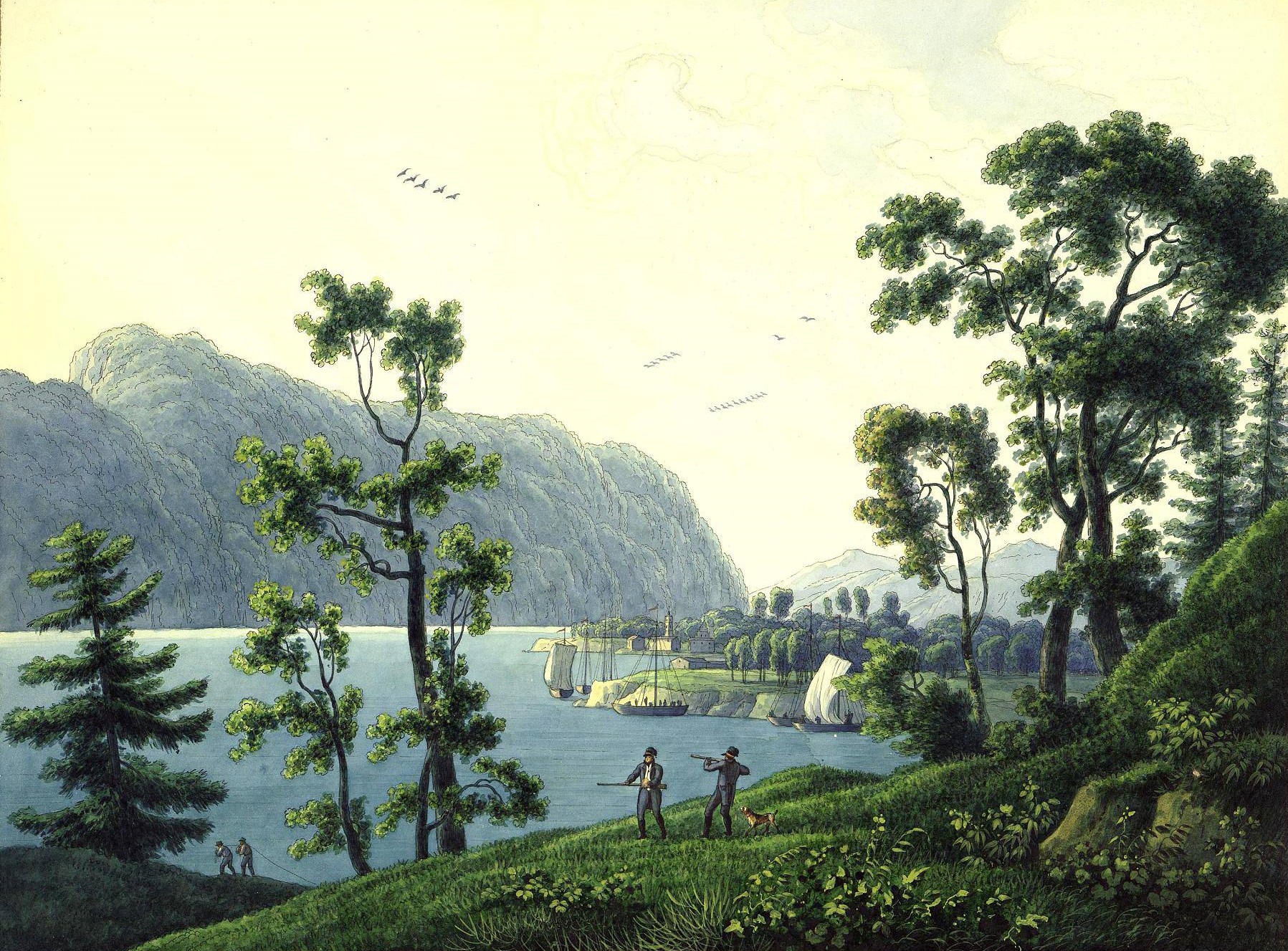
Above the entry is “View of the Nikolsky Monastery on Lake Baikal” by Andrei Martynov, 1806–1810. The painter crossed Siberia with the Russian embassy to China, and this is one of the first views of Baikal in Russian painting.
IIWhat is there now
Since 1996 Baikal has been a UNESCO World Heritage site. It is protected — and still has to be fought for.
For more than forty years the Baikalsk Pulp and Paper Mill worked on the southern shore, and its effluent was the lake’s greatest plague. In 2013 the mill was closed. Today other things cause alarm: the green alga Spirogyra spreading along the shores, the death of endemic sponges, sewage from settlements and the stream of tourists.
The omul. Baikal’s great fish was on the brink in the 2010s. The stock shrank several times over, and in 2017 the omul fishery was closed. Scientists say the ban helped avoid a collapse, but it is too early to speak of full recovery: the Federal Fisheries Agency expects the ban to be lifted no earlier than 2027–2029.
The ice. From January to May Baikal is covered with ice a metre thick and more — clear, with bubbles and cracks. Cars drive on it, people walk on it and anglers sit at their holes. And every year someone falls through: Baikal’s ice is alive, cracks run across it and pressure ridges rise.
IIIWhat is taken here
Baikal omul — the lake’s great fish; the fishery is closed, angling only in permitted places and seasons.
Grayling — the black and white Baikal grayling, fish of mountain streams and stony shores.
Whitefish and lenok — in the bays and river mouths.
Perch, roach, pike — in the shallow bays, the main catch of winter fishing.
Golomyanka — a translucent live-bearing fish of the deep that almost nobody has seen alive; the nerpa and the omul feed on it.
IVHow it is taken
Recreational fishing
Fishing on Baikal is above all winter fishing, on the ice. In order:
Rules. The fishing rules of the Baikal fishery basin apply. They set daily limits, sizes, spawning closures and special rules for the omul: where and when anglers may take it is laid down in a separate annex. Check every season.
Protected shores. Parts of the coast are national parks and reserves, Pribaikalsky and Zabaikalsky. They have their own limits on fishing and camping.
In winter. Perch, roach and grayling are taken through the ice on a small jig and a spoon. The best places are the bays and the Small Sea by Olkhon Island.
The ice. Go out only on known crossings and with local people. Cracks on Baikal open overnight, and pressure ridges hide open water.
In summer. Grayling — on the fly in the streams running into the lake; perch and pike — in the shallow bays.
The trade
For centuries the omul was the main fish of the Baikal fishery. It was taken with seines and set nets, salted in barrels and carried all over Siberia. Smoked omul sold at Trans-Siberian stations became a symbol of Baikal.
Since 2017 the omul fishery has been closed. Fishing for other fish — perch, roach, whitefish — remains, and so does the acute problem of poaching: omul still fetches a price and is caught in secret.
Encyclopaedic and scientific summaries on Baikal — depth 1,642 m, volume about 23,600 km³, age about 25 million years, rivers, endemics, the nerpa. · UNESCO — World Heritage site “Lake Baikal”, 1996. · The Federal Fisheries Agency and studies of the omul stock — the 2017 fishing ban and expected lifting. · Fishing rules for the Baikal fishery basin (Russian Ministry of Agriculture order no. 226 of 24 April 2020, as amended), annex 6 — angling for omul. · History of the icebreaker-ferry Baikal and the 1904 ice railway. · Closure of the Baikalsk Pulp and Paper Mill, 2013. · A. E. Martynov, View of the Nikolsky Monastery on Lake Baikal.