IHistory
The Tree River — in Inuinnaqtun Kogluktualuk — is a short river that runs down off the tundra plateau into Coronation Gulf, in the Arctic Ocean, some hundred and thirty kilometres east of Kugluktuk and the mouth of the Coppermine. Near the sea it drops in a cascade of rapids and falls through a narrow rocky channel.
The Kogluktualugmiut lived here — one of the Copper Inuit groups, named after the river. In summer they fished at the rapids for char coming up from the sea, in autumn they went inland for caribou, in winter out onto the sea ice for seals.
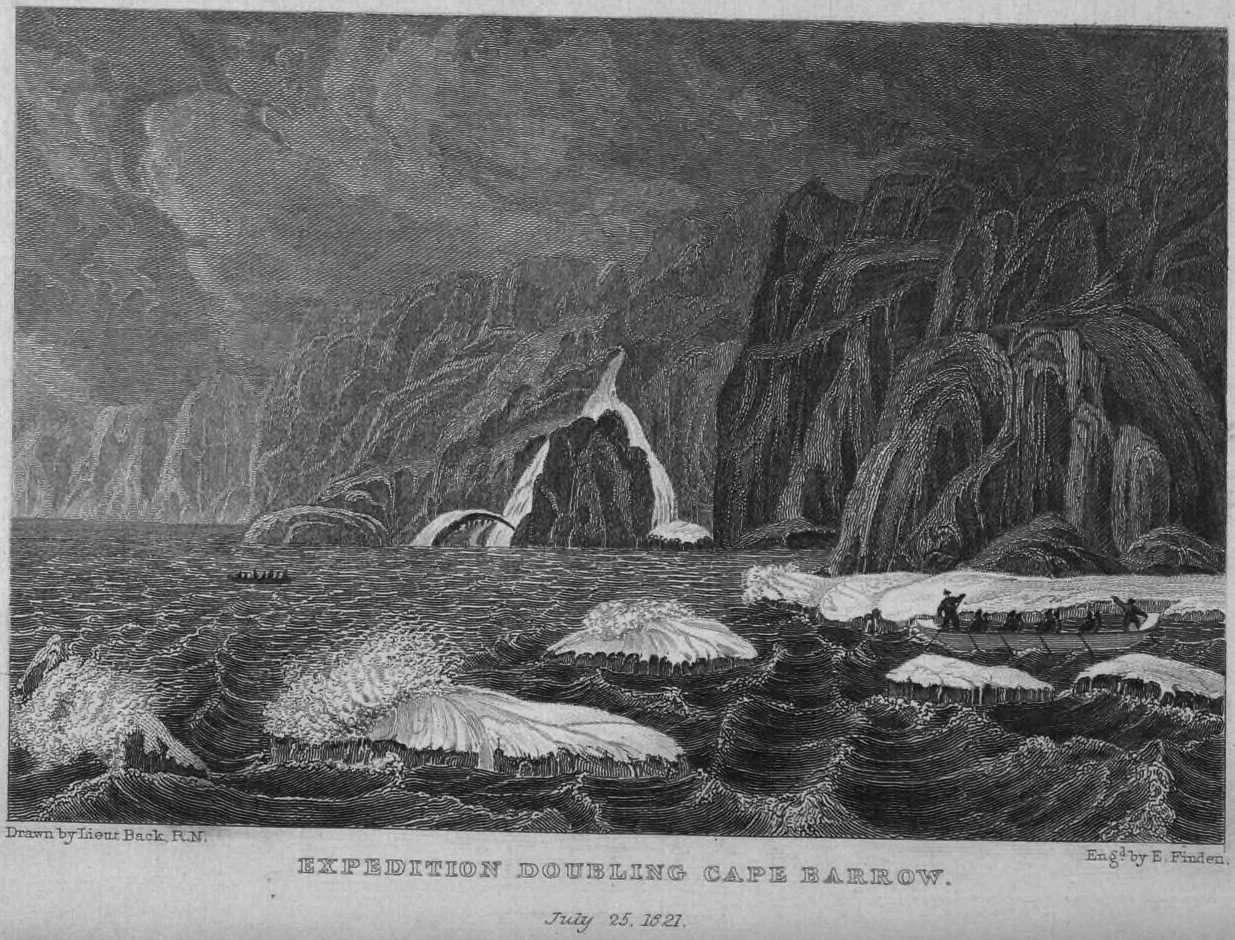
In July 1821 John Franklin’s men came along this shore by canoe. They were travelling east from the mouth of the Coppermine, charting the coast, and on 25 July they rounded Cape Barrow, where Coronation Gulf meets Bathurst Inlet. Above the entry is that scene, after a drawing by Lieutenant George Back: canoes among waves and ice floes under sheer cliffs. It lies a few dozen kilometres east of the Tree River’s mouth, on the same route.
In 1919 a post of the Royal Northwest Mounted Police was set up at the river’s mouth. In 1921 two Inuit, Alikomiak and Tatamigana, accused of murder, were brought there under arrest. On 1 April 1922 Alikomiak shot Corporal William Doak as he slept, and in the morning Otto Binder, a Hudson’s Bay Company man.
The trial was held in 1923 on Herschel Island, and on 1 February 1924 both men were hanged. It was the first execution of Inuit under Canadian law. Many historians call that trial a show trial: the authorities wanted to frighten the Arctic, and no one meant to defend the accused in earnest. In Nunavut it is still remembered.
IIWhat is there now
Today the Tree River is known to anglers all over the world. The reason is the char. Sea-run char, fattened in the sea over the summer, come up the river to winter, and here they grow bigger than almost anywhere else.
On 31 July 1981 Jeffery Ward caught a char here weighing 32 pounds 9 ounces — still the all-tackle world record for Arctic char. In all, the International Game Fish Association has recognised eight world records on the Tree River.
At the first cascade of rapids above the sea stands a fishing camp. Small planes fly in, there are few guests, and almost all the char are released: big fish here grow very slowly, and each one is many years in cold water.
There is hardly anything else on the river: no settlements, no roads. The nearest community is Kugluktuk, a hundred and thirty kilometres away. Tundra, rapids, an icy sea and char.
IIIWhat is taken here
Arctic char — the river’s great fish and its world records.
Lake trout — a big predator of the tundra lakes upstream.
Grayling — a fish of fast water, on the dry fly.
Whitefish — in the lower reaches and at the mouth.
IVHow it is taken
Recreational fishing
You reach the Tree River only through the fishing camp. In order:
Getting there. Usually by plane from Yellowknife to the main lodge and from there by small plane to the river. The season is short: midsummer, while the char are running.
Licence. Anyone who is not a beneficiary of the Nunavut Agreement needs a Nunavut sport fishing licence. The camp usually arranges it.
Release. Almost all fish are released at the camp: big char take decades to grow. A few may be kept, under Nunavut’s and the camp’s rules.
How it is fished. With spoon and streamer in the pools below the rapids, where the char hold before the dash upstream. The tackle must be strong: a record fish in fast water runs downstream and has to be followed through the rapids.
And the tundra. The weather changes within the hour, and there are bears. Don’t go to the river without the camp’s guide.
The trade
There is no commercial fishery on the Tree River. Char here is a fish for release and for the table of the few who live and fish along this coast.
The commercial char fishery of these parts is further east — at Cambridge Bay on Victoria Island.
Encyclopaedia articles on the Tree River and Coronation Gulf. · International Game Fish Association (IGFA) — Jeffery Ward’s record, 31 July 1981, and the Tree River records. · Canadian Encyclopedia and Dictionary of Canadian Biography — Alikomiak and Tatamigana; the killing of Corporal Doak and Otto Binder, 1922; the trial on Herschel Island, 1923; the execution, 1924. · J. Franklin, Narrative of a Journey to the Shores of the Polar Sea, 1823 — Cape Barrow, 25 July 1821. · Nunavut Sport Fishing Guide.