IHistory
The Tonle Sap is the largest freshwater lake in Southeast Asia, and it does not stay still. At the end of the dry season it is shallow water of some two and a half thousand square kilometres, about a metre deep. By the end of the rains the lake spreads to almost sixteen thousand square kilometres, and the depth reaches nine or ten metres. The forest along its shores goes under water for half the year.
The reason is the Mekong. The lake is joined to it by the Tonle Sap River, which flows into the Mekong at Phnom Penh. In the dry season it flows as it should, out of the lake into the Mekong. But when the flood comes down from the mountains in May and June, the Mekong rises so high that the water goes back: the Tonle Sap River turns round and for several months flows into the lake. In autumn, when the Mekong falls, the current turns again.
Life comes into the lake with the water. Fish move onto the flooded forest and fields — to spawn, to feed, to grow. The lake is called a pulsing one: its “breathing in” and “breathing out” make it one of the richest freshwater fishing grounds on Earth.
People have always lived here. Angkor stood on the northern shore, and Tonle Sap fish fed its capital. On the reliefs of the Bayon temple fishermen with nets, boats and the fish of the lake are carved in stone.
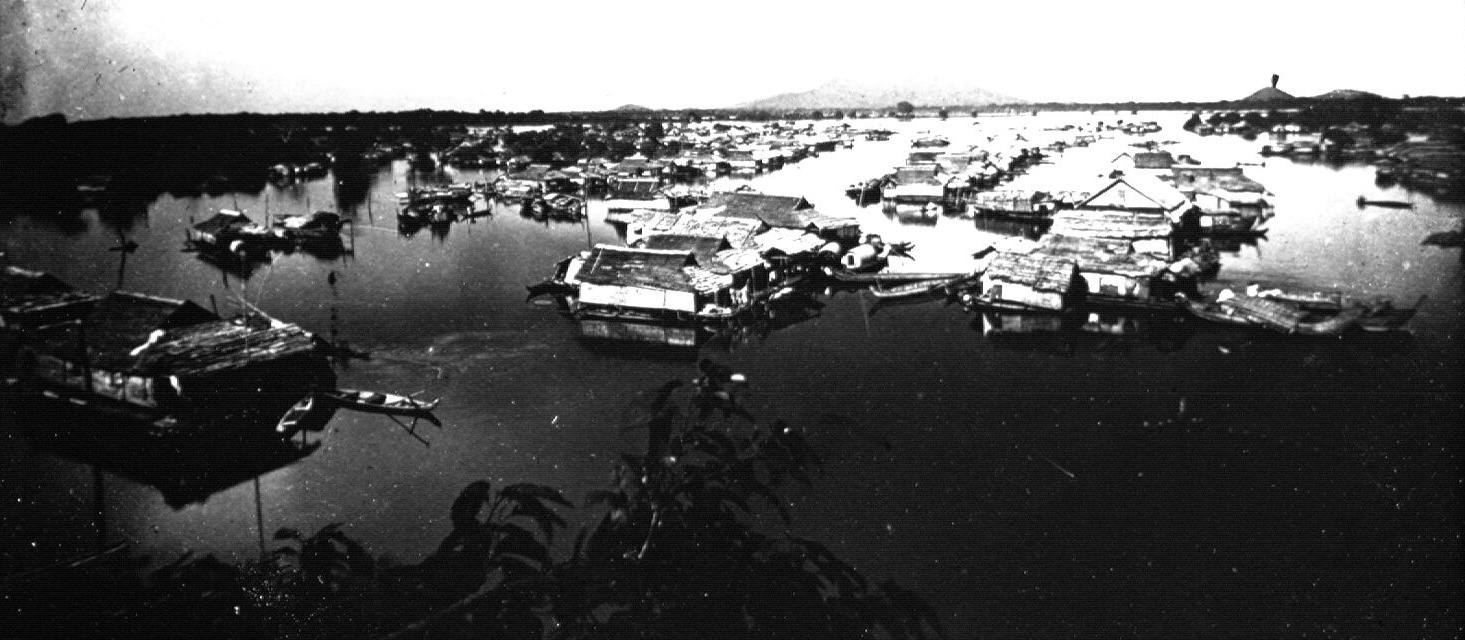
Above the entry is Kampong Chhnang, a town at the southern end of the lake, in flood: floating houses stand on the water in streets. The photograph was taken by the French mission of Marie-Joseph Guesdon between 1883 and 1894. This is how people live on the Tonle Sap today, too.
IIWhat is there now
The Tonle Sap still feeds Cambodia today. Its fish are a large share of the country’s whole freshwater catch, and fish are the Cambodians’ main source of protein. Small fish from the lake are made into prahok — a paste of fish fermented with salt, which Cambodian cooking cannot do without.
Floating villages. On the lake and at the river mouth stand villages of houses on rafts and stilts: schools, churches, pagodas, shops — all on the water. When the water goes down, the villages move after it.
The lots. For more than a century the lake’s best fishing grounds were divided into “lots” that the state leased out: they were fished with great fences of netting, and local fishermen were shut out. In March 2012 the government abolished the lots altogether and opened the lake to all, keeping part of the waters as reserves.
Troubles. Dams were built upstream on the Mekong, and the floods grew weaker. In the dry years of 2019 and 2020 the river turned into the lake late and only briefly, and the fish grew noticeably fewer. The lake “breathes” ever more weakly — and that is the main worry for everyone who depends on it.
Bon Om Touk. Every November, when the current turns back towards the Mekong, Phnom Penh holds the water festival: races of long boats, lights on the river. The festival marks the turning of the water — the very turning the lake lives by.
IIIWhat is taken here
Trey riel — a small silvery fish of the carp family, caught by the ton; they say the country’s currency, the riel, is named after it.
Mekong giant catfish — the Mekong’s giant, up to three hundred kilograms; young fish enter the lake, but almost no adults are left in it.
Giant barb — Cambodia’s national fish, one of the largest carps in the world.
Snakeheads — predators of the flooded forest that can breathe air and crawl across land.
Pangasius catfish, small catfish, climbing perch — fish of the floating market and the home table.
IVHow it is taken
Recreational fishing
The Tonle Sap is a lake of fishermen, not of sport anglers: there is almost no sport fishing for visitors here. But you can go out on the water and see how the fishing is done. In order:
With whom. You go out with local boatmen from the floating villages — Chong Kneas near Siem Reap, Kampong Luong, Kampong Chhnang. Fishermen are glad to show their gear and sometimes take visitors along to check the nets.
Where it is forbidden. The lake has conservation zones where fishing is banned for everyone. They are marked with signs and buoys — respect them without fail.
When it is forbidden. In the spawning season, as the rains begin, fishing is restricted by Cambodia’s fisheries law. Check the dates and limits with the fisheries administration or with local people.
A rod. If you want to fish yourself — by the floating houses, with small bait, for small fish. It is more a way to spend an evening with your hosts than fishing for a trophy.
The trade
Fishing on the Tonle Sap uses hundreds of kinds of gear: nets of every size, bamboo traps, fences, funnel traps, hook lines.
The most famous gear is the dai: huge bag-shaped nets set in rows on the Tonle Sap River below Phnom Penh from October to February, when the water leaves the lake and the fish run down into the Mekong. On the best nights a single dai brings up tonnes of small fish — trey riel — at once.
The catch goes to the floating markets, into prahok and onto drying racks. How much fish the lake yields is reckoned differently — from a little over a hundred to several hundred thousand tonnes a year — and the estimates agree on one thing: with every weak flood there is less.
Mekong River Commission — Tonle Sap hydrology: dry- and flood-season area and depth, reverse flow, catch estimates. · FAO, 2001 — Tonle Sap Fisheries: a case study on floodplain gillnet fisheries; studies of the dai fishery. · UNESCO — Tonle Sap Biosphere Reserve, 1997. · The abolition of fishing lots in March 2012 — studies and press. · IUCN — fish conservation areas of the Tonle Sap. · The Bon Om Touk festival. · Photograph by the Guesdon mission, Bibliothèque nationale de France.