IThe portrait
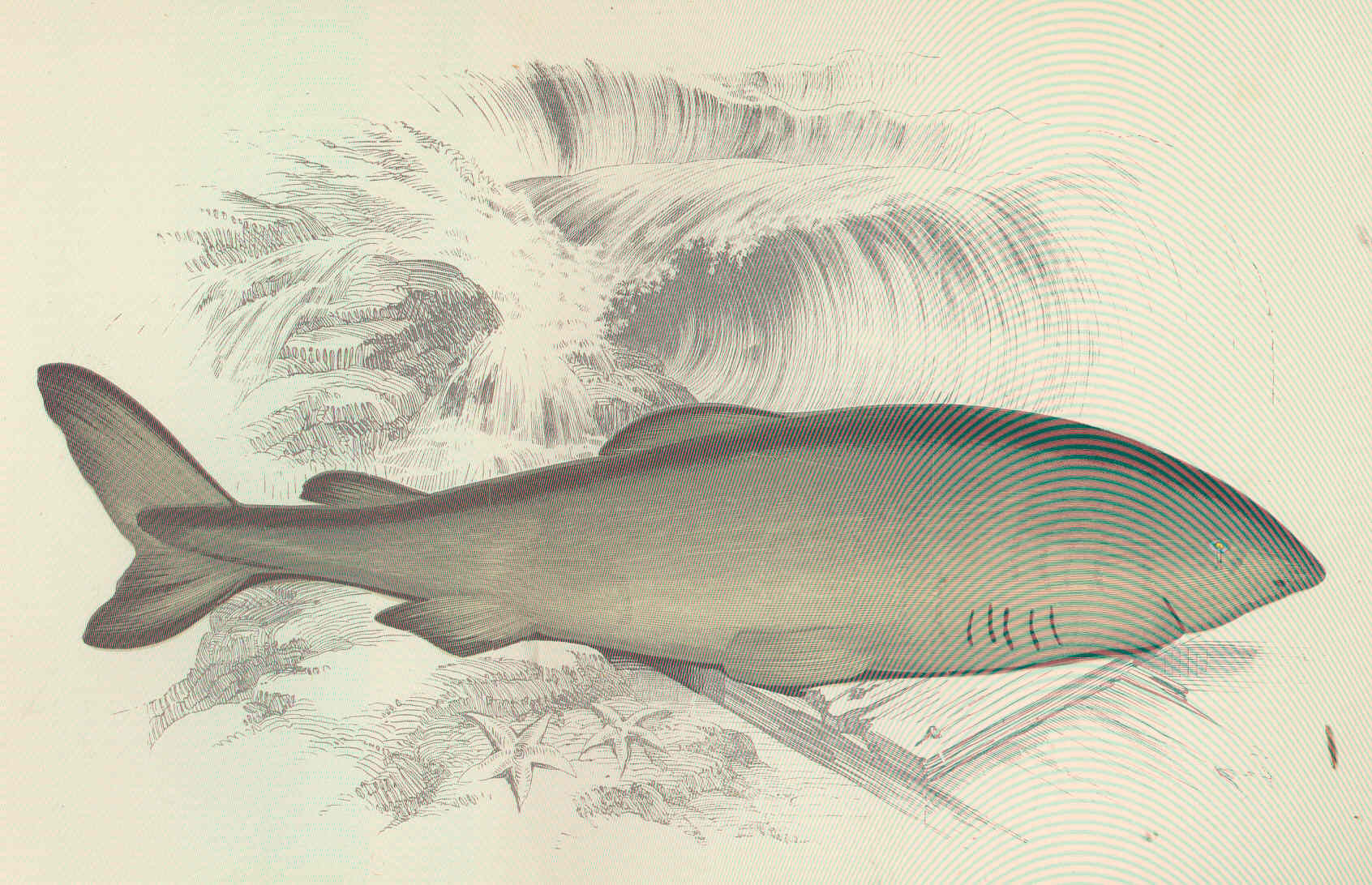
The Greenland shark is huge, heavy and slow. The body is as thick as a log, the head short and blunt, the dorsal fins small and set far back. The skin is grey-brown or dark. It is usually three to five metres long; big ones exceed six.
It is the slowest fish for its size: it swims at about a kilometre an hour. And yet seals have been found in Greenland sharks’ stomachs — probably taken asleep in the water — and even the remains of reindeer and polar bears that the shark found already dead.
Many of them are half blind. A small parasite often hangs from the Greenland shark’s eye — a copepod that damages the cornea. It hardly troubles the shark: in the dark of the deep it hunts not by sight but by smell.
What matters most about it is age. In 2016 scientists aged twenty-eight sharks by the lens of the eye: it forms before birth and never changes afterwards, and it keeps the carbon of those years. The largest shark, five metres long, turned out to be 392 years old — give or take a hundred and twenty. It is the longest-lived vertebrate known. And the Greenland shark comes of age at around a hundred and fifty.
Above the entry is a Greenland shark in an engraving from Jonathan Couch’s book on the fishes of the British Isles, 1877.
IIWhere she holds
drag to turn · ctrl + wheel to zoom · a mark is a water of the atlas — click to open it
The Greenland shark lives in the cold waters of the North Atlantic and the Arctic Ocean: off Greenland and Iceland, in the Canadian Arctic, off Norway and Svalbard, in Baffin Bay and the Barents Sea.
It likes water near zero degrees. In the north, where the sea is cold right to the surface, it can be met just under the ice, in shallow water. Further south it goes where it is cold — into the depths, hundreds of metres down and to two kilometres and beyond.
It never enters Arctic rivers and lakes, but it comes into fjords and bays, to the river mouths where the sea-run char run.
IIIHow she is taken
For the visiting angler
There is almost no sport fishing for the Greenland shark — and rightly so. First, the rules.
A vulnerable species. Since 2020 the IUCN has listed the Greenland shark as vulnerable. A shark that matures at a hundred and fifty takes centuries to recover.
If one is caught. Most often a shark is caught by accident — on a longline or in a trawl set for other fish. Release it at once, without bringing it aboard if possible.
How scientists catch it. On strong gear with a hook on a chain, set near the bottom. The shark is measured, tagged and released. The tags show where it goes — and the slow shark turns out to cover thousands of kilometres over the years.
Where to see it. In Greenland and northern Canada local fishermen sometimes show visitors how the shark was taken through the ice. It is more a story of the past than fishing.
By the trade
For centuries the Greenland shark was caught for its liver. Oil was rendered from it, and the oil filled lamps. In Iceland the shark fishery was worked from open boats, later from decked vessels, and in the nineteenth century shark oil was exported. The flesh — poisonous raw — was dried and eaten at home.
In Greenland the shark was caught through the ice and its meat fed to sled dogs. Raw meat is poisonous because of a substance that builds up in it: the dogs reeled as if drunk — hence the phrase “shark drunk”.
Today there is hardly any fishery. The main threat is bycatch: sharks are caught on longlines and in trawls set for cod, halibut and shrimp, and many die.
IVSecrets of the craft
Look for cold, not depth. In the north the shark rises right to the ice; in the south it goes a kilometre down. Its place is water near zero.
Rotten is better than fresh. The shark hunts by smell, and the bait for it was always taken half-rotten — seal meat, blubber.
Don’t haul it aboard. A body of hundreds of kilograms lifted from the water injures itself. Release it in the water.
It may be three hundred years old. No exaggeration: a large Greenland shark may well have been swimming in the sea in the days of Peter the Great.
VStories about her
The Greenland shark’s best-known story is Icelandic, and it is about food.
Raw shark meat cannot be eaten: it is full of substances that other fish pass out in urine but that stay in the shark’s body. Icelanders learned to get round this. The carcass is cut into pieces, buried in gravel and weighed down with stones for several weeks so the fluid drains away. Then the pieces are hung to dry in an airy shed for several months. The result is kæstur hákarl — “fermented shark”: with a sharp smell of ammonia and a long aftertaste. It is eaten in small cubes, washed down with strong spirit, at the midwinter feast of Þorrablót.
The Inuit have their own tales of the Greenland shark. By one tradition recorded among the Igloolik Inuit, the shark lives in the chamber pot of Sedna — the mistress of the sea animals — and serves as a helper to shamans. By another, an old woman washed her hair and dried it with a cloth, the wind carried the cloth into the sea, and it became the first shark, Skalugsuak. Hence, they say, the smell of its flesh.
And scientists have added a story of their own. The shark aged at 392 years in 2016 was, in all likelihood, born in the seventeenth century — while the Thirty Years’ War was still being fought in Europe and whales were being hunted off Svalbard. It swam in the cold water all that time, slowly, at a walker’s pace — until it came into the researchers’ net.
Nielsen et al., 2016, Science — “Eye lens radiocarbon reveals centuries of longevity in the Greenland shark”: 28 females, the largest 502 cm at 392 ± 120 years, maturity at about 156 years. · IUCN, 2020 — vulnerable. · Studies of the Greenland shark’s swimming speed and diet. · The Icelandic hákarl tradition — Slow Food, Ark of Taste. · Igloolik Inuit traditions of the Greenland shark and Sedna. · J. Couch, A History of the Fishes of the British Islands, 1877.