IHistory
At the far south-west of Sweden a low sandy cape runs out into the sea — Falsterbonäset. On it stand two small towns, Skanör and Falsterbo. Today it is a quiet resort with dunes, a lighthouse and beaches. But from the thirteenth to the sixteenth century, every autumn, one of the biggest trading towns of Northern Europe sprang up here — and every winter it vanished.
There was one reason — the herring. Every year at the end of summer huge shoals came through the Sound, the strait between Scania and Zealand, to spawn off the Scanian shore. Scania then belonged to Denmark, and the Danish king let the coast out for the fair.
The beach between Skanör and Falsterbo was divided into plots — fitte. Each plot went to a town: Lübeck, Danzig, Stralsund, Rostock, Dutch and English merchants. On a plot stood wooden booths, storehouses, a church, its own court and its own laws. The fishermen — Danes and Swedes — netted the herring from boats, and on shore it was cleaned and salted.
Salt came from Lüneburg by way of Lübeck, and the barrels from German towns too. Lübeck also sent women to gut the fish: herring had to be cleaned and salted the same day or it spoiled. In the best years two to three hundred thousand barrels of salt herring left this shore. It went all over Europe — above all where fasts were kept: on fast days meat was forbidden, but fish was allowed.
Wars were fought over this herring. In the 1360s the Danish king Valdemar IV raised the tolls, and the Hanse went to war with him. By the Peace of Stralsund in 1370 Denmark handed four castles on the Sound — Helsingborg, Malmö, Skanör and Falsterbo — to the Hanseatic towns for fifteen years. The Hanse gained command of the Baltic herring trade.
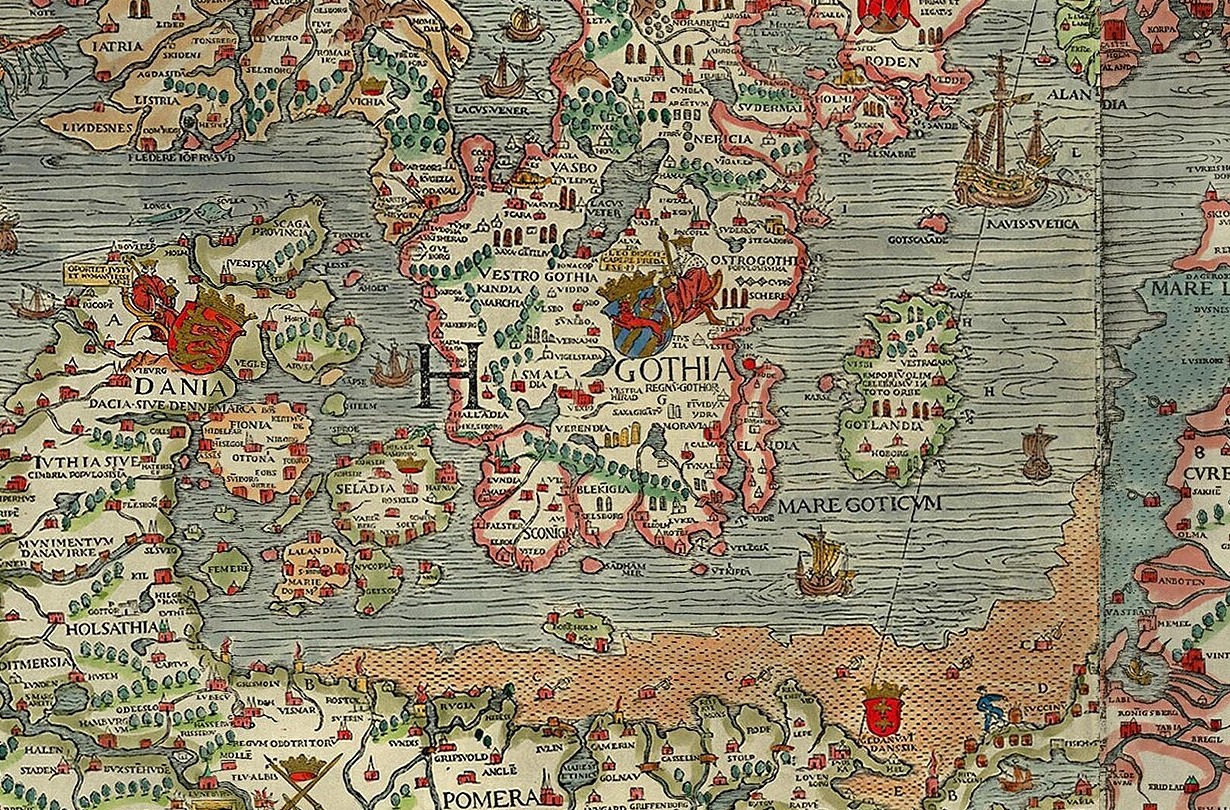
Above the entry is Scania on Olaus Magnus’s Carta Marina, 1539. SCONIA and Falster are marked, Denmark and the Sound beside them, ships under sail on the sea. Olaus Magnus later wrote that the herring came here so thick that a halberd thrust into the shoal stood upright without falling.
IIWhat is there now
In the sixteenth century the herring left. The shoals stopped coming to Scania as before, and the great fishery moved to the North Sea, to the Dutch. The fair faded, and Skanör and Falsterbo became small again. In 1658 Scania passed from Denmark to Sweden.
Of the fair there remain churches, earthworks and names. Today Falsterbonäset is famous for something else: it is one of the best places in Europe to watch the autumn bird migration. Millions of migrants gather on the cape before crossing the Baltic, and ornithologists have counted them here for many decades.
And the sea around the cape is still full of fish. Cod and flatfish are caught here, sea trout along the shore in spring and autumn, and in spring the herring still comes in along the Öresund coast: at Helsingborg and Malmö it is taken by the hundred from the piers on feather strings.
The herring has not gone from the Baltic. It is a different herring now — the small Baltic herring, strömming — and the Swedes still salt it, pickle it and smoke it the way they learned on this shore.
IIIWhat is taken here
Herring — a town stood here for its sake; in spring it comes in along the Öresund.
Cod — from a boat over rocks and wrecks in the Öresund.
Sea trout — the fish of shore fly-fishing in spring and autumn.
Flounder and turbot — bottom fish of the sandy shoals around the cape.
Garfish — the green-boned “needle fish” that arrives in spring on the heels of the herring.
IVHow it is taken
Recreational fishing
Fishing the Scanian coast is simple. In order:
No licence. In Sweden fishing with hand-held tackle — rod, spinning rod, feather string — along the sea coast is free for everyone. A licence is needed only in certain waters and on rivers.
But with rules. There are minimum sizes and closed seasons: for sea trout, for Baltic cod, for eel, which may hardly be fished anywhere. Check them on the Swedish Agency for Marine and Water Management’s site before going out.
Herring in spring. When the herring comes in along the Öresund, it is caught from the piers on feather strings — a line of small hooks with feathers. They are taken by the dozen: the herring stands thick.
Sea trout from the shore. In spring and autumn, in cold water, sea trout are taken on the fly and on a narrow spoon, wading waist-deep.
And the birds. In autumn the cape is a reserve, and part of the shore is closed for the birds. Respect it.
The trade
There is no great herring fishery off Scania any more. Little is caught here: cod, flatfish, eel — and the eel fishery is strictly limited.
Baltic herring today is taken by trawl in the open sea, and it is argued over in earnest: scientists ask for lower quotas because big Baltic herring are growing ever fewer.
Encyclopaedia articles on the Scania Market and Skanör-Falsterbo — the fitte plots, the Hanseatic towns, Lüneburg salt, the Lübeck gutting women, the decline in the 16th century. · The Peace of Stralsund, 1370 — four castles on the Sound for fifteen years. · Estimates of herring exports from Scania — 200–300 thousand barrels in the best years. · Olaus Magnus, Carta Marina, 1539; Historia de gentibus septentrionalibus, 1555. · Swedish Agency for Marine and Water Management (HaV) — free hand-held fishing on the coast, sizes and closures. · Falsterbo Bird Observatory — migration counts.