IHistory
Victoria is Africa’s biggest lake and the largest tropical lake in the world: sixty-eight thousand eight hundred square kilometres. It is shallow for its size — about forty metres on average, some eighty at the deepest. Its shores are divided between three countries: Tanzania has a little over half, Uganda a little under, Kenya six per cent.
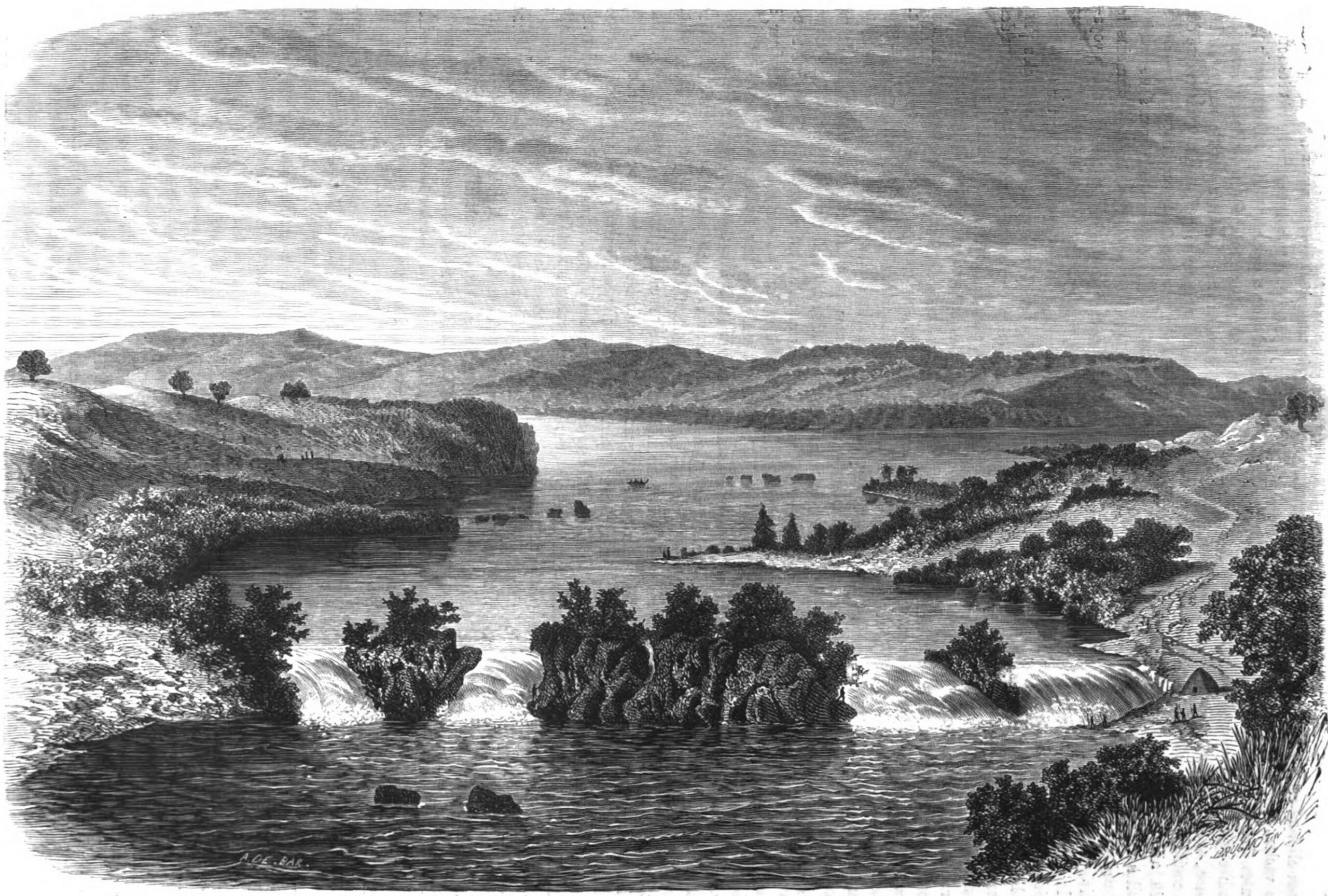
The Nile flows out of it. The first European to see the lake was John Hanning Speke — in 1858, from the southern shore. In 1862 he reached the place on the northern shore, by today’s Jinja, where the water leaves the lake over a stone step; he named it Ripon Falls and declared it the source of the Nile. That waterfall is in the engraving above this entry.
The falls themselves are gone: in 1954 the Owen Falls dam was built downstream, and the water rose over the rocks. The source of the Nile went under water.
But the lake’s great story is not about the river but about the fish. Victoria held more than five hundred species of cichlid of a single group, the haplochromines, nearly all of them found only here. They arose from a few ancestors in what is, by nature’s measure, a short time, and diverged into everything a fish can be: some ate algae, some snails, some insects, some the eggs and fry of others. Scientists called the lake a living laboratory of evolution.
In 1952 Nile perch was secretly put into the lake on the Ugandan shore. In 1962 and 1963 it was put in openly. Uganda’s colonial officials wanted a big commercial fish and went against the advice of scientists and the objections of their neighbours in Kenya and Tanganyika.
IIWhat is there now
The perch spread slowly. In 1964 it was found off Tanzania, in 1970 off Kenya, and by the early 1980s it was across the whole lake. And then, all at once, there was a great deal of it.
The Nile perch is a predator that grows to two metres. The haplochromines, which had never known such an enemy, were easy prey. In the 1980s more than two hundred species vanished. It is called the greatest vertebrate extinction within the memory of science — and it happened in a single decade, in a single lake, from a single fish.
Yet the lake became richer in fish, not poorer. In 1989 more than five hundred thousand tonnes were taken from it: nearly two thirds Nile perch, a fifth dagaa, a small native sprat-like fish, and the rest Nile tilapia, also brought in. Victoria became the largest freshwater fishery in the world.
That wealth was not shared evenly. Perch fillet went for export, to Europe. Dagaa, dried right on the shore, stayed a cheap protein for the lakeside people themselves. Hubert Sauper’s 2004 film Darwin’s Nightmare was about that difference, and it provoked long arguments.
In the 1990s another plague joined the fish — water hyacinth, which covered the bays in a solid carpet. It is held back with weevils and pulled out by machine.
And one piece of good news. When the perch grew fewer — the fishermen themselves took them out — some of the surviving haplochromines began to recover. In the 1990s and 2000s their numbers rose again. The vanished cannot be brought back, but the survivors are holding on.
IIIWhat is taken here
Nile perch is the lake’s main fish today, both commercial and sporting.
Nile tilapia — brought in, like the perch; the main fish of the lakeside table.
Dagaa — in Kenya called omena, in Uganda mukene: a small silver fish caught at night by lamplight and dried on the shore.
Haplochromines — the survivors, the natives, furu: small cichlids of every colour, for which the lake is famous among biologists.
And the fish older than all of them — the lungfish, Protopterus: in drought it burrows into the mud and breathes air.
IVHow it is taken
Recreational fishing
On Victoria you do not fish from the bank at random but from a boat with an operator. In order:
Permits. In Uganda the sport-fishing licence is issued by the Ministry of Agriculture, Animal Industry and Fisheries; in practice it is arranged by the licensed operator you go out with. Trips mostly start from Entebbe and Jinja.
What is taken. Nile perch — by trolling big plugs and on live bait. Tilapia — on small lures near the shore.
Downriver is the great place. The biggest perch are taken not in the lake itself but on the Victoria Nile at Murchison Falls, in the national park. There the permit is issued by the Uganda Wildlife Authority and costs 50 dollars a day. Details are in the entry on Nile perch.
And health. The lake’s inshore water carries schistosomiasis, a disease from a parasite that enters through the skin. Not swimming and not wading near the shore without need is not over-caution but a local rule.
And the weather. The lake is as big as a sea, and storms come on it suddenly. Go out with an operator who has life jackets, a radio and a knowledge of the sky.
The trade
Victoria’s fishery is one of the largest freshwater fisheries in the world. Perch is taken with gillnets and longlines and landed at processing plants, and the fillet goes for export. Dagaa is fished at night by lamplight with fine-meshed nets and dried on the shore.
Three countries share the lake and its fishery, and they have to negotiate about it constantly: the fish know no borders.
African Center for Aquatic Research and Education (ACARE), African Great Lakes Inform — area, depths, shares of shoreline, the 1989 catch by species. · History of the Nile perch introduction: the secret release of 1952, the releases of 1962 and 1963, spread across the lake. · Studies of the haplochromine extinction and the later recovery of surviving species (including genetic work from 2024). · John Hanning Speke — discovery of the lake in 1858 and of Ripon Falls in 1862; the Owen Falls dam, 1954. · Uganda Wildlife Authority — the sport-fishing permit in Murchison Falls park. · Hubert Sauper, Darwin’s Nightmare, 2004. · Engraving by Alexandre de Bar, Le Tour du monde, 1864.