IHistory
The Murray is Australia’s longest river: two thousand five hundred and eight kilometres. It rises in the Australian Alps, not far from Mount Kosciuszko, runs west, and for most of its course forms the border between New South Wales and Victoria. In South Australia, at the township of Morgan, the river turns sharply south, spreads into Lake Alexandrina and reaches the Southern Ocean near Goolwa.
Together with the Darling and its other tributaries the Murray drains a basin of more than a million square kilometres — a seventh of the continent. But it carries little water for such an area: most of the basin is dry plain, and in drought the river shrinks to a chain of pools.
For the river peoples — the Yorta Yorta, the Barkindji, the Ngarrindjeri and many more — the Murray was road, larder and home. The Ngarrindjeri, who live at the mouth, tell how the river got its bends. The ancestor Ngurunderi chased the giant cod Ponde in his canoe from the headwaters. The cod fled downstream, lashing its tail, and wherever it turned, the river bent. At Lake Alexandrina Ponde was at last speared, cut into pieces and thrown into the water — and from each piece a different fish was born. From the last one came the cod that is caught today.
Europeans reached the river in 1824 — Hume and Hovell. In 1830 Charles Sturt went down it by boat all the way to the lake and named it after the British Colonial Secretary, George Murray.
In 1853 the first paddle steamers came up the river — Francis Cadell’s Lady Augusta and William Randell’s Mary Ann. Dozens more followed: they carried wool from the stations downstream and, upstream, everything the bush needed. Echuca became the busiest river port on the continent. So that the steamers would not be holed, snags — fallen gum trunks — were dragged out of the river for decades, and special snagging steamers did nothing else.
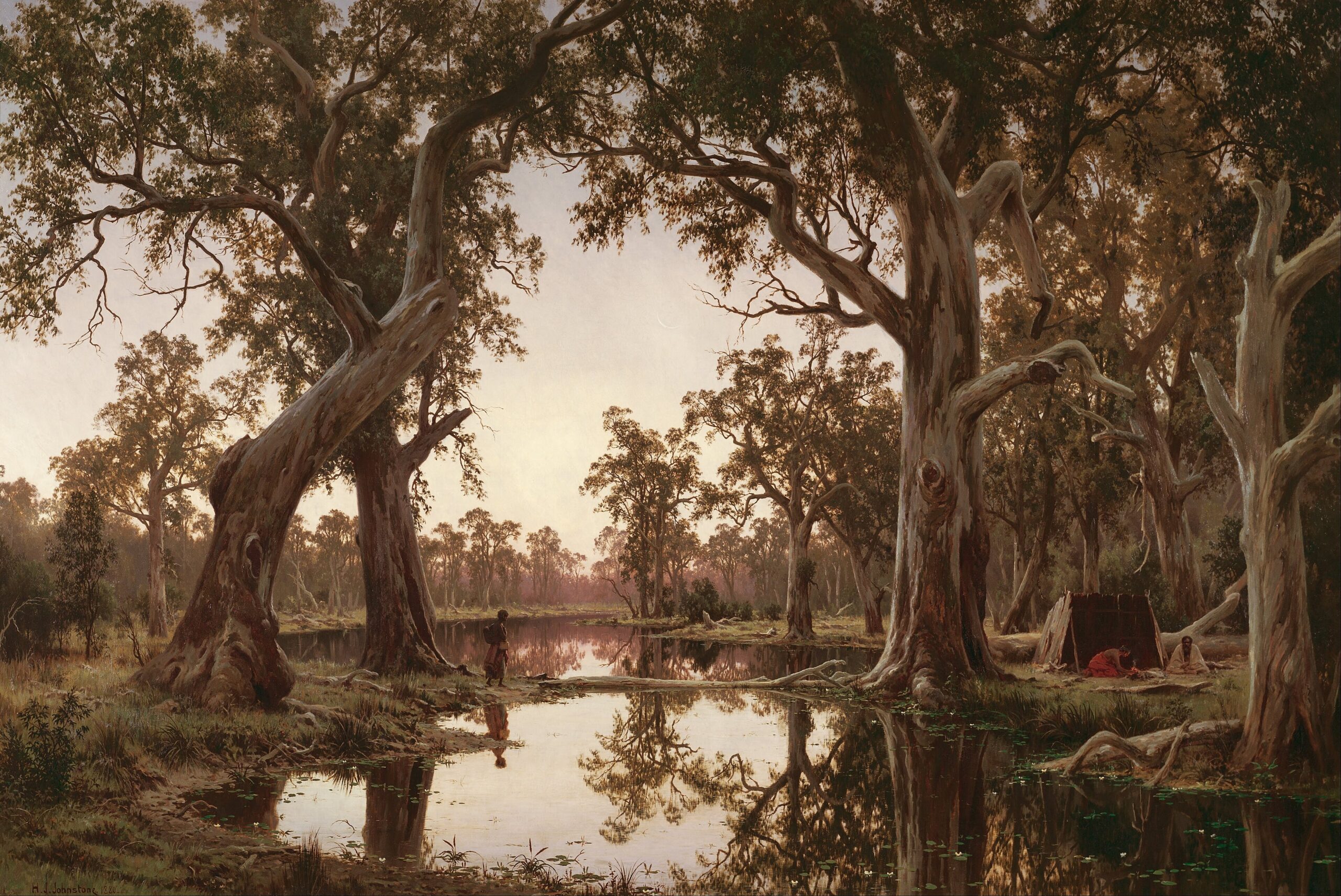
Above the entry is Henry James Johnstone’s Evening shadows, backwater of the Murray, 1880. River red gums, still water, a new moon in the sky and a camp by the water: a bark shelter, two people at the fire, a woman on the bank.
IIWhat is there now
The Murray today is a river that has been divided up. Fields, towns and the river itself all need water, and there is not enough for everyone.
Dams and locks. From the 1920s the river was barred: the Hume Dam in the upper reaches, a chain of locks and weirs in South Australia, and in 1940 the barrages at the mouth, separating the fresh lake from the sea. The river became convenient for irrigation and boats and inconvenient for fish: there are fewer of the spring floods by which fish know when to spawn, and cold water comes from the depths of the reservoirs.
Droughts. During the Millennium Drought, 1997–2009, the lake at the mouth fell below sea level, and the mouth itself had to be held open by dredges. Since then they have been sent there whenever the river runs low.
Carp. European carp were released in Victoria in the 1960s, and after the floods of the 1970s they spread through the whole basin. In the muddy water below the locks they now make up most of the fish — by estimates, up to eighty or ninety per cent in places. Carp root up the bottom, and the water grows muddier still.
Fish kills. In 2019 and 2023, on the Darling, the main tributary, millions of fish died at Menindee — from heat, algal blooms and lack of oxygen. Among the dead were old cod, several decades old.
And the snags going back. Now the river is given back what was once taken from it: gum trunks are laid in the channel, fishways are built at the locks. The cod return where they have a home again.
IIIWhat is taken here
Murray cod — the biggest fish of the river and of all Australian rivers, Ponde himself.
Golden perch — locally “yellowbelly” or “callop”: a fish of the floods, going upriver to spawn when the water rises.
Silver perch — a schooling fish of the current; it has grown scarce and is protected in many places.
Trout cod — the Murray cod’s relative, with an overhanging upper jaw and fine speckles. It was nearly lost, and almost everywhere it must be released.
Freshwater catfish — a native, with barbels and a tail merged with its fins into a single fringe. It builds a nest of pebbles on the bottom.
And the incomers — European carp and the European perch, known here as “redfin”.
IVHow it is taken
Recreational fishing
The Murray runs through three states, and each has its own papers. In order:
Whose river. By law the river itself belongs to New South Wales: the state border runs along the top of the southern, Victorian bank. So on the border stretch New South Wales rules apply. Which licence is enough if you fish from the Victorian bank is worth checking on the state fisheries site before going out.
Licences. In New South Wales you pay the recreational fishing fee; in Victoria you buy a licence. In South Australia, on the lower river, there is no general recreational fishing licence, but there are size and bag rules there too.
Cod. From 1 September to 30 November the cod spawn, and they are not fished at all: even one caught by accident is released at once. The rest of the year in New South Wales and Victoria only fish of 55 to 75 centimetres may be kept, and no more than two a day. Everything smaller and larger goes back. Details in the entry on Murray cod.
Where. By snags and undercut banks, in the holes on the bends, below the locks. Cod are sought where there is cover; perch on the current and in the floodwaters.
Do not release carp. A carp once caught is not put back in the river: in Victoria and New South Wales that is forbidden.
The trade
Murray cod were once sent to Melbourne and Sydney by the ton — by train, on ice. The trade is what undermined them: by the mid-twentieth century cod had grown scarce. In New South Wales the river fishery was closed in 2001.
Today nets on the Murray take mostly carp — and turn it into fertiliser. The cod has become a rod-and-line fish.
Murray–Darling Basin Authority (MDBA) — river length, basin area, locks, weirs and barrages, dredging of the mouth. · South Australian Museum — the Ngarrindjeri account of Ngurunderi and Ponde. · Charles Sturt, Two Expeditions into the Interior of Southern Australia, 1833. · State Library of South Australia — the paddle steamers of 1853, snag clearing. · NSW Department of Primary Industries — the border on the southern bank, cod rules, the 2001 closure of the river fishery, the ban on releasing carp. · Victorian Fisheries Authority — licences and rules. · Reports on the Menindee fish kills of 2019 and 2023. · Art Gallery of South Australia — H. J. Johnstone, Evening shadows, backwater of the Murray, 1880.