IThe portrait
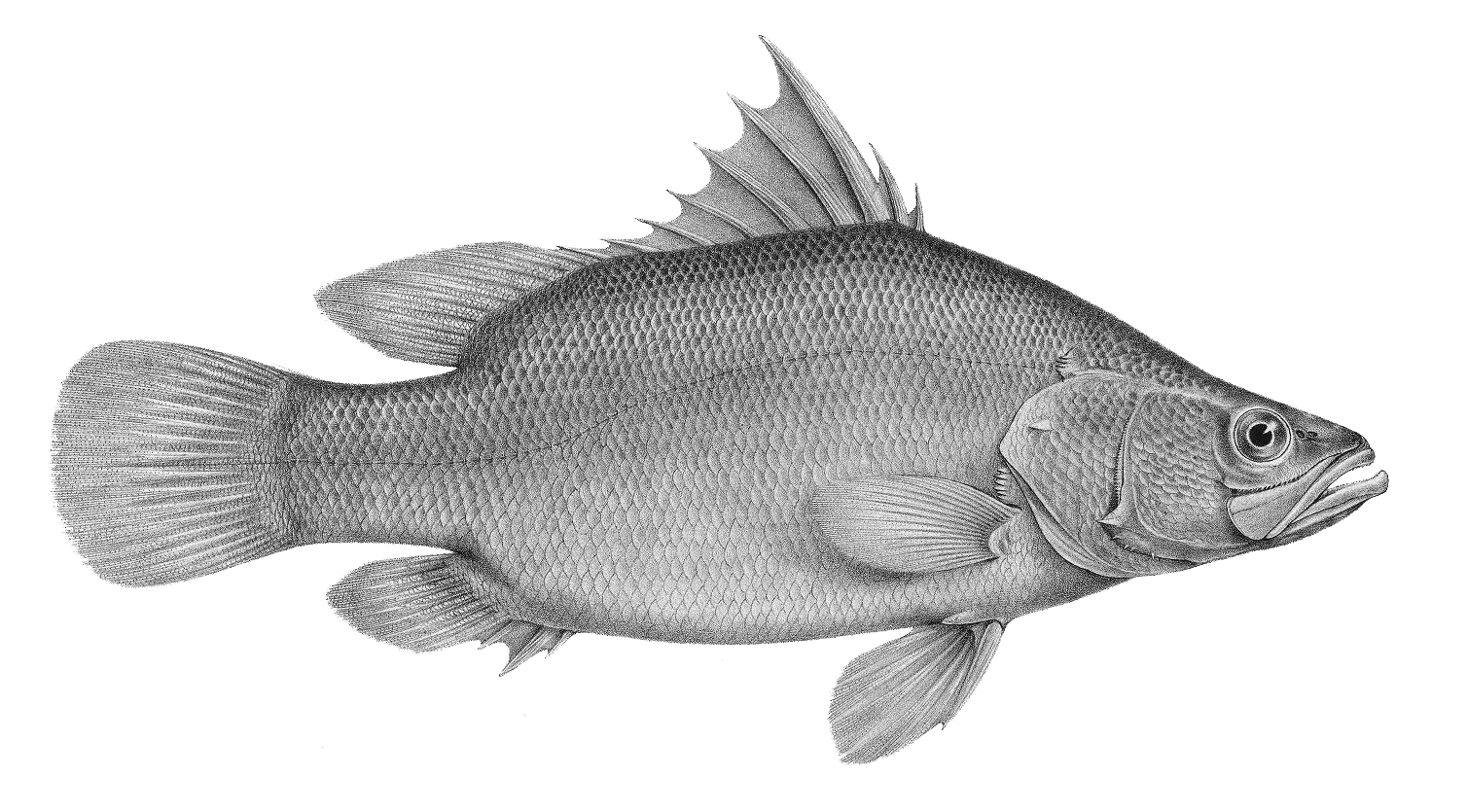
The Nile perch is not a perch in the strict sense but a relative of the perches: a heavy silver body, a humped back, a head sloping down to a big mouth with a jutting lower jaw. The tail is broad and rounded, like a spade.
There are two dorsal fins, the front one spiny, with stiff rays. The eye is large, and in the half-dark of murky water that eye sees better than its prey supposes.
It is one of the largest freshwater fish in the world: up to two metres long and up to two hundred kilograms. Such giants are rare, the ordinary fish far smaller — but the perch grows fast and keeps growing all its life.
Above the entry is a lithograph from George Boulenger’s Fishes of the Nile, 1907. It is drawn as things were drawn for science: no background, no ornament, every scale in its place.
IIWhere she holds
drag to turn · ctrl + wheel to zoom · a mark is a water of the atlas — click to open it
The Nile perch’s homeland is the rivers and lakes of Africa north of and along the equator: the Nile itself from the delta to its upper reaches, the basins of Lake Chad, the Niger, the Volta, the Senegal, the Congo. Lakes Albert and Turkana are its own, native waters.
It keeps to deep places: holes, pools below rapids, drop-offs. The big fish lie where the current brings food, and come out to hunt the shallows at dusk.
But it was not in Lake Victoria. Waterfalls cut the lake off from the lower Nile, and the perch could not climb there by itself. In the 1950s people carried it there — and it found itself in water where nothing knew how to defend itself against it. What came next is in the entry on Lake Victoria.
Today it lives in Victoria and in neighbouring Lake Kyoga, also brought in. And the biggest are caught where it always lived: on the Victoria Nile at Murchison Falls and on Lake Nasser in Egypt.
IIIHow she is taken
For the visiting angler
The Nile perch is one of Africa’s great sport fish: big, strong, and it takes an artificial lure. First — where, and with what papers.
Murchison Falls, Uganda. The Victoria Nile below Murchison Falls, in the national park, is one of the best places in the world for big perch. The permit is issued by the Uganda Wildlife Authority and costs 50 dollars a day. Perch of more than a hundred kilograms have been taken here on rod and line.
Lake Victoria. Fished from a boat with a licensed operator, who also arranges the fisheries ministry’s licence. Details in the entry on Lake Victoria.
Trolling. A big plug running deep behind a slow boat, along drop-offs and islands. The most productive method on the lakes.
Live bait. By rapids and below falls — a live fish in the pool behind the chute, where the big perch lies waiting for what the water brings. That is how the biggest are taken at Murchison.
The tackle is heavy. Fish of tens of kilograms, a strong current, rocks. The perch will not leave light tackle in one piece.
And let it go. Many guides at Murchison release the big fish: weighed in the water, photographed — and returned. A big perch is a fish many years old.
By the trade
In Lake Victoria the Nile perch is the basis of the world’s largest freshwater fishery. It is taken with gillnets and longlines, and the fillet goes for export, to Europe, under the name “Victoria perch”. In 1989 it made up nearly two thirds of the lake’s whole catch.
The fishery has a double fame. It gave work to a great many people on the shores of three countries — and it rests on a fish that destroyed more than two hundred native species. Both halves of that story are true at once.
IVSecrets of the craft
Look for the pools below rapids. A big perch does not roam the whole channel. It lies in one pool behind the chute, sometimes for years, and takes what the current brings.
Dusk is its time. By day the big fish are deep. At sunset and dawn they come out onto the shallows to hunt, and then they can be taken closer to shore.
The plug must be big. The perch is used to prey of half a kilogram and more. Small stuff it lets go by.
Do not confuse it with tilapia. In Victoria both tilapia and perch are incomers, and to a beginner on the bank both look like “just fish”. The perch is a predator with a big mouth and a spiny front dorsal fin; the tilapia eats plants and has a small mouth.
It grows all its life. So a big fish is an old fish. A giant released is years released.
VStories about her
The oldest story of the Nile perch is Egyptian.
The Greeks called the town of Esna on the Nile Latopolis — the city of the latos fish, the Nile perch. Here the perch was a sacred fish, and it was buried: in the cemetery near Esna mummified perch have been found, laid out as carefully as sacred animals were laid out. The fish’s scientific name, Lates, comes from the same Greek word.
Three thousand years later the story turned the other way. The fish that was worshipped on the Nile was carried to where no one expected it — into Lake Victoria. And there it became what the Egyptians never saw it as: not a sacred thing and not food, but a disaster. More than two hundred native species vanished in a single decade.
Between those two stories lies the whole difference between a fish in its place and a fish out of it. On the Nile the perch was part of an order in which people and fish both lived. In Victoria it broke that order — not because it had changed, but because it was carried to where everything had been arranged without it.
FishBase — Lates niloticus: size, range. · Studies of the Nile perch introduction to Lake Victoria and the haplochromine extinction. · African Center for Aquatic Research and Education — Lake Victoria’s 1989 catch by species. · Uganda Wildlife Authority — the sport-fishing permit in Murchison Falls park. · Strabo, Geography, book XVII — Latopolis. · G. A. Boulenger, The Fishes of the Nile, 1907.