IThe portrait
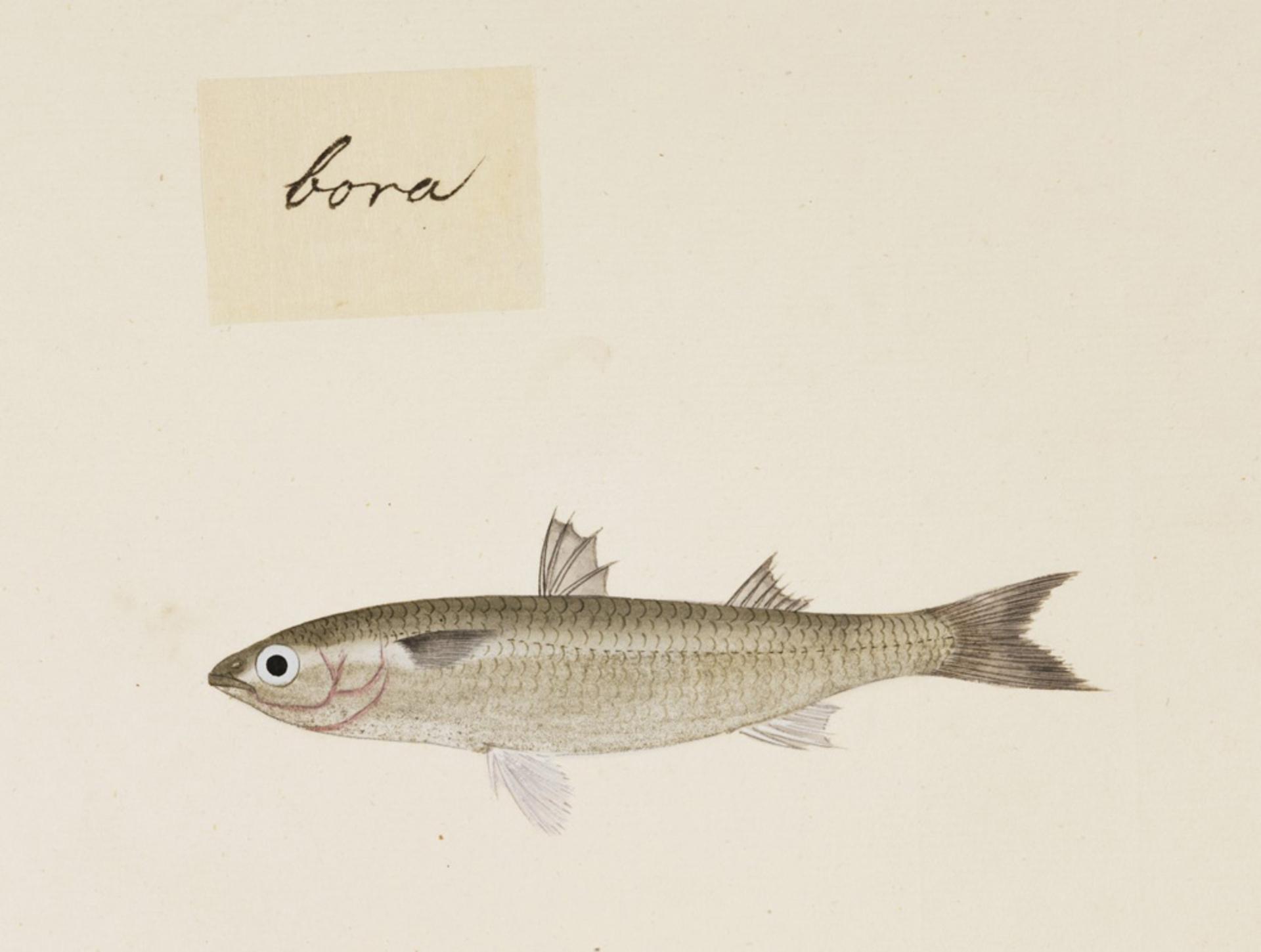
The flathead grey mullet is a sturdy, torpedo-shaped fish with a broad, flat head. Hence its Latin name, cephalus — “head”. The back is grey-olive, the flanks silver, and along the flanks run dark lengthwise stripes, by which it is told from other mullets.
Its mouth is small, the lips thick, and there are almost no teeth. A predator has no use for such a mouth — and the mullet is no predator.
It eats mud. The mullet gathers a thin film of algae and organic silt from the bottom along with the sand, and grinds it all in its stomach — thick-walled and muscular, like a bird’s gizzard. Its gut is long, like a grazing animal’s. That is why it was raised in ponds: it needs no feeding, it feeds on what grows on the bottom by itself.
And it jumps. A shoal of mullet throws itself out of the water for no visible reason, one fish or several at a time, and that splash on still water is the first way it is found.
Above the entry is a watercolour by the Japanese painter Ishizaki Yūshi from the collection of Jan Cock Blomhoff. The label is handwritten bora — the Japanese name for mullet.
IIWhere she holds
drag to turn · ctrl + wheel to zoom · a mark is a water of the atlas — click to open it
The flathead grey mullet is a fish of every warm coast in the world. Hawaiʻi and Japan, China and Australia, the Indian Ocean from Africa to India, the Mediterranean and Black seas, the Atlantic off America and Africa, the Pacific coast of America.
It keeps close inshore: lagoons, estuaries, shallow bays, river mouths. It tolerates both salt and almost fresh water and goes far up rivers.
It spawns out at sea, far from shore. The fry come back to the coast, into lagoons and mouths — which is exactly why Hawaiians could catch them with pond grates: they went of their own accord where they were safe.
In the Black Sea the flathead mullet has relatives: the golden and the leaping mullet. And in the 1970s and 1980s another mullet was brought to the Sea of Azov from the Far East — the so-iuy or haarder — and it took hold and spread across the whole Azov–Black Sea basin.
One of its oldest waters is Heʻeia fishpond on Oʻahu, where mullet was raised for six to eight centuries.
IIIHow she is taken
For the visiting angler
Mullet is a fish with a reputation: there is a lot of it, it is big, it is close at hand — and it is hard to take on a hook. It will not look at a predator’s lure. Here is how to deal with it.
Float and dough. A light float, fine line, a small hook, and on it a pellet of dough or a pinch of bread. Mullet takes shyly, mouthing the bait for a long time, and you strike not at the first twitch of the float but when it goes under with purpose.
Groundbait. Bread soaked and mixed with sand so that it sinks. Mullet comes to the cloud and stays where it is fed.
The cast net. The oldest method: a round net weighted round its edge opens in the throw and falls over the shoal. That is how mullet is taken in Hawaiʻi and in the Mediterranean. Whether an angler may use a net, and where, is for local rules to decide.
Rules. In Hawaiʻi mullet fishing is closed from December to March in most places, and a visitor aged 15 or over needs a marine licence. In Russia, on the Black and Azov seas, recreational fishing is free; seasons and limits are set by the rules of the Azov–Black Sea fisheries basin.
Where to look: quiet bays, river mouths, lagoons, breakwaters. And by the jumps: where mullet leap, the shoal is there.
By the trade
Mullet is one of the oldest fish of the trade and the first fish people learned to raise: Hawaiian ponds, the lagoon farms of Italy, the ponds of Egypt.
The chief value of the trade is not the flesh but the roe. Mullet roe sacs are salted, pressed and dried, and the result is bottarga in Sardinia and Italy, karasumi in Japan, batarekh in Egypt. In Japan the karasumi of Nagasaki is counted among the country’s three great delicacies.
IVSecrets of the craft
A smaller hook than seems needed. The mullet’s mouth is small and soft. It will not take a big hook, and it will tear free from a coarse one.
Do not strike too soon. Mullet sucks at the bait for a long time. The float trembles, bobs, lies flat — and only then goes under. A strike at the tremble is wasted.
Look at the lips and the stripes. There are many kinds of mullet in the world, and one shoal may mix them. The flathead grey mullet has a broad head, a thick upper lip and dark lengthwise stripes along its sides.
The taste depends on the water. A fish that eats mud tastes of the mud it lived in. Mullet from a clean sea lagoon is one thing; from a murky harbour, quite another.
Its names change as it grows. Hawaiians called it pua ʻamaʻama, kahaha, ʻamaʻama and ʻanae, from fry to full-grown. The Japanese too give mullet different names as it grows, and call it a fish that makes a career.
VStories about her
To a Russian ear the mullet has a song of its own. In 1943, in the film Two Soldiers, Mark Bernes sang “Schooners full of mullet” — a song by Nikita Bogoslovsky to words by Vladimir Agatov, about Kostya, an Odessa fisherman. Ever since, in Russian culture, mullet has been the fish of Odessa and the Black Sea, the fish of a port town where everyone knows everyone.
The Hawaiian story of the mullet is older and more serious. According to tradition, shoals of mullet set out every year from Puʻuloa, today’s Pearl Harbor, on a journey along the coast of Oʻahu — and come back again. This mullet was called ʻanae-holo, “the travelling mullet”.
And the Japanese story is about roe. Nagasaki, through which Japan traded with the Dutch, is famous for its karasumi — dried mullet roe, one of Japan’s three great delicacies. The watercolour above this entry comes from there too: it belongs to the collection of Jan Cock Blomhoff, head of the Dutch trading post at Nagasaki, and is labelled with the fish’s Japanese name.
Three shores, three very different lives — and one fish that everywhere eats mud, everywhere jumps, and everywhere was one of the first that people learned not only to catch but to raise.
FishBase and descriptions of Mugil cephalus — size, feeding, stomach, range, spawning. · Hawaiʻi Department of Land and Natural Resources — the December–March mullet closure, the non-resident licence. · Hawaiian dictionaries — names of the mullet by size. · Fishing rules of the Azov–Black Sea basin. · Introduction of the so-iuy mullet into the Sea of Azov. · The film Two Soldiers, 1943; the song “Schooners full of mullet” (N. Bogoslovsky, V. Agatov). · Ishizaki Yūshi, “bora”, Cock Blomhoff collection, Naturalis.