IHistory
The Yangtze is Asia’s longest river and the third in the world: about six thousand three hundred kilometres from the glaciers of the Tibetan Plateau to the East China Sea at Shanghai. Its basin covers about a fifth of China, and about a third of its people live in it. The Chinese more often call it simply Chang Jiang — “the Long River”.
Midway, the river cuts through the mountains in three gorges — Qutang, Wu and Xiling. Two hundred kilometres of sheer walls, rapids and whirlpools. For centuries junks were hauled upstream on ropes by trackers walking on paths cut into the rock.
In the eighth century the poet Li Bai wrote of sailing down through the gorges: “At dawn I left Baidi among the coloured clouds; a thousand li to Jiangling I made in a single day. On both banks the monkeys cried without ceasing, and my light boat had already passed ten thousand mountains.”
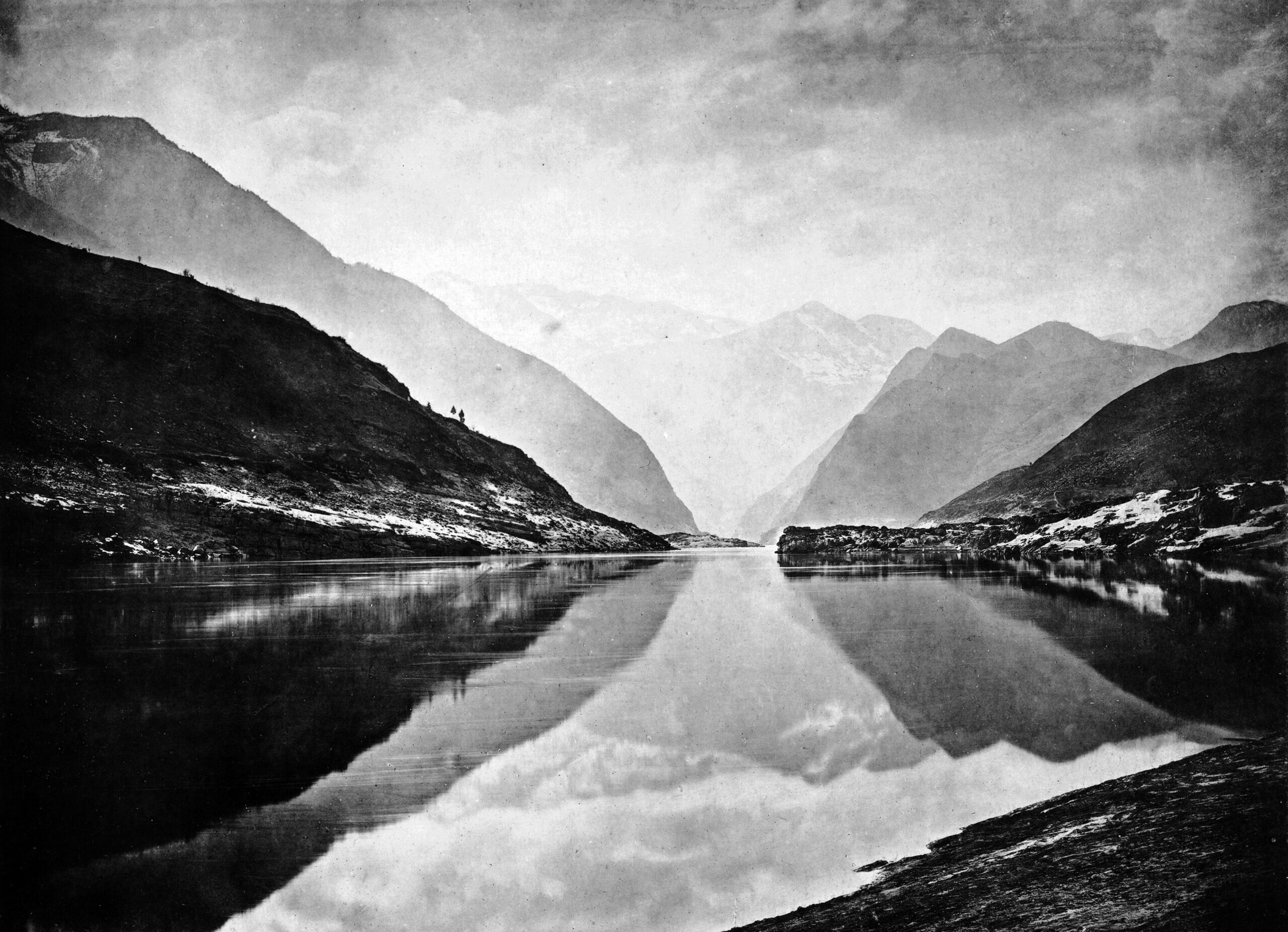
Above the entry is the Wu Gorge, the “Witches’ Gorge”, in a photograph by John Thomson. Between 1868 and 1872 the Scottish photographer travelled thousands of kilometres across China with a cumbersome camera and a portable darkroom, went up the Yangtze to the gorges, and the picture went into his China albums. In it the river lies like a still mirror, and the mountains rise over it the way Chinese painters drew them.
The river in the photograph is gone. In 2006 the Three Gorges Dam rose in the lowest gorge, and by 2010 the water behind it had risen to the hundred-and-seventy-five-metre mark. The rapids went under the water, the trackers’ paths too, and the gorges became a deep reservoir.
IIWhat is there now
In the second half of the twentieth century the Yangtze lost fish and animals faster than anyone could count them. Dams blocked the way to spawning grounds, nets and electro-fishing took everything, thousands of vessels came onto the river, and the water grew filthy.
The baiji, the Yangtze river dolphin — pale, nearly blind, with a long narrow beak — had lived in the river for millions of years. It was last reliably seen in 2002. In 2006 two expedition boats spent six weeks going the length of the river and back and neither saw nor heard a single one. The baiji was declared gone: the first species of dolphin wiped out by humans.
The Chinese paddlefish, a fish with a long sword-like snout, by old accounts grew to seven metres — one of the largest freshwater fish in the world. The last one was seen alive in 2003, and in 2022 the IUCN officially declared the species extinct. At the same time the wild Yangtze sturgeon was declared extinct in the wild.
And then China did what few dare. From 1 January 2021 all fishing for trade was banned on the Yangtze, its main tributaries and its great lakes — for ten years. A hundred and eleven thousand fishing vessels left the river; two hundred and thirty-one thousand fishers changed their work.
The first results are in. The Yangtze finless porpoise — the river’s last cetacean — was counted at 1,012 in 2017, at 1,249 in 2022, and later at 1,426. Scientists write that the ban has halted a seventy-year decline in fish diversity. The research stations are catching more kinds of fish again — and the fishers on the bank wait to see what will happen after 2030.
IIIWhat is taken here
Mandarin fish — the Chinese perch, a predator of rocks and dark water, a fish out of poetry.
The four “domestic” carps — black carp, grass carp, silver carp and bighead carp: the fish on which Chinese pond farming has stood for centuries; their eggs and fry were gathered from the Yangtze.
Wuchang bream — a fish of the middle river’s lakes, famous all over China.
Chinese sturgeon — a sea-run giant that comes up the river from the sea to spawn; critically endangered, with young fish released into the river every year.
The finless porpoise — not a fish, but the chief sign that the river is alive.
IVHow it is taken
Recreational fishing
Fishing on the Yangtze today is first of all the rules of the ban. In order:
Commercial fishing is closed. Until the end of 2030 all commercial fishing is banned on the Yangtze, its main tributaries and the great lakes — Poyang and Dongting. In protected stretches everything is banned.
Angling is not banned outright but limited by provincial rules. Most often it is allowed like this: one person, one rod, one line, one hook. Nets, traps, electro-fishing and fishing from boats are banned, and in many places live bait too. The rules differ from province to province and are learned on the spot.
What is never allowed. Catching Chinese sturgeon or other protected fish, disturbing the porpoises. Fines here are strict.
Where people fish. In reservoirs and small rivers outside the banned waters, and at paid ponds, of which the Yangtze valley has thousands.
The trade
Before the ban the Yangtze fed hundreds of thousands of families with fish: by net, by trap, by cormorant, and at the end by electro-fishing that stunned every living thing.
Now Yangtze fish on the market is pond-raised. China is the world’s largest producer of farmed fish, and much of it comes from the ponds and pens of the same Yangtze valley. Former fishers are paid allowances and trained for new work; some have become river wardens — watching over the very ban.
Ministry of Agriculture of the PRC — the ten-year Yangtze fishing ban from 1 January 2021, numbers of vessels and fishers. · Science, 2025 — “Fishing ban halts seven decades of biodiversity decline in the Yangtze River”. · Surveys of the Yangtze finless porpoise in 2017, 2022 and later. · The 2006 baiji survey expedition (Turvey et al., 2007, Biology Letters). · IUCN, 2022 — the Chinese paddlefish extinct, the Yangtze sturgeon extinct in the wild. · The Three Gorges Dam — reservoir at 175 m since 2010. · Li Bai, “Leaving Baidi at dawn”, eighth century. · John Thomson, Illustrations of China and Its People, 1873–1874.