IThe portrait
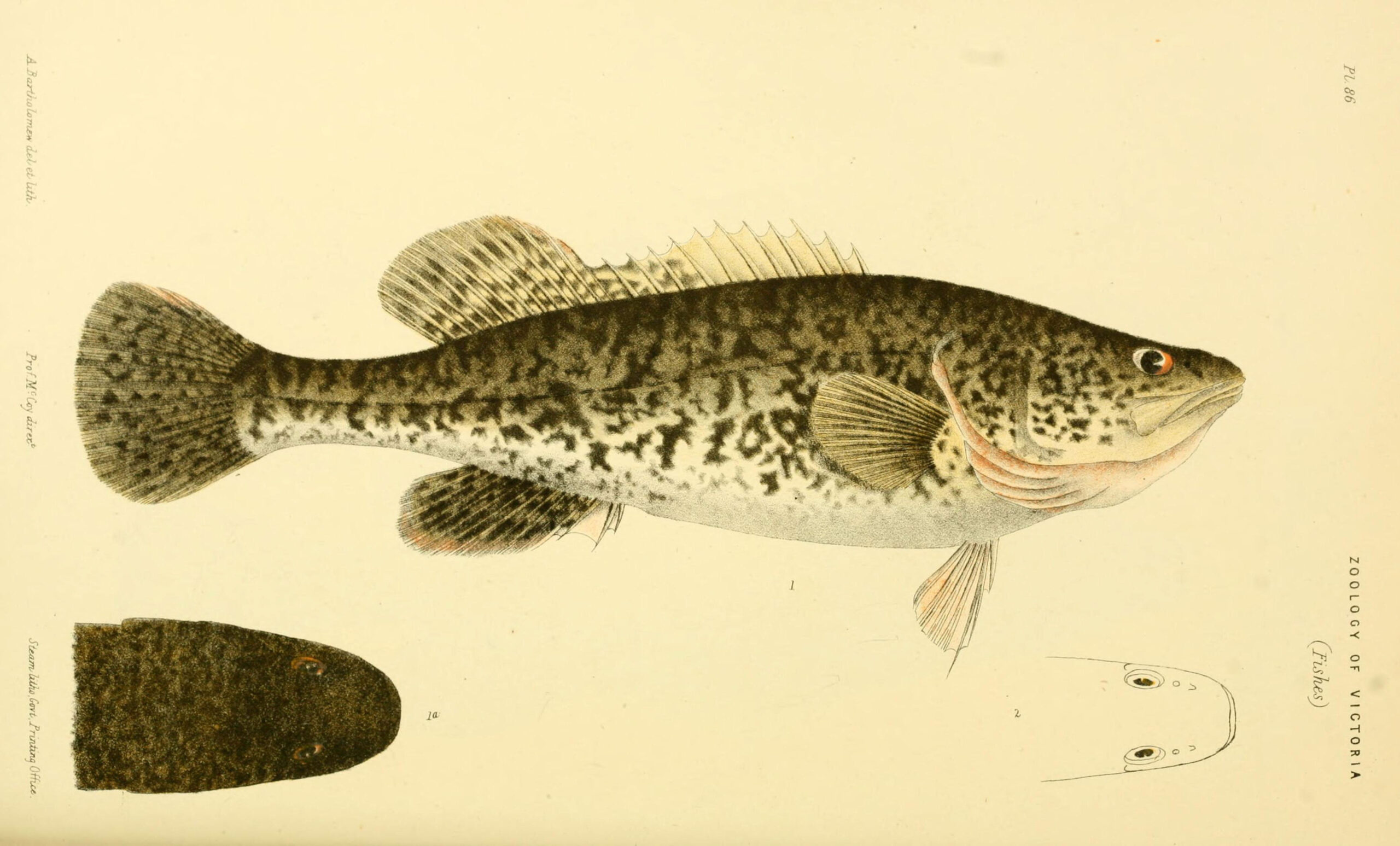
The Murray cod is a heavy, broad fish: a big rounded head, an enormous mouth, the lower jaw level with the upper or a little longer. The back and flanks are greenish-yellow, marbled with dark mottling, the belly white. The fins are rounded, pale-edged in a big fish.
The first settlers called it a cod — it has nothing to do with the true cod. It is a relative of the perches, of the family of Australian basses and perches. Its scientific name honours two: the genus is named after the ichthyologist Allan McCulloch, the species after the Peel River, from which the Surveyor-General Thomas Mitchell described the fish in 1838.
It is the largest fish that lives its whole life in Australia’s fresh water. A fish of 1.8 metres and 113.5 kilograms is on record. The cod grows slowly and lives long: the oldest aged so far was forty-eight.
Above the entry is plate 86 from Frederick McCoy’s Zoology of Victoria, lithographed by Arthur Bartholomew, 1884. In the nineteenth century this fish and its relative the trout cod were confused and went under one name; they were told apart as separate species only in 1972. This plate shows the Murray cod: the heavy mottling and the rounded head.
IIWhere she holds
drag to turn · ctrl + wheel to zoom · a mark is a water of the atlas — click to open it
The Murray cod is the fish of one basin, the Murray–Darling: from Queensland in the north to South Australia in the south, through all its rivers, from the foothills to the lower reaches. People have released it into rivers of the east coast, and in some it has taken hold.
What it needs above all is cover. The cod lies under snags, by undercut banks, among rocks, in the holes on the bends. Gum trunks fallen into the river are its home and its ambush at once. Many fish live for years under one and the same snag.
In spring, when the water warms and rises, some fish go upriver to spawn — sometimes tens of kilometres — and then come back to their snag. The female lays her eggs on something hard: in a hollow log, a hollow in the clay bank, on a stone. The male stays to guard them, and keeps watch until the larvae hatch.
Its great river is the Murray. Where the snags were pulled out for the steamers, the cod grew fewer; where they are being put back, there are more.
IIIHow she is taken
For the visiting angler
The Murray cod is Australia’s chief freshwater sport fish. First the rules — they are strict here.
Spawning — closed. From 1 September to 30 November cod are not fished anywhere in the rivers: the male is guarding the eggs, and if he is taken the whole clutch dies. A fish caught by accident is released at once.
The slot. In New South Wales and Victoria only fish of 55 to 75 centimetres may be kept, and no more than two a day. The small ones should grow; a big one is a breeder that has given and will give thousands of eggs. Some reservoirs have their own rules — check them before going out.
Licence. In New South Wales — the recreational fishing fee; in Victoria — a licence. On whose river it is and whose rules apply, see the entry on the Murray.
On top, at night. Big cod come out to hunt in the dark. A surface lure waddling slowly across the water is the most thrilling fishing there is: a strike from below, and the water boils.
By the snag. By day the lure — a spinnerbait, a plug — is worked right past the snag, almost touching it. The cod does not chase far: it strikes from cover at what passes by.
Bait. The river’s old baits are the yabby, a freshwater crayfish, and the grub of a wood-boring moth, locally the bardi. The bait is set on the bottom by a snag, and you wait.
Tackle must be strong. A hooked cod heads straight back under its snag. Hold it in the first seconds or not at all.
By the trade
In the second half of the nineteenth century cod were taken from the Murray with nets and set lines and sent to the cities by train, by the ton. The trade went on for more than half a century, and the fish had grown scarce in the river long before the dams and the carp.
Today there is no river fishery for cod: in New South Wales it was closed in 2001. Cod are raised in hatcheries — both for the table, in ponds, and for the river: every year fingerlings are released into rivers and reservoirs by the million.
IVSecrets of the craft
One snag, one fish. A big cod holds its cover and will not tolerate neighbours. Took a fish from a snag — look for the next one at another.
Muddy water is no obstacle. The cod hunts less with its eyes than with its lateral line: it feels the movement of the water. So a lure that is noisy and pushes water works better in a muddy river than a shiny one.
Rising water is a signal. When the water begins to rise after rain, the cod wake up and come out from under the snags.
Do not confuse it with trout cod. The trout cod’s upper jaw overhangs the lower, and its flanks carry fine dark speckles instead of marbling. Almost everywhere it must be released.
A big one stays in the water. A metre-long fish of over twenty kilograms is held level, under the belly, not hung from its jaw. Such a fish is decades old.
VStories about her
The oldest story of the Murray cod is older than the river as it is known today.
The Ngarrindjeri, the people of the lower Murray, tell of the cod Ponde. Once the river was a narrow stream and Ponde a huge fish. The ancestor Ngurunderi chased it in a bark canoe from the very headwaters. The cod fled downstream, lashing its tail, breaking the banks — and wherever it turned, the river bent. That is how the Murray got its bends.
Ponde was speared at Lake Alexandrina. Ngurunderi cut it into pieces and threw them into the water, and each piece became a new fish: so all the river’s fish came to be. And what was left of Ponde became the Murray cod — the one that lives in the river today.
The story holds what anyone who has fished for cod knows: it lives in the river’s bends and snags, flees downstream and into the deep, and lashes its tail so hard it breaks the tackle. It is a story about a fish that was known very well.
Australian Museum and Atlas of Living Australia — Maccullochella peelii: size, age, range. · Environment Protection and Biodiversity Conservation Act (EPBC) — “vulnerable” status; IUCN Red List. · NSW Department of Primary Industries and Victorian Fisheries Authority — the closed season 1 September to 30 November, the 55–75 cm slot, the bag limit, the closure of the NSW river fishery in 2001. · Studies of cod spawning and movement (radio-tracking) in the Murray–Darling Basin. · Berra and Weatherley, 1972 — separating the Murray cod and the trout cod. · Thomas Mitchell, 1838 — first description. · South Australian Museum — the Ngarrindjeri account of Ngurunderi and Ponde. · F. McCoy, Prodromus of the Zoology of Victoria, plate 86.