IHistory
The Chesapeake is the largest estuary in the United States: a river valley flooded by the sea when the glaciers melted. The bay runs north to south for some three hundred and twenty kilometres, from the mouth of the Susquehanna to Capes Henry and Charles, where it opens into the Atlantic. And yet it is shallow: six and a half metres deep on average.
About a hundred and fifty rivers and streams flow into it — the Susquehanna, the Potomac, the Rappahannock, the James and a host of small ones. Their water gathers from the lands of six states and the capital. Fresh and salt mix here slowly, along the bay’s whole length, so the water is different everywhere: nearly fresh at the head, nearly sea at the mouth.
The bay was named by Algonquian peoples: the village of Chesepiooc stood by its southern entrance. The meaning is disputed; most often it is read as “great shellfish bay”.
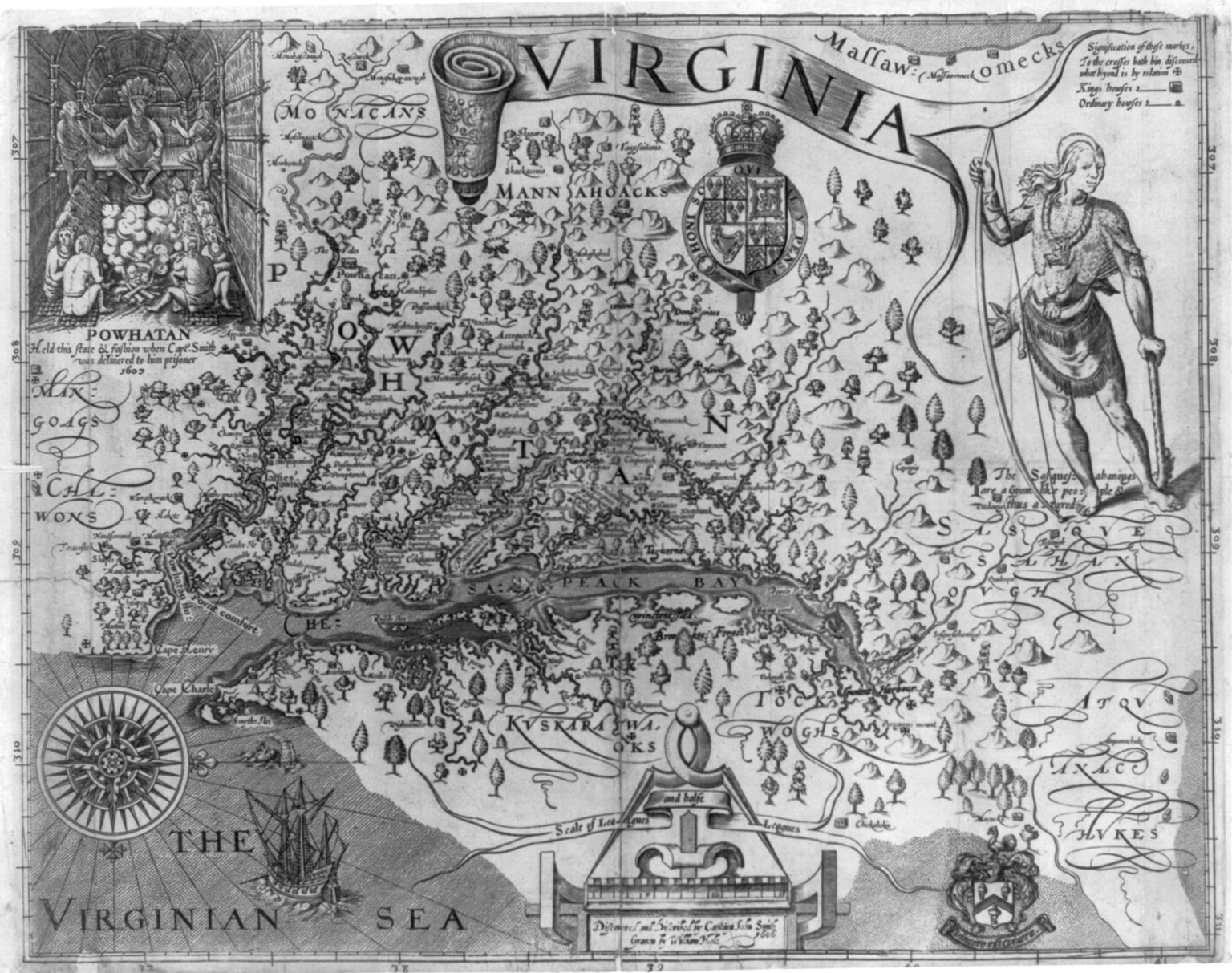
In the summer of 1607 the Virginia Company’s ships entered the bay, and Jamestown rose on the James River. The next year Captain John Smith twice went round the Chesapeake in an open boat. There were so many fish, he wrote, that for want of nets they tried to catch them with a frying pan — and found it a bad instrument to catch fish with.
Above the entry is the map Smith drew from those voyages. It was engraved by William Hole and printed at Oxford in 1612. To read it you have to tilt your head: west is at the top, the ocean at the bottom, and the bay lies across the sheet. Top left is the chief Powhatan in his house; on the right, a Susquehannock warrior. For decades afterwards Virginia was drawn from this map.
IIWhat is there now
In three centuries the bay where fish were caught with a frying pan became a bay that has to be rescued.
Oysters. In the nineteenth century the Chesapeake was one of the great oyster bays of the world: in the best years of the 1880s Maryland alone took up to fifteen million bushels. Maryland and Virginia fought over the oyster bars in earnest — with gunfire — and Maryland set up its own “oyster navy” for the purpose. Then the bars were raked bare, and in the mid-twentieth century two oyster diseases joined the overfishing. Today, by estimates, about one per cent of the old oysters remain. They are being raised again — on reefs of shell and stone.
Dead zones. Fertiliser runs into the bay from fields and towns. In summer it makes the water bloom, the algae die and rot, and oxygen runs out on the bottom. Fish and crabs leave those places or die. Since 1983 the bay states have worked on this under a shared agreement, and in 2010 a limit was set for the whole watershed — how much nitrogen and phosphorus the bay can take.
Striped bass. The bay’s great story of the twentieth century is the striped bass, locally the “rockfish”. Most of the striped bass of the whole Atlantic coast are born in the Chesapeake’s rivers. When in the 1980s the fish all but vanished, Maryland closed its fishing entirely, for five years — and the bass came back. More in the entry on striped bass.
And the skipjacks. For a long time Maryland allowed oyster dredging only under sail, so that engines would not strip the bars. That is why the skipjacks survived here to our day — flat-bottomed single-masted sailboats, the last working sail fleet in North America. Few are left, but they still go out.
IIIWhat is taken here
Striped bass — the bay’s fish number one, and Maryland’s state fish.
Blue crab — Callinectes sapidus, the “beautiful savoury swimmer”. Not a fish, but without it there is no Chesapeake: Maryland crab cakes, soft-shell crab after the moult, bushel baskets of crabs steamed with spice.
Menhaden — an oily fish of the herring family on which the whole bay feeds: bass, birds, whales at the mouth. People take it for fish oil and meal.
Spot and croaker — the bay’s summer fish: along the shores and by the pilings, every other angler catches them.
American eel — born in the Sargasso Sea, it came into the bay’s rivers as a larva. A live eel at night takes the biggest bass.
And ancient visitors — the Atlantic sturgeon, which is again running up Virginia’s rivers to spawn.
IVHow it is taken
Recreational fishing
Two states share the bay, and each has its own rules. In order:
Licence. In Maryland tidal waters need the Chesapeake Bay and coastal sport fishing licence; Virginia has its own saltwater licence. Both are bought online.
Striped bass in Maryland, 2026. From 1 April fishing is catch-and-release only. From 1 May a bass may be kept — one fish a day and only within the “slot” of 19 to 24 inches. In August striped bass fishing is closed entirely. The rules change every season, and before going out they are checked on the state Department of Natural Resources site.
Bait only on a circle hook. This is the rule along the whole Atlantic coast: the circle hook’s point turns back toward the shank, the fish is hooked in the corner of the mouth instead of swallowing the hook, and it can be released alive.
How it is fished. Live-lining spot or menhaden from a drifting boat; chumming at anchor; trolling an “umbrella” of several lures in spring; topwater at dawn, when the bass drive bait to the surface and gulls scream over them.
And the heat. In summer the bay warms so much that a bass caught and released often does not survive. On hot days the state asks anglers to fish early in the morning or not at all.
The trade
The bay’s trade is crab, oyster and fish, and each has its own story.
Crab is taken in wire pots and on baited trotlines. Oysters with dredges from the skipjacks, with hand tongs from small boats, and more and more on farms. Striped bass with gill nets and pound nets, under quota. Menhaden off Virginia are taken with purse seines, and the bay has its own cap on that catch.
All of it rests on one thing: that the bay’s water should be enough for everyone — for the fish, for the people and for the oxygen.
Chesapeake Bay Program — area, depth, watershed, rivers, the 1983 agreement, the 2010 pollution limit. · U.S. Geological Survey — the bay’s origin. · John Smith, A Map of Virginia, 1612, and The Generall Historie of Virginia, 1624. · Library of Congress — the map “Virginia”, Smith and Hole, 1612. · Maryland Department of Natural Resources — 2026 striped bass rules, the 1985–1990 moratorium, the oyster fishery and the “oyster navy”. · Atlantic States Marine Fisheries Commission (ASMFC) — circle hooks for bait fishing. · Chesapeake Bay Maritime Museum — skipjacks.