IThe portrait
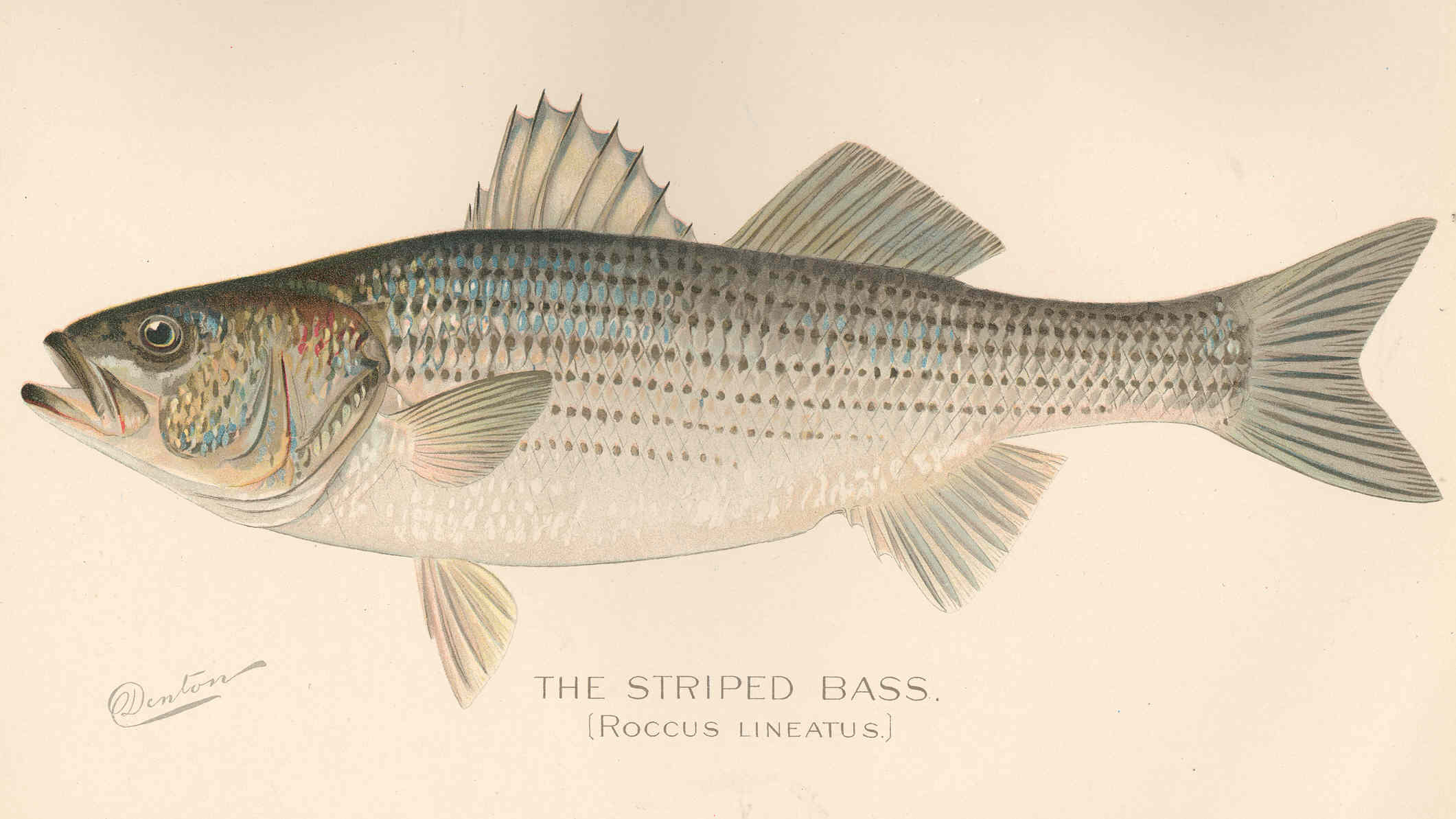
The striped bass is known at first sight: a silver flank with seven or eight dark lengthwise stripes running from gills to tail, like the rules in a copybook. The back is olive or blue-grey, the belly white. The body is strong and long, the head large, with a jutting lower jaw.
There are two dorsal fins, and they stand apart: the front one of hard spines, the rear one soft. It is a fish built for current and surf — along the shore it hunts where the waves break.
It grows slowly and lives long, up to thirty years. A fish of up to two metres and fifty-seven kilograms is the limit known from old net catches. The rod record is 81 pounds 14 ounces: on 4 August 2011 Greg Myerson took that bass in Long Island Sound, at night, on a live eel.
Above the entry is a lithograph by Sherman Foote Denton from the New York fisheries commission’s report for 1899. The fish is labelled with its old name, Roccus lineatus — “the striped one”. Its present scientific name, Morone saxatilis, means “dwelling among rocks”; hence the Chesapeake nickname, “rockfish”.
IIWhere she holds
drag to turn · ctrl + wheel to zoom · a mark is a water of the atlas — click to open it
The striped bass’s homeland is the Atlantic coast of North America, from the Gulf of St. Lawrence in the north to the St. Johns River in Florida in the south. A separate population of its own lived on the Gulf of Mexico coast as well.
It is an anadromous fish: it lives in the sea and in salty bays, and to spawn it goes up rivers in spring, into fresh water. Its eggs drift — they need current so as not to sink to the bottom and smother before the larva hatches.
The coast’s chief spawning grounds are the rivers of Chesapeake Bay. Most of the Atlantic’s striped bass are born there, and then, grown, they go out to the ocean and each summer migrate north along the coast to New England, returning in autumn. The two other great spawning grounds are the Hudson and the Delaware.
And the Pacific. In 1879 a hundred and thirty-odd young bass were caught in the Navesink River in New Jersey, carried by train across the whole continent and released into San Francisco Bay. Three years later more were brought. The fish took so well that by the end of the century it was being caught in California for market, and today striped bass live on the Pacific coast from California to Oregon.
IIIHow she is taken
For the visiting angler
The striped bass is the chief sport fish of the US Atlantic coast: fished from shore and boat, in the surf and in the bays, on everything from a fly to a live eel. First, the rules.
The rules are each state’s own. For the whole coast they are coordinated by the Atlantic States Marine Fisheries Commission, but each state sets the slot, the daily limit and the closed months itself. In Maryland in 2026 — one fish a day, within the slot of 19 to 24 inches, and August closed entirely. The rules change every year and must be checked before going out.
Bait only on a circle hook. Since 2021 this has been the rule for the whole coast. The point turns back toward the shank, the fish is hooked in the corner of the mouth and survives release.
Live eel, at night. This is how the biggest are taken: an eel on a circle hook, the boat drifting over rocks and drop-offs, or an eel worked slowly from shore along the rocks. The record was caught this way.
Topwater at dawn. When bass drive a school of bait to the surface, the water boils, and gulls scream and dive over it. This is a blitz. A popper thrown into a blitz is the most thrilling fishing on the coast.
In Chesapeake Bay — live-lining on the drift, chumming and trolling: details in the entry on Chesapeake Bay.
And release it gently. A big fish is a female carrying eggs. Keep her in the water, not by the gills, and in the heat do not fish at all: out of warm water a released bass often does not survive.
By the trade
The Atlantic fishery for striped bass uses gill nets, pound nets and hook gear, under each state’s quota. In several states commercial fishing for striped bass is banned entirely: the fish is left to the rod.
In California commercial fishing for striped bass was closed back in 1935 — and there it has been a rod-only fish ever since.
IVSecrets of the craft
Watch the birds. Gulls and terns see a blitz before you do. Where they circle and drop to the water, the bass are driving bait.
Night and the tide. A big bass is wary and hunts in the dark, especially on the turn of the tide, when the current carries food past points and through channels.
Look for moving water. Bass lie where the current breaks on rocks, pilings, the mouth of a creek — and wait for what the water brings.
An eel stands up to anything. A live eel lasts long on the hook and works until morning. Keep it cold, on wet burlap — then it stays calm and does not knot the line.
Big means female. Fish heavier than fifteen kilograms are almost always females. A big fish released is the future spawn of the whole coast.
VStories about her
The striped bass has perhaps the longest conservation story of any fish in America — and it begins with the colonists.
In 1639 the Massachusetts Bay Colony forbade manuring fields with cod and bass: there were so many fish that they were buried in the ground under the corn. It is called one of the first fish conservation laws in the New World. And in 1670 Plymouth Colony gave the income from the fishery at Cape Cod — bass, mackerel and herring — to the upkeep of a free school.
Three centuries later there was no reason left to spare the bass from the ground, because there was nothing to bury. In 1973 almost fifteen million pounds were landed on the coast; by 1983 fewer than two million. In the Chesapeake the young almost stopped being born.
Then something rare happened. In 1984 Congress obliged the coastal states to agree on rules, and Maryland, where the fish spawn, closed its fishing entirely in 1985 — for five years. Fishermen protested, dealers counted their losses. But in 1995 the striped bass was declared restored. It is one of the few stories where a ban did exactly what it was meant to do.
The story has not ended. Since 2019 the bass has been overfished again, few young have been born in the Chesapeake several years running, and the rules have been tightened once more — now with the aim of rebuilding the stock by 2029. It has worked once before.
FishBase — Morone saxatilis: size, lifespan, range. · International Game Fish Association (IGFA) — Greg Myerson’s world record, 4 August 2011. · Atlantic States Marine Fisheries Commission (ASMFC) — the 2019 stock assessment, the rebuilding plan to 2029, circle hooks since 2021. · NOAA Fisheries — landings of 1973 and 1983; the Atlantic Striped Bass Conservation Act of 1984. · Maryland Department of Natural Resources — the 1985–1990 moratorium, the 2026 rules, the juvenile index. · California Department of Fish and Wildlife — the introductions of 1879 and 1882, the 1935 commercial ban. · Records of the Massachusetts Bay Colony, 1639; records of Plymouth Colony, 1670. · New York fisheries commission report for 1899, lithograph by S. F. Denton.