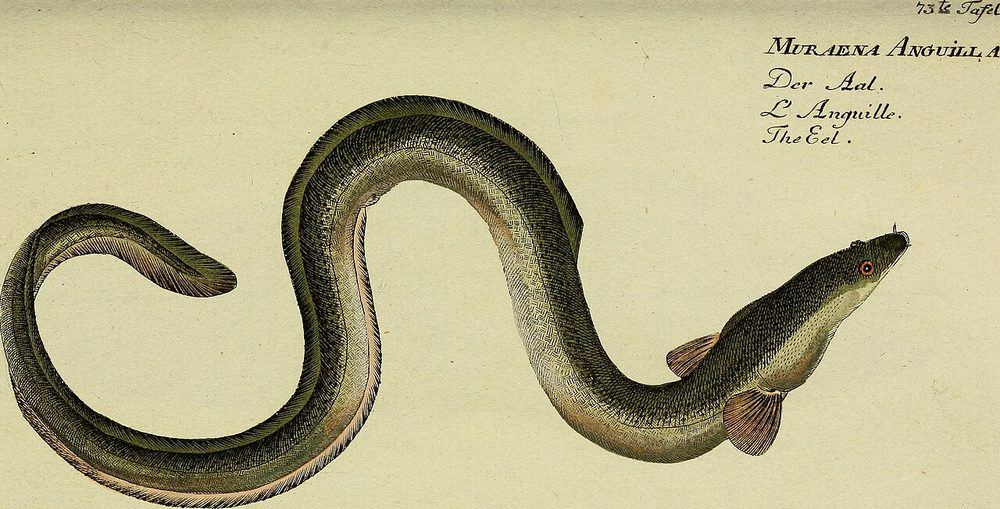
IThe portrait
Eel cannot be mistaken for anything, and this is the rare case where no marks need looking for.
The body is serpentine, round in section, flattened toward the tail. There are no pelvic fins at all — dorsal, caudal and anal merge into one continuous fringe running from mid-back around the tail and down to the belly. It swims not by the tail but by the whole body, in a wave.
There are scales, but they cannot be seen: minute, set deep in the skin and lying scattered rather than overlapping. Over all this lies slime, and that slime is not dirt but equipment — it holds moisture, and across wet grass an eel travels overland further than people care to believe.
The colour changes twice in a life, and age can be read from it. A young eel in the river is yellow-brown with a dirty belly — the yellow eel. Before going to sea it repaints itself: the back blackens, the flanks go silver, the eyes nearly double. This is the silver eel, and it no longer feeds.
The transparent fry entering rivers from the sea is called the glass eel. It is genuinely glass: a newspaper can be read through it.
IIWhere she holds
drag to turn · ctrl + wheel to zoom · a mark is a water of the atlas — click to open it
The eel’s range is built as no other fish’s in this atlas: it consists of two halves divided by an ocean, and in each half the eel lives a different life.
The first half is Europe. Rivers, lakes, estuaries and inshore waters from Morocco to northern Norway: the Atlantic coast, the Mediterranean, the Baltic, the North Sea, the British Isles, Iceland. Here it spends years — males four to six, females eight to twelve, and often far longer. It keeps to the bottom, to silt and sunken wood, and moves at night.
The second half is the Sargasso Sea. There it goes to spawn, and from there it does not return. Between the halves lie five to ten thousand kilometres of open Atlantic — the longest spawning migration of any eel in the world.
What comes back is the larva. A transparent leaf, willow-shaped, drifts with the currents for over six and a half thousand kilometres and after a year or two reaches the European shore, where it becomes a glass eel and enters a river. It has never seen that river.
IIIHow she is taken
For the visiting angler
Here something must be said that articles about fishing usually leave out.
Eel may not be taken now, and that applies to the angler too. Under the precautionary approach, ICES advises zero catch in all habitats for 2026 — commercial, recreational, and even glass eel taken for restocking.
In the European Union annual closures during the migration have applied since 2018. The rules leak: a member state may keep the fishery open for thirty days at the peak of migration, and for glass eel a further fifty on top, provided the catch goes to restocking. But the direction does not change: the fishery is being wound down.
In practice this means one thing. Check the rules of the particular country and the particular water before travelling, and assume the eel goes back. If it takes at all: the fish moves at night and takes off the bottom.
The plate below is historical. It shows how eel was taken while it was taken, and stands here as a memory of the craft, not as instruction.
By the trade
One figure explains the rest. In the 1960s the European fishery took some ten thousand tonnes of eel a year. In 2022 it took two thousand and twenty-eight, and that across all life stages together.
They were taken in basket traps and fyke nets on the river run, on longlines and in nets in the estuaries, and glass eel was strained out at the river mouths. The last proved the most destructive: what was removed was not fish but a whole generation, before it had got upriver at all.
IVSecrets of the craft
Leaving for the sea it stops eating — and dismantles itself for the road. In the silver eel the gut shrinks and goes out of use as no longer needed. Several thousand kilometres lie ahead, and all of it will be covered on what was stored in the river. Not one meal to the end.
The eyes nearly double before departure, and the optics change: from river sight, fitted for murky water at the bottom, to deep-sea blue. The fish rebuilds itself for a road it has never seen.
Sex is not settled at birth. What an eel becomes is decided in the river and depends on how crowded it lives: crowding yields more males. This is one reason restocking works less well than was reckoned.
It travels overland. Not by legend but in fact: across dew, across wet grass, around a weir. The slime holds moisture, the skin breathes. The distance is short, but for a fish it is an impossible thing, and that is why it is talked about.
And above all — nobody has seen it spawn. Neither eggs nor a spawning-ready adult has ever been caught in the Sargasso Sea, though the search has run a hundred years. Everything we know was deduced from where the smallest larvae were found.
VStories about her
For two thousand years the eel was living proof that a fish can arise by itself.
Aristotle, opening eels, found neither roe nor milt in them — and concluded that they are born of mud and earthworms. For his time this was an honest conclusion from honest observation: the sexual organs of a river eel genuinely cannot be found, for they develop only before the run to sea.
The answer was found by the Dane Johannes Schmidt, and his method was simple to the point of genius.
From 1920 to 1922 he worked the Atlantic aboard the Dana, funded by the Carlsberg Foundation, trawling the deep haul after haul. The rule was one: go where the larvae are smaller. Year after year, tack after tack, across the ocean — west and south. Until in 1922, south of Bermuda, he caught the smallest eel larvae anyone had seen.
That same year he published “The breeding places of the eel” and named the Sargasso Sea.
And here is the astonishing part. Schmidt saw neither spawning nor a spawning-ready fish. He worked the place out from the size of larvae — and he was right. Only in 2022, exactly a hundred years later, were adult eels first tracked by tag all the way to the Sargasso Sea.
The spawning itself still nobody has seen.
ICES advice on European eel for 2026: zero catch in all habitats. · EU Council regulations on eel fishing closures, in force since 2018. · IUCN Red List — critically endangered since 2008; CITES Appendix II since 2007. · J. Schmidt, “The Breeding Places of the Eel”, Philosophical Transactions of the Royal Society of London, 1922 — public domain. · Scientific Reports, 2022 — first direct evidence of adult eel migration to the Sargasso Sea. · Aristotle, “History of Animals” — public domain.