IThe portrait
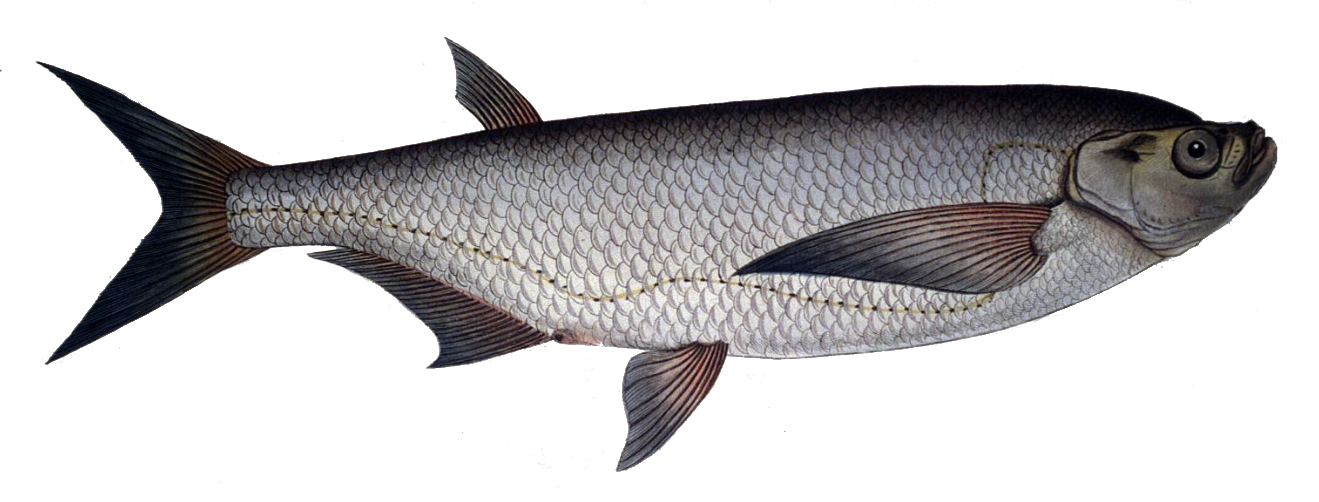
The sabrefish cannot be mistaken for anything, and one look from the side is enough.
The body is drawn out and flattened so far from the sides that there is almost nothing to see from above — a narrow strip. The back is straight as a rule, the belly curves sharply down and ends in a keen scaleless keel. Hence all its names: sabre-fish, sideling, sword.
The mouth is superior, almost vertical — built to take from above, off the surface. From that mouth alone it is plain where to look for it: not on the bottom.
The scales are fine and come away easily; the whole fish flashes silver with a greenish back. Fresh from the water a sabrefish shines so that you can tell what you have caught from a distance.
The lateral line bends sharply downward and runs almost along the belly rather than the middle of the flank, as in most fish. That detail is the surest mark if any doubt arises.
And its kin are few: the sabrefish is the only species of its genus. Nothing in the carp family stands closer to it.
IIWhere she holds
drag to turn · ctrl + wheel to zoom · a mark is a water of the atlas — click to open it
The sabrefish keeps to the basins of four seas: the Caspian, the Black, the Azov and the Baltic. Its chief waters are the large rivers and reservoirs that feed them, and above all the middle and lower Volga.
Weedy places it dislikes entirely. It wants clean open water with current: the channel of a big river, a reservoir, a reach. In grass and sunken wood it will not be.
And the main thing — it runs high. Not on the bottom, where almost every river fish is looked for, but through the water column and right at the surface, in shoals. That is the one thing to understand about the sabrefish before starting to fish for it.
The shoals can be vast. A running shoal gives itself away by splashes and a characteristic smacking at the surface — a sound by which it is found before it is seen.
Some populations are semi-anadromous: they feed in the freshened water off the river mouth and go up into the river to spawn. On the lower Volga such runs are what produce the sackfuls people speak of there.
IIIHow she is taken
For the visiting angler
The sabrefish is a fish for those tired of sitting over a ledger rod. It is active, takes greedily and fights briskly for its weight.
There is one rule and it governs everything: fish near the surface. Let the bait down past a metre and a half and there is no fish, though the shoal stands right under the boat.
Trotting. A light quill float, a couple of shot, a hook with a maggot or a fly, and the lot let down with the current. An old method, simple and productive.
Bubble float. A clear weighted float with a long leader behind it, up to two metres, carrying a fly or small lure. It casts far and fishes shallow — which ordinary float tackle cannot do.
A small spinner. A size 0 or 1 blade on light spinning gear, worked fast, right at the surface. Best of all on an active shoal.
It takes maggot, worm, small fry, fly. In a feeding mood it takes whatever comes.
Where to look: drop-offs and seams, the edges of currents, below riffles, and on reservoirs the open reaches. And listen to the water: a shoal is found more surely by the splashes than by a sounder.
By the trade
Commercially the sabrefish counts for little and appears in quotas as a minor line. It is taken incidentally, by seine, along with other common fish.
But it has its own place in everyday use. Dried sabrefish is a well-known and well-liked article in southern Russia and Ukraine: the fish is fatty, and in drying that is its chief virtue.
IVSecrets of the craft
Look at the lateral line, not the shape. Narrow silver fish are plentiful in a river — bleak, young asp. But in none of them does the lateral line drop almost to the belly. That is a mark that will not fail.
It is fatty, and that settles what to do with it. Frying sabrefish wastes the fish: in the pan it comes out dry and bony. In drying the fat spreads through the flesh, and the result is what it is caught for.
There are many bones and they are fine. This is not a fish to give children. But in a dried fish the bones come away with the rib section — knowing how to split it makes the problem disappear.
It bites by ear. Experienced hands fish it by sound: they walk the bank, listen for splashes, and only cast once they hear. The shoal moves, and chasing it by sounder is pointless.
It may not be taken while spawning. The sabrefish is on the list of species with closed seasons. Dates differ between regions and shift from year to year — check the rules of your fishery basin before travelling.
VStories about her
Hardly anything is written about the sabrefish, and that in itself is curious.
It has neither the size of sturgeon, nor the fame of pike-perch, nor the standing of trout. The trade overlooked it, cookery passed it by, and literature granted it almost nothing.
Yet everyone who has fished the Lower Volga knows it. There it runs in such shoals that the count is kept not in fish but in sacks, and dried sabrefish hangs in the yards as a matter of course.
That mismatch is worth noting. There are famous fish and there are needed fish, and they are different lists. Cod is known the world over because it fed half of it; the sabrefish is known to almost nobody outside four river basins — and inside them it is known better than cod.
This atlas was begun partly for fish like this. About sturgeon everything has been written. About the sabrefish, almost nothing, and the reference books honestly admit how little is known.
Whether it is worth it is a matter of taste. But a narrow silver fish that takes a fly off the surface and travels in shoals of thousands deserves a page at the least.
Caspian branch of VNIRO — ichthyofauna of the Volga-Caspian basin, species account. · Fishing rules for the Volga-Caspian fishery basin — closed seasons and catch limits. · L. P. Sabaneyev, “The Life and Catching of Freshwater Fish”, 1875 — public domain; habits and methods.