IThe portrait
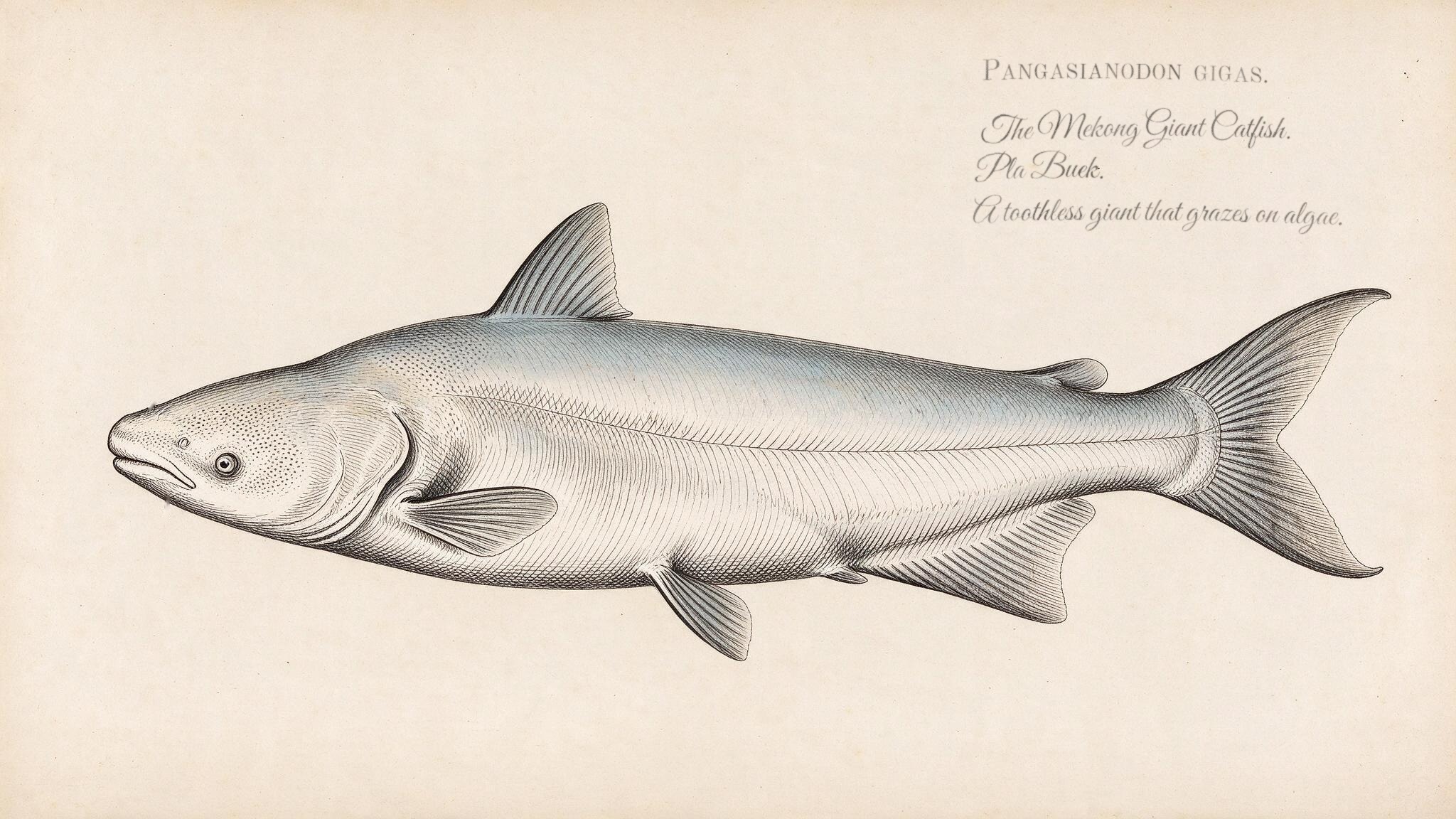
The Mekong giant catfish is a giant of the family Pangasiidae, the “shark catfishes”. The body is long and heavy, like a huge shark’s, the skin smooth and scaleless. The back is grey, the flanks paling to a silvery-white belly. The dorsal fin is tall and triangular with a thick leading ray, there is a small adipose fin near the tail, and the tail is deeply forked.
Young fish have barbels and teeth, like any catfish. With age the barbels almost vanish and the teeth go entirely. A grown giant is toothless and lives not on fish but on algae and plants, which it scrapes from the rocks.
It is one of the largest freshwater fishes in the world. In 2005 a catfish of two hundred and ninety-three kilograms was caught in northern Thailand — for years it was counted the heaviest freshwater fish whose weight was reliably recorded. Only a giant freshwater stingray of three hundred kilograms, caught in 2022 in the Mekong too, outweighed it. The catfish grows up to three metres long.
Above the entry is not an old plate but a drawing generated by AI. The species was described by the Frenchman Pierre Chevey only in the early 1930s, there are almost no old scientific plates of it, and modern photographs are under licence. The drawing was made from the species’ features and checked against photographs: the eye low, level with the mouth, no barbels on the grown fish, the fins in their places.
IIWhere she holds
drag to turn · ctrl + wheel to zoom · a mark is a water of the atlas — click to open it
The Mekong giant catfish lives in only one river in the world — the Mekong: from northern Thailand and Laos down through Cambodia to the delta in Vietnam.
It is a travelling fish. Adults are thought to move upstream in spring, northwards, to the spawning grounds — in Laos and northern Thailand — while the young drift downstream. They grow up in the Tonle Sap — the lake into which the Mekong turns a river backwards every year — and on the flooded plains.
The giants keep to the deep pools of the main channel. Exactly where they spawn is still not fully known: the fish is so rare that scientists follow every one that is caught.
IIIHow she is taken
For the visiting angler
There is one main rule: wild Mekong giant catfish may not be caught. The species is critically endangered, protected in Thailand, Laos and Cambodia, and trade in it is banned under CITES. One caught by accident is released at once.
Where it is caught today. Since the 1980s Thailand’s fisheries department has bred the catfish in hatcheries and released young fish into reservoirs and ponds. These hatchery catfish are what is caught in Thailand’s paid fishing ponds — almost always catch-and-release.
How. A pond catfish takes a ball of bread, bran and rice on a big hook laid on the bottom. The tackle must be heavy: a fish of several dozen kilograms fights for a long time.
How to release. The giant is not hauled up the bank: it is held in the water, supported on two hands, given time to breathe and let go.
By the trade
There is no fishery for wild catfish any more. The last place it was taken was the village of Hat Khrai near Chiang Khong on the Thai bank of the Mekong: every spring, in April and May, fishermen went out on the river with drift nets. In ten years of such fishing the number of adult catfish there fell, by estimates, by four-fifths.
In 2009 the governor of Chiang Rai province banned targeted fishing for the catfish. Today the main threat is no longer nets but dams on the Mekong, which bar the giant’s way to its spawning grounds.
IVSecrets of the craft
Don’t confuse it with pangasius. The supermarket pangasius is a relative, but small, and it has barbels. The Mekong giant is two or three times longer and nearly barbelless.
The eye is low. In the Mekong giant catfish the eye sits low, almost level with the mouth. It is one of the marks it is known by.
A plant-eating giant. It will not take live bait. In a pond it is caught on dough — like a huge carp.
Every fish counts. If a wild catfish turns up in a net or on a line, report it to the fisheries department: scientists tag every such fish and follow where it goes.
VStories about her
In Thailand it is called pla buek, in Laos pa beuk. For the people of the Mekong it was not just a big fish but a fish to be approached with respect.
At Hat Khrai near Chiang Khong, every year before the fishing season, the fishermen held a ceremony: they asked the river spirits for leave and for luck and brought them offerings. Only then did the boats go out on the river. Catching a catfish was counted good fortune for the whole village.
The catfish of two hundred and ninety-three kilograms was caught in 2005 right here, near Chiang Khong. By reports, it was meant to be kept alive for breeding, but it died. Its photographs went round the world and became a symbol — both of the giants that still live in the Mekong and of how few of them are left.
Four years later the fishing was banned. The ceremony by the river remained; only now the river is asked for something else: that the giants come back.
IUCN — Pangasianodon gigas, critically endangered; CITES Appendix I. · US Fish and Wildlife Service — ecological risk screening summary. · WWF — Mekong giant catfish: the 293 kg record, 2005. · Studies of the Chiang Khong fishery and the Chiang Rai governor’s decree of 2009. · Thailand’s Department of Fisheries — artificial breeding since the 1980s. · P. Chevey, early 1930s — description of the species. · Cover generated by the Seedream 5.0 model (BytePlus); the prompt is kept in the entry’s record.