IThe portrait
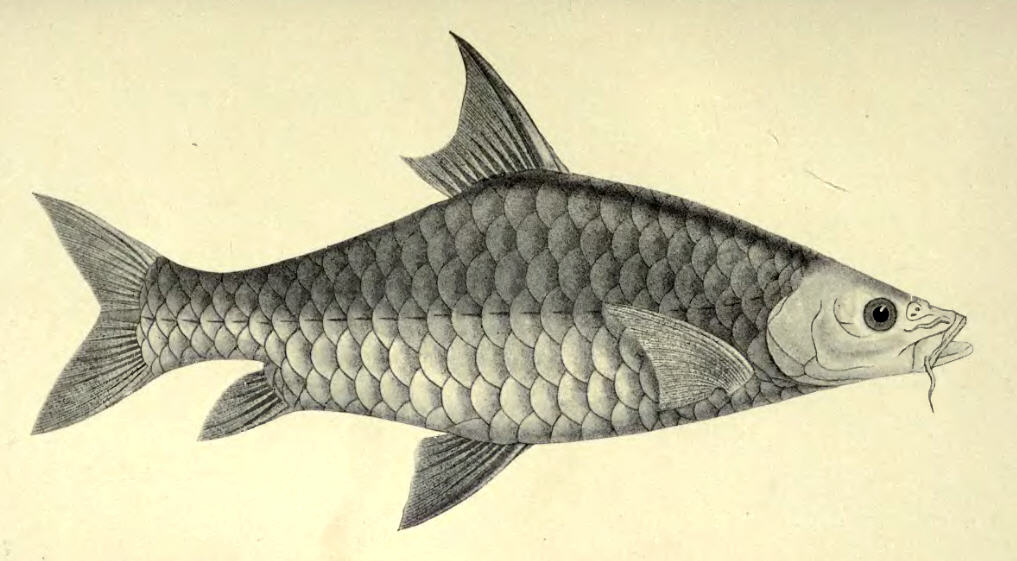
The mahseer is a big barbel of the carp family: a heavy body in scales as large as coins, thick lips, two pairs of barbels. South Asia has many species of mahseer, and all of them are anglers’ favourites: strong, wary, able to bolt into the rocks.
The hump-backed mahseer is the strangest of them. Behind the head of a grown fish rises a tall hump, as if the back had broken upward, and its fins are orange. Its river neighbour, the blue-finned mahseer, is known by bluish fins and a level back.
It is a giant. The biggest mahseer ever taken on the Kaveri weighed more than fifty kilograms, and scientists who went through the old photographs judge that they were hump-backed fish.
The name mahseer is read in different ways — as “tiger fish” or as “big head”. The hump-back has a nickname of its own: “the tiger of the Kaveri”.
Above the entry is a mahseer from the Bhavani, a tributary of the Kaveri, from Henry Sullivan Thomas’s The Rod in India, 1897. Then all mahseer went under one name, and the hump-back was not yet told apart from the blue-fin. Which of the two is drawn here cannot be said — but it is a mahseer of that very river.
IIWhere she holds
drag to turn · ctrl + wheel to zoom · a mark is a water of the atlas — click to open it
The hump-backed mahseer lives in only one river system in the world — the Kaveri basin in south India: in the river itself and in the tributaries that run down from the Western Ghats, in Karnataka, Tamil Nadu and Kerala.
It keeps to where the river is fast and rocky: in deep pools below rapids, by boulders, in the current. In the dry season, when the water falls, the big fish gather in a few deep pools — and there they are easiest to take, by net and by dynamite alike.
Science described the species in 2007 from young fish of the Pambar — the southernmost tributary of the Kaveri, in Kerala. That this small orange-finned fish was the very hump-backed giant of the angling books was proved only in 2018.
Its great river is the Kaveri. Where it was once caught by the hundred, the blue-finned mahseer brought from a hatchery is now taken, and the hump-backs are left in a few tributaries.
IIIHow she is taken
For the visiting angler
This fish has one rule, and it outweighs all the rest: a hump-backed mahseer is always released. It is one of the rarest fishes in India, and every adult counts.
Where it is forbidden. In the Cauvery sanctuary — at Galibore, Bheemeshwari and the other old camps — fishing has been banned since November 2012. Under the wildlife law, angling in a sanctuary counts as hunting.
Where it is allowed. Outside the sanctuaries, stretches of the river and its tributaries are opened by local authorities — the state fisheries department, the forest department or the owner of the stretch. The rules differ; ask on the spot and in advance. Almost everywhere the rule is catch and release.
How it was fished. In the camps mahseer were taken on a ball of ragi paste — finger millet — laid on the bottom in a pool; on a heavy spoon in the run below a rapid; on live bait. The mahseer takes softly and then bolts into the rocks hard enough to snap the line, and the first seconds decide everything.
How to release. The fish is not hauled onto the rocks: it is held in the water, weighed in a wet net, unhooked and released head into the current.
By the trade
There is no fishery for the hump-backed mahseer — and nothing left to catch for sale. But it is not the rod that kills it.
It is dynamited and poisoned in the dry season, when the fish gather in a few pools. Sand is mined from the riverbed. Dams cut the fish off from their spawning grounds. And the blue-finned mahseer, released into the river for decades, has taken its place.
IVSecrets of the craft
The hump and the fins. A hump-back is known at once: a tall hump behind the head and orange fins. The blue-fin has a level back and bluish-grey fins.
The dry season is the time of danger. When the water falls, the fish lie in a few pools, visible from above — and to the poacher. Whatever can be done for the mahseer matters most in those months.
Big means old. In the camp logs fewer and fewer hump-backs were caught, while their average weight rose: the young had stopped coming, only the old giants remained. A big hump-backed fish is a fish that as yet has no replacement.
The blue-fin is not an enemy but a mistake. It was released with the best of intentions, to make more fish. The lesson is that putting a foreign fish into a river is easy, and taking it out again is impossible.
VStories about her
This is the story of a fish everyone knew and no one could name.
From the 1870s the Kaveri mahseer was written about in every book on fishing in India. In 1946 the Mysore taxidermist J. de Wet van Ingen took a mahseer of about fifty-four kilograms on the Kaveri — by the old records, a record never beaten. The van Ingen workshop in Mysore mounted tigers for maharajas and hunters, and a record mahseer was as much a trophy to them as a tiger.
But the hump-backed mahseer had no scientific name. Anglers knew it by sight; scientists confused it with other mahseer. And a species without a name cannot go on the Red List, and the law has nothing to take hold of to protect it.
While the arguments went on, the fish was vanishing. In 2015 scientists read the logs of the Galibore camp: for fifteen years anglers had written down every fish they caught — and in those records you could see the hump-backed mahseer going.
In 2018 scientists compared living hump-backed fish — their looks and their genes — with the young fish from the Pambar described back in 2007. Everything matched. The “tiger of the Kaveri” had a name — Tor remadevii — and in the same year the status of a species on the edge of extinction.
The name came late. But without it the fish could not even begin to be saved.
Pinder et al., 2015, Endangered Species Research — the Galibore camp logs 1998–2012, the fall in hump-backed mahseer catches. · Pinder et al., 2018, PLOS ONE — “Resolving the taxonomic enigma of the iconic game fish, the hump-backed mahseer”. · Kurup and Radhakrishnan, 2007 — description of Tor remadevii from young fish of the Pambar. · IUCN Red List, 2018 — Tor remadevii, “critically endangered”. · The order ending fishing in the Cauvery sanctuary, November 2012. · Tata Power — releases of blue-finned mahseer from 1976 and their end. · J. de Wet van Ingen’s record, 1946. · H. S. Thomas, The Rod in India, 1873, 3rd edition 1897.