IThe portrait
The mandarin fish is the Chinese perch, in Chinese guiyu. A deep body flattened at the sides, a big head and an enormous mouth with a jutting lower jaw. The colour is golden-yellow and brown with dark blotches and marbling, and a dark stripe runs through the eye and from the snout to the dorsal fin. On stones among weed such a fish is nearly invisible.
Its dorsal fin is long, and the front of it is made of hard sharp spines. There are spines on the pelvic and anal fins too, and on the edges of the gill covers. A prick is painful and leaves a swelling for a long time: the spines carry venom.
The mandarin fish grows to seventy centimetres and over eight kilograms. But what matters is not its size but its habit. It eats only living fish and seizes them from ambush in a single rush. It will not touch dead prey, even when hungry.
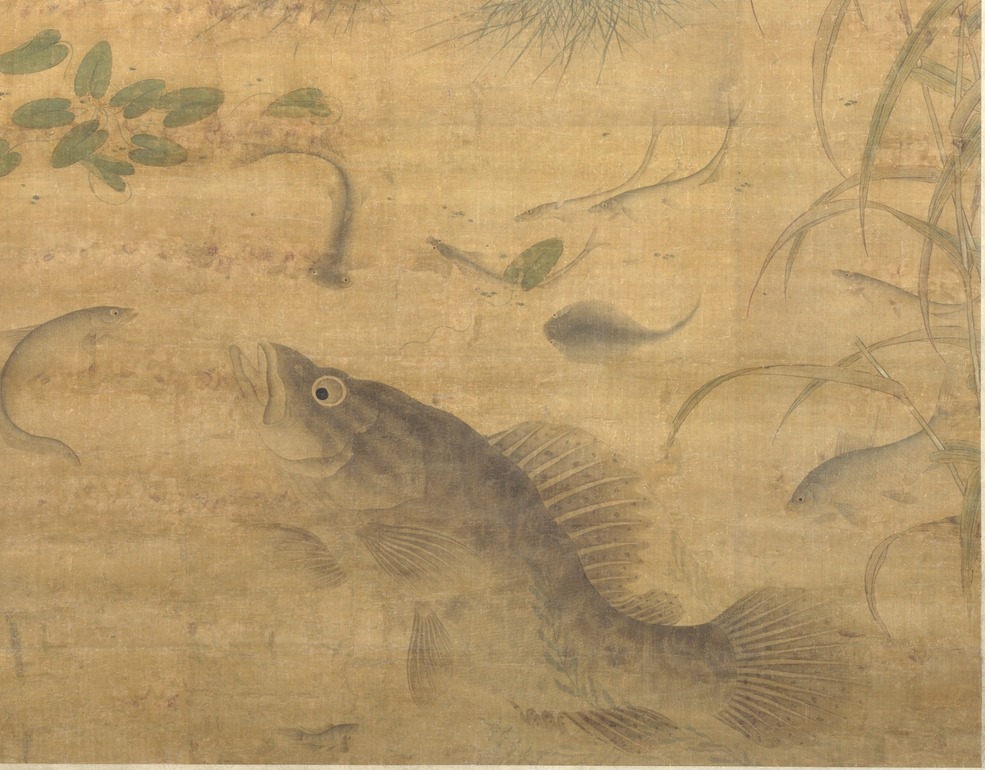
Above the entry is part of a scroll by the Ming painter Liu Jie, mid-sixteenth century. At the bottom is a big mandarin fish with its jaws wide open, around it small fish, reeds and water leaves. The painter signed the scroll: “Painted by Liu Jie of Ancheng, commander of the Embroidered Uniform Guard, Wenhua Hall.” This is how court masters signed.
IIWhere she holds
drag to turn · ctrl + wheel to zoom · a mark is a water of the atlas — click to open it
The mandarin fish lives in the rivers and lakes of East Asia — from the Amur in the north to the Pearl River in the south of China. It is most plentiful in the basin of the Yangtze: in the river itself, its tributaries and its great lakes — Poyang, Dongting, Tai.
It keeps to where it can hide: among stones and snags, in weed beds, by steep banks. By day it lies in cover, and it hunts at dusk and by night. It spawns in summer, in flowing water; its eggs float in the water column and the current carries them downstream.
In Russia the mandarin fish is a fish of the Far East: the Amur, the Ussuri, Lake Khanka. There have always been few of them here, and for a long time it was in Russia’s Red Book. Then its numbers recovered, and it was taken off the Red Book — first Russia’s, then the regional ones.
IIIHow she is taken
For the visiting angler
The mandarin fish is a prize for the spin angler: wary, strong and fussy about the lure. First, the rules.
In China, in the Yangtze basin, a fishing ban runs until the end of 2030. Angling is limited by provincial rules: most often one rod, one line, one hook, no boat and no nets. Details in the entry on the Yangtze.
In Russia it is fished on Lake Khanka, the Amur and the Ussuri under the Far Eastern basin fishing rules. Check them before the trip: spawning closures and lists of protected fish change.
Live bait. The surest way: the mandarin fish takes only the living, and a small fish under a float by the stones is just what it wants.
Soft lure. A swimbait on a jig head, hopped along the bottom by stones and snags. The mandarin fish rushes at whatever moves like a living fish.
Careful with the spines. A caught fish is held by the lower jaw with a lip grip or in a thick glove. Pricks from the dorsal fin hurt and are slow to heal.
By the trade
In China the mandarin fish is one of the most expensive freshwater fish, and almost all of it on the market is farmed. It is raised in ponds and pens all along the Yangtze valley.
It is hard to farm precisely because of its habit: it takes only live food, and next to its ponds there must be ponds of small fish to feed it. Scientists are looking for ways to teach it to take prepared feed — one of the main tasks of Chinese fish farming.
IVSecrets of the craft
Look for stone and shadow. The mandarin fish lies in cover and waits. It is not over clean sand.
Dusk and night. By day it hardly hunts. The best hours are evening, night and early morning.
The bait must live. A dead fish does not interest it. If the lure is artificial, work it so it twitches and falls like an injured minnow.
The jaw first, everything else after. The mandarin fish raises its spines when it is taken in hand. Grabbing it by the back is a sure way to get pricked.
VStories about her
For China the mandarin fish is not just a fish but a line of verse and a sign of good fortune.
In the eighth century the poet Zhang Zhihe, who had left court service and settled by the water, wrote the “Fisherman’s Song”: “Before Xisai Mountain the white egrets fly; in the peach-blossom water the mandarin fish grows fat. A hat of bamboo leaves, a cape of green grass — in slanting wind and fine rain there is no need to hurry home.” In spring, when the peach trees bloom and the petals float on the water, the mandarin fish grows fat — and every schoolchild in China knows it.
Its name has a second meaning. The gui in the fish’s name sounds the same as the word for “noble, precious”. So the mandarin fish was painted as a wish for high rank and wealth — and Liu Jie’s scroll above the entry, where the mandarin fish reigns over all the small fish, can be read both as a picture and as such a wish.
And on the table the most famous mandarin fish is the “squirrel fish” of Suzhou. It is scored so that after frying it opens out like a bushy tail, and it is dressed with sweet-and-sour sauce. They say it “squeaks” when the hot sauce is poured over it.
FishBase — Siniperca chuatsi: size, range, feeding. · Studies of the mandarin fish genome and its live-prey-only feeding (including work on weaning to artificial feed). · Red Book of Russia — removal of the Chinese perch from the list; decisions of the Khabarovsk and Primorye regions. · Zhang Zhihe, “Fisherman’s Song”, eighth century. · Metropolitan Museum of Art — Liu Jie, Flowers, Fish, and Crabs, 47.18.130. · Angling rules in the Yangtze basin during the 2021–2030 ban.