IHistory
Lofoten is a chain of islands above the Arctic Circle, cut off from the mainland by the Vestfjord: a wall of mountains rising out of the water, and beyond it a belt of sea a few dozen kilometres wide.
Every January the fish comes into that belt.
Skrei is the Norwegian name for the grown cod that feeds in the Barents Sea and comes here to spawn. The word is kin to the verb for wandering. The run begins in January and ends in April, and it has not changed in a thousand years.
What people did with this fish matters more than how they caught it. Cod here was not salted — it was dried. Split fish is hung in pairs on wooden racks in the open air, and the polar wind at a little below freezing dries it through before it can spoil.
The result is stockfish: fish that keeps for years, needs neither salt nor ice nor barrel, and weighs a fifth of what it did fresh. Viking crews carried it with them. Norway traded it to Hanseatic Bergen for centuries.
The method has not changed. The racks are the same, the wind is the same, and the fish is hung on them as it was hung in Harald’s day.
IIWhat is there now
The Lofoten fishery is alive, and that is rare: most of the world’s old fisheries are either closed or holding at a quarter of what they were.
The reason is plain and unromantic. Northeast Arctic cod — the very stock that spawns at Lofoten — is managed jointly by Norway and Russia, on a quota agreed in advance. It is one of the few large Atlantic stocks that was not brought down.
Compare the Grand Banks: the same fish was taken out there in fifteen years and the fishery closed for thirty-two. Here it was not taken out.
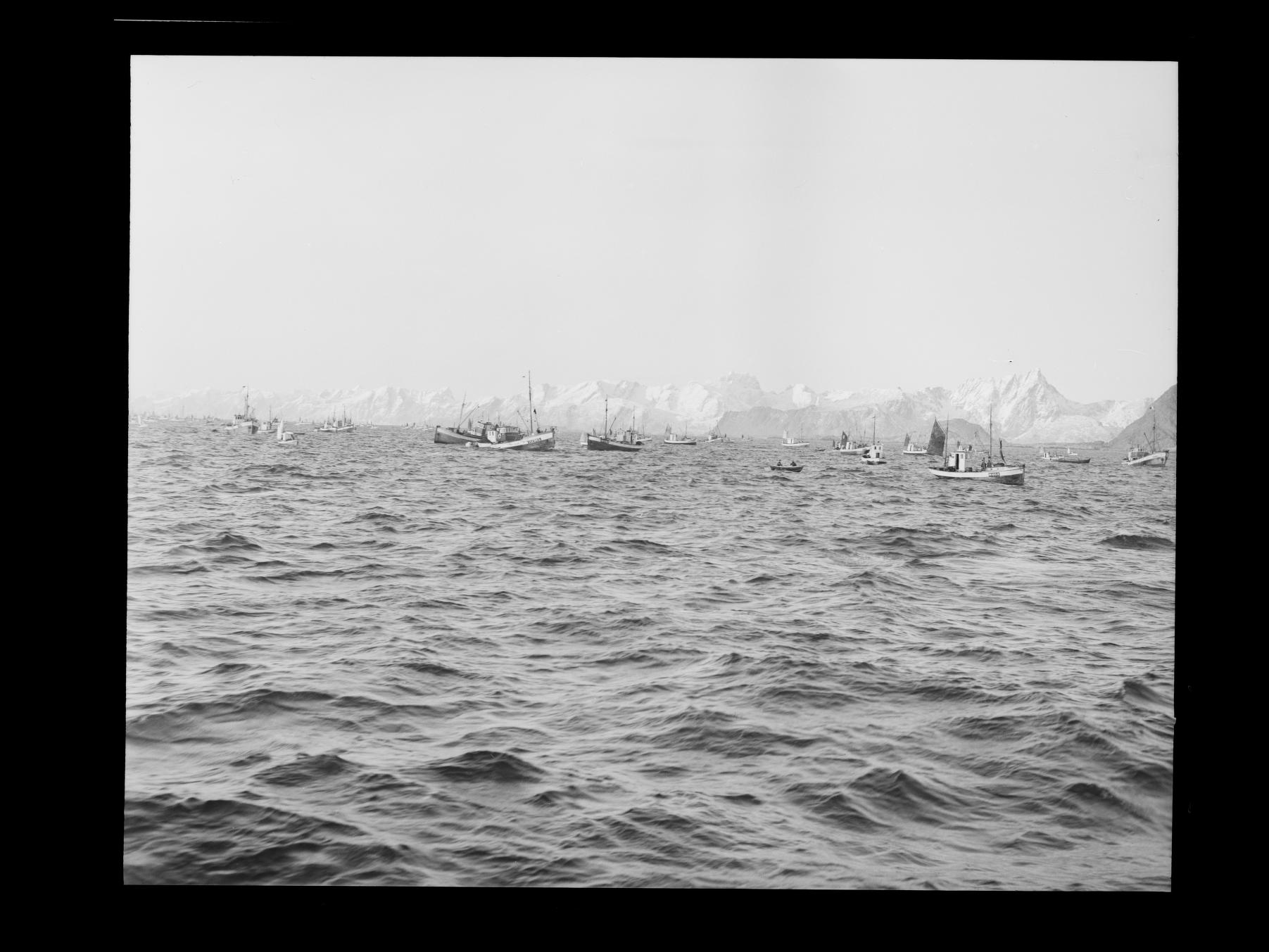
In winter the islands grow crowded. Boats come from all down the coast, the villages fill, and the rorbu — old fishermen’s cabins on stilts — are let to visitors, which is an income of its own.
By spring the racks stand hung to the horizon. A large share of the stockfish goes to Italy, where it is known as baccalà and soaked for a week before cooking.
IIIWhat is taken here
Skrei is the main fish and the reason for everything else. In winter and early spring, while the spawning run is on. At other times there is markedly less of it here.
Haddock. The one with the black lateral line and the dark patch above the pectoral fin they call the thumbprint. It keeps to the same depths and takes just as greedily.
Saithe. Fast and lively, moving in shoals through the water column rather than along the bottom. For an angler it is often better sport than cod — it fights harder.
Halibut, both Greenland and Atlantic. The Atlantic halibut is a rare fish and strictly limited; the Greenland halibut turns up more often.
Beyond these: redfish, wolffish, flounder. The wolffish is frightful to look at and excellent to eat — a case where first impressions mislead entirely.
IVHow it is taken
Recreational fishing
Norway has arranged this about as conveniently as anywhere in the world — and at the same time more strictly than it appears. In order:
No licence is needed for sea fishing. No fee, no permit, no registration. The sea is open to everyone, visitors included. This applies to the sea only: fresh water has different rules.
But the gear must be hand tackle. For a foreigner without residence that means a rod, spinning gear, a handline or a pilker. Nets, pots, traps and longlines are forbidden outright. Not limited — forbidden.
A hundred metres from the pens. Salmon farms stand all along the coast, and fishing closer than a hundred metres to them is not allowed.
And then export — this is what matters most, and the figure is changing. In 2026 you may take 15 kilograms of fish or fillet per person out of Norway, no more than twice a year. From 2027 the allowance drops to 10 kilograms.
The old exemption for one trophy fish on top of the quota has been withdrawn: everything now counts, without exception.
And the rule visitors learn last. To export a single gram you must stay at a registered fishing business — a turistfiskebedrift — which reports your catches daily. Come on your own, rent ordinary lodging, fish for pleasure, and you may take nothing home.
The practical conclusion: if you are coming for fish rather than for views, choose the lodging by that before anything else.
The trade
The trade works by longline, gillnet, Danish seine and snurrevad. In winter hundreds of boats are on the grounds, from ten-metre craft to trawlers.
The Northeast Arctic cod quota is divided between Norway and Russia and then allotted at home between fleet groups. The inshore fleet has a share of its own — deliberate policy, and it is what keeps life in villages that would otherwise empty.
Fiskeridirektoratet (Norwegian Directorate of Fisheries) — sea angling rules and export requirements. · Tolletaten (Norwegian Customs) — fish export quota: 15 kg in 2026, 10 kg from 2027. · Joint Norwegian-Russian Fisheries Commission — Northeast Arctic cod quota. · Skrei run dates from Norwegian fishery records.