IThe portrait
The Arctic char is a fish of the salmon family, kin to trout and Atlantic salmon. The body is long and lean, the scales so fine they seem not to be there at all. The back is dark, olive or bluish, the flanks silver with pale pinkish spots.
At spawning time the char is transformed. The males’ bellies and fins flush scarlet and orange, the leading edges of the lower fins turn bright white, and the jaw hooks. In the cold clear water of a northern river such a fish can be seen from far off.
It grows slowly, lives long and varies greatly: dwarfs and giants live in the same lake. The biggest char ever taken on rod and line weighed thirty-two pounds nine ounces — Jeffery Ward caught it on 31 July 1981 on the Tree River in Nunavut.
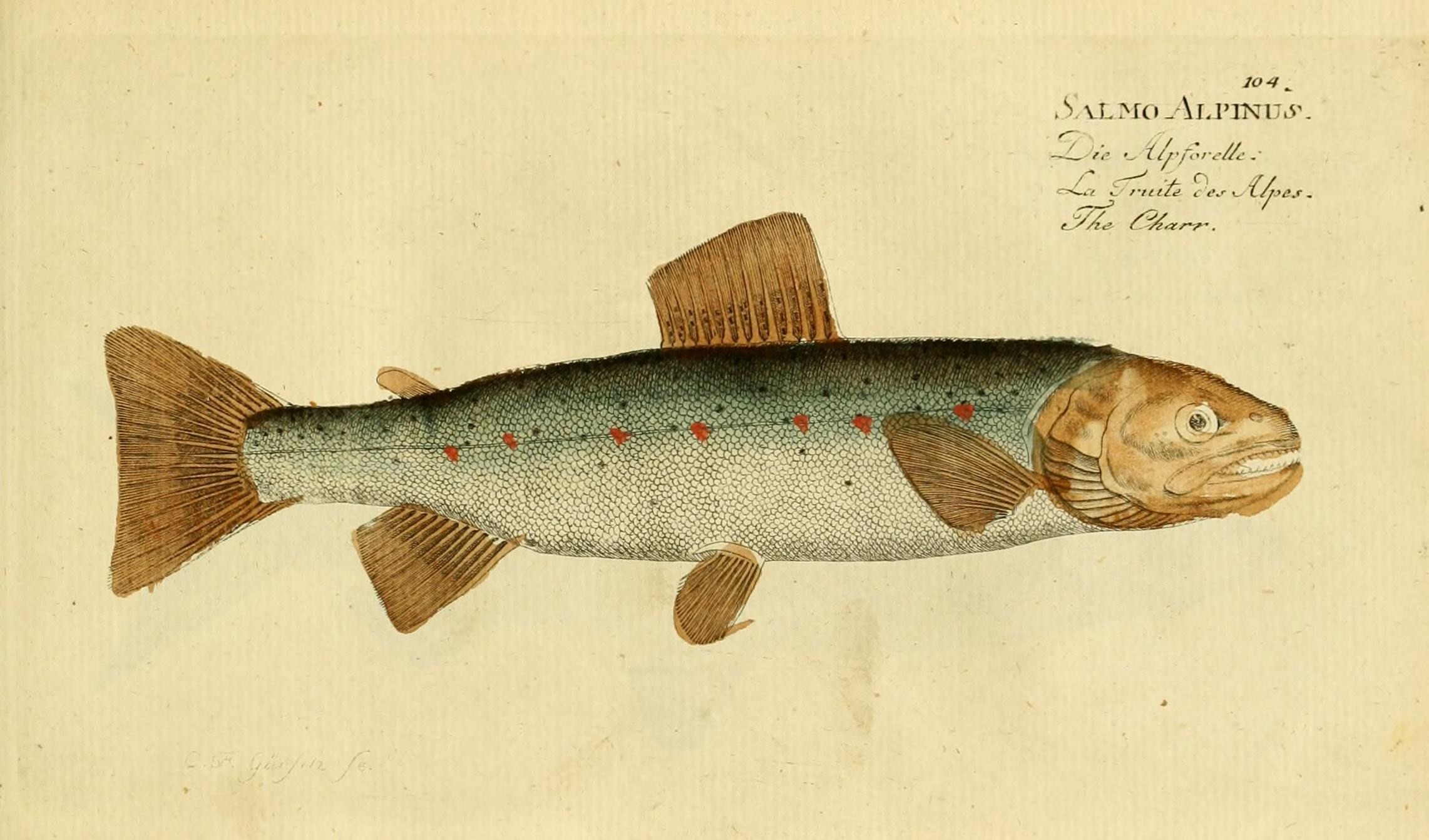
Above the entry is plate 104 from Marcus Elieser Bloch’s natural history of fishes, 1796. It is labelled in three languages: “Die Alpforelle — La Truite des Alpes — The Charr”. Bloch drew a char from the mountain lakes of Europe — the same species that runs to the Arctic Ocean.
IIWhere she holds
drag to turn · ctrl + wheel to zoom · a mark is a water of the atlas — click to open it
The char lives around the North Pole: in the rivers and lakes of Arctic Canada, Alaska, Greenland, Iceland, Svalbard, Norway and the Russian North. Lake Hazen on Ellesmere Island, beyond the eighty-first parallel, is home to the most northerly freshwater fish in the world, and they are char.
There are two char — the sea-run and the resident. The sea-run char, like the one in the Coppermine, goes down to the sea every summer as soon as the ice is out. There, close along the shore, it feeds for four to eight weeks and in that time doubles its weight. By autumn it comes back to the river: to winter in fresh water and, if its year has come, to spawn. It does not spawn every year — it takes too much strength.
The resident char never goes to sea at all. After the Ice Age it stayed behind in cold deep lakes far to the south — in the Alps, in Britain, in Scandinavia — and has lived there for thousands of years, as if in a reserve of lasting cold.
IIIHow she is taken
For the visiting angler
People travel to Nunavut, Greenland and Iceland for sea-run char — for a fish that has come in from the sea strong and silver. First, the papers.
Licence. In Nunavut a sport fishing licence is needed by anyone who is not a beneficiary of the Nunavut Agreement. Carry it with you.
Limits by water. Each river has its own: on the Coppermine above Bloody Falls, one char a day and one in possession; more on other rivers. Get a current Nunavut Sport Fishing Guide before the trip.
Spoon. Silver or red, across the current, at the end of summer, when the char come into the river from the sea. The most productive tackle for sea-run char.
Fly. Char readily take streamers, wet and even dry flies. On shallow fast water the fly is the best way.
Under the ice. In spring, when the sun no longer sets but the ice still holds — through a hole, on a jig. Inuit and visitors fish this way alike.
Release gently. The char grows slowly, and a big fish is many years in cold water. Keep it in the water, hands wet.
By the trade
In Canada the commercial fishery for sea-run char is in Nunavut — at Cambridge Bay on Victoria Island since 1960, under a quota for each river. The fishery is recognised as sustainable.
But most of the char on the world market is not wild but farmed. Char is raised in pens and tanks, and one of the chief producing countries is Iceland.
IVSecrets of the craft
Find the run. Sea-run char come in from the sea not all at once but in waves, with the tide and after rain. No fish today — there will be tomorrow.
Stand by the rapids. Where the river narrows and leaps over stones, the char pause before the dash upstream. It was no accident that the Inuit built their weirs there for thousands of years.
Red works. A spoon or fly with red and orange takes char better than others — especially near spawning.
Shallow water, wary fish. In a clear northern river the char sees you before you see it. Do not stand against the sky, and do not splash.
Spots paler than the flanks. This is how char are told from trout and salmon: theirs are dark spots on light, the char’s are light on dark.
VStories about her
For the Inuit the char is not just a fish. It is fish itself: the word iqaluk means both “char” and “fish” in general. The capital of Nunavut is called Iqaluit — “many fish”.
For thousands of years the Inuit caught char the same way. When in autumn the char run upriver from the sea, a shallow river is barred with an arc of stones — saputit. A narrow passage is left in the weir; a watcher sits on the bank and looks for fins in the passage. Then it is closed with stones, the fish are left in the pen, and everyone wades in with kakivak spears — they have three prongs, and the side prongs bend inward so the fish cannot slip off.
With spears, too, char were being taken at the Coppermine rapids in July 1771, when Samuel Hearne came there. And stone weirs are still built on the rivers of Nunavut.
At the other end of the range, in England, the char has its own story. On Windermere in the eighteenth century char were baked and sealed in pots under a layer of butter — “potted char” went to London as a northern delicacy, and special painted dishes were made for it. One and the same fish — for the Inuit on the tundra and for Londoners at dinner, and both times as the best the water gave.
Fisheries and Oceans Canada — Salvelinus alpinus: sea-run and resident char, Canada’s most northerly freshwater fish, the Cambridge Bay fishery since 1960. · Studies of overwintering and marine feeding of sea-run char (including in the lower Coppermine). · International Game Fish Association (IGFA) — Jeffery Ward’s record, Tree River, 31 July 1981. · Nunavut Sport Fishing Guide — licence and limits. · Travel Nunavut and the Canadian Museum of History — saputit weirs and the kakivak spear. · Samuel Hearne, 1795 — char fishing at the Coppermine rapids. · M. E. Bloch, Ichthyologie, plate 104, 1796.