IThe portrait
The ayu is a small fish, and everything in it is made more finely than it seems.
The body is long and slender, the back olive-brown, the flanks pale with a golden sheen. Behind the gill cover, above the pectoral fin, sits a yellow spot by which an ayu is known at once. Between the dorsal fin and the tail is a small adipose fin, as in salmon and smelt.
But the main thing about the ayu is its mouth. The lips of a grown fish are set with tiny teeth gathered into combs, and with these combs the ayu scrapes a thin film of algae from the stones. The stone is left marked, hami-ato — pale strips, as if from a chisel. An angler who can read them knows where the fish lies without seeing it.
From this food comes the scent. A fresh ayu smells of cucumber, watermelon, melon, and the Japanese also write its name as kōgyo, 香魚, “the fragrant fish”. The scent lasts while the fish is fresh, and is missing in one raised on feed in a pen.
The ayu lives one year. Another old name for it is nengyo, 年魚, “the fish of the year”. Born in autumn, it lives through winter, spring and summer, spawns in autumn and dies. Everything told about it fits into twelve months.
IIWhere she holds
drag to turn · ctrl + wheel to zoom · a mark is a water of the atlas — click to open it
The ayu is a fish of East Asia: Japan from south-western Hokkaido to Kyushu, the Korean peninsula, the coast of China to Hong Kong and northern Vietnam. In the Ryukyu islands lives a separate subspecies, the Ryukyu ayu — rare and protected.
And it runs to the sea, though it is a river fish. It lays its eggs in autumn in the lower river. The hatched larvae drift down to the sea and winter by the coast. In spring the young climb back into the river, spread through the middle course, grow all summer on the stones — and in autumn drop downstream, spawn and die. The circle closes in a year.
In summer the ayu keeps to fast clear water over stony ground: riffles, gravel runs, seams of current. Where the stones are clean and lit, algae grow, and where algae grow, the ayu holds. Murky, warm water is no good to it.
A strong ayu takes its own ground — a few stones — and drives every other fish off it. The weak and the young keep in small shoals with no land of their own. The whole of Japanese ayu fishing rests on that difference.
There is also a lake ayu, shut into Lake Biwa. It is smaller than the river fish, never goes to sea, and its young are used to stock rivers all over Japan.
One of the great ayu rivers is the Nagara, where for thirteen centuries it has been caught with cormorants.
IIIHow she is taken
For the visiting angler
Ayu are taken by a method found nowhere else: tomozuri, “fishing with a friend”. It is not bait in the usual sense but a provocation.
A live ayu, the otori, is put on the line — a small ring through the nostrils, and behind the tail, on a short leader, a treble or a cluster of bare hooks. The otori is let down the current to where fresh marks show on the stones. The owner of the ground sees an intruder on its land and rushes to drive it off — strikes with its flank and hooks itself on the hooks behind the decoy’s tail.
The fish just caught at once replaces the old otori: a fresh, angry fish works better than a tired one. So the decoy is renewed all the time, and a good angler changes it dozens of times a day.
The rod for tomozuri is eight or nine metres long, light and thin, the line fine as a hair. You fish standing in the water, wading in to the waist. The live decoys are bought at otori shops along the river.
There is a simpler way too — fishing with a fly, a kebari. Japanese makers tie flies of their own for ayu, gaudy and tiny, and fish them in slow water where the fish hold in a shoal rather than keeping ground.
The rules. Rivers in Japan are held by fishing cooperatives, and each stretch needs its own ticket, a yūgyoken. The date ayu fishing opens is announced by the cooperative afresh each year, and falls at the start of summer. How this works in practice is in the entry on the Nagara.
By the trade
The ayu fishery is a river fishery and a seasonal one. In autumn, when the fish drop downstream to spawn, the river is barred with yana — weir traps of bamboo through which the water runs away and the fish stay behind. On the Nagara it has been taken with cormorants for thirteen centuries.
Most ayu on the market come from pens. Rivers are stocked with young from hatcheries and from Lake Biwa, and without this stocking many rivers would not have enough ayu of their own.
IVSecrets of the craft
Read the stones, not the water. Fresh marks, hami-ato, are paler than the stone around them and shine: here the ground’s owner is grazing, and the otori is sent straight here. A stone without marks is empty, however good it looks.
The otori must be lively. A tired decoy does not anger the owner — it just hangs there. So every ayu caught goes to work at once in place of the last, and the old one goes into the keep.
In China this character means catfish. 鮎 in Chinese is a catfish, and the ayu itself is called 香魚 there, “the fragrant fish”. The Japanese took the character and gave it to another fish. Hence a confusion that catches everyone who compares Japanese and Chinese books.
It is eaten whole, guts and all. Ayu is grilled with salt, shioyaki, and served with water-pepper vinegar, tade-zu. The innards are not thrown away — their bitterness is prized, and salted ayu guts, uruka, are a delicacy of their own.
The autumn ayu is another fish. Before spawning it darkens and takes on rusty tones, and is called sabi-ayu, “rusty ayu”. The fish dropping downstream is ochi-ayu, “falling ayu”. It is the last month of its life.
VStories about her
The Japanese character for ayu, 鮎, is made of two: on the left “fish”, on the right 占, “divination”. It is explained by an old story from the Nihon Shoki, an eighth-century chronicle.
The Empress Jingū was preparing a campaign across the sea and wished to know how it would end. By the Matsura river she bent a needle into a hook, baited it with a grain of rice, tied on a thread from her own robe in place of a line, and made a wish: if a fish took, the campaign would succeed. A fish took. It was an ayu.
Whether the character really arose that way is another question. The sign 鮎 existed in China long before and meant a catfish there. But the Japanese read it their own way, and the story of the empress who divined with a fish took root better than any etymology.
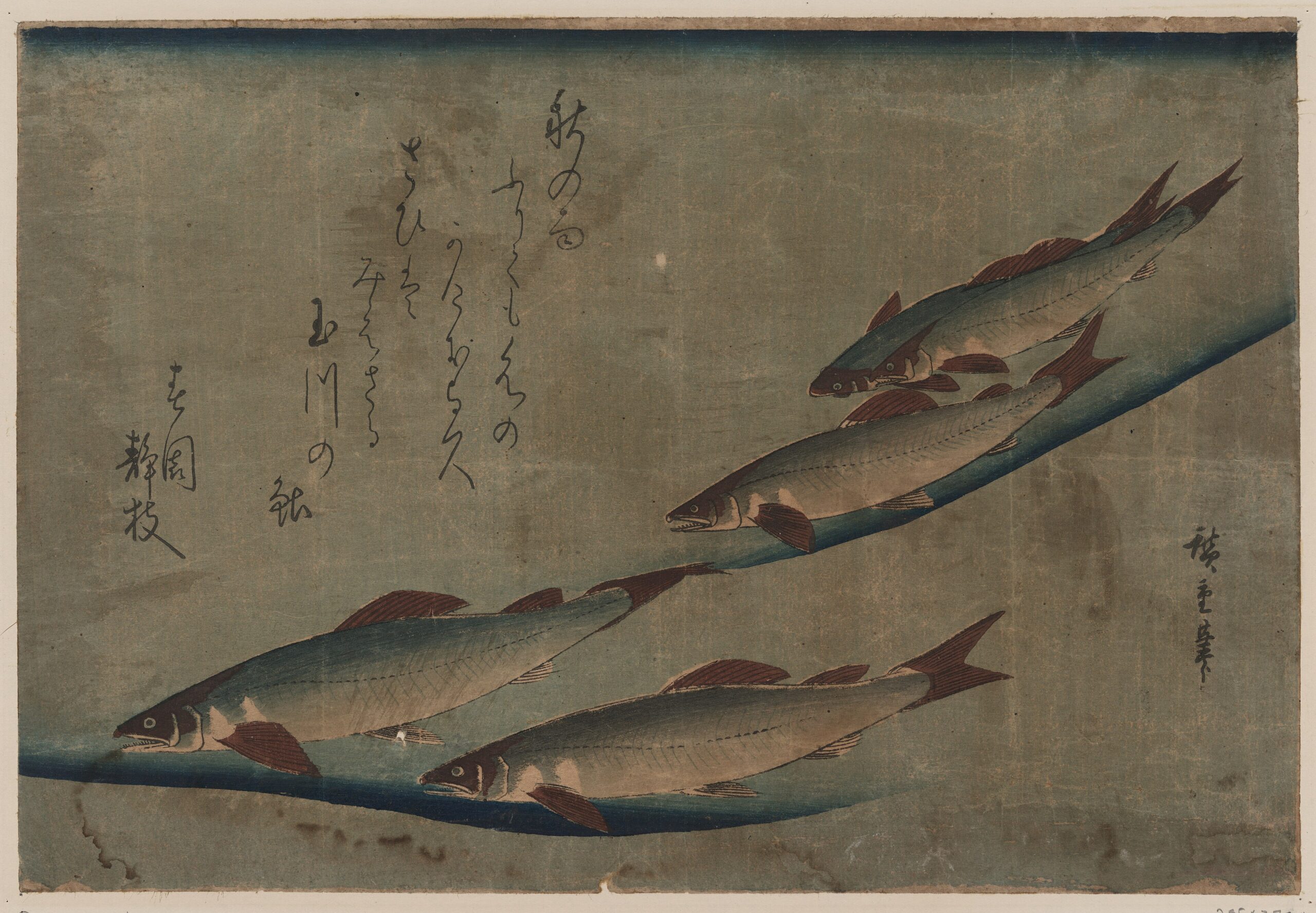
Above this entry is Hiroshige’s print “Ayu”, 1841: four fish climbing the current in a blue stream, and a poem written beside them. The same subject was later taken up by his successor, Hiroshige III. To the Japanese eye this is the fish of summer — as much a sign of the season as the first wild strawberries are for us.
And one more story, in which the ayu is caught without a rod. On the Nagara cormorants have taken it for thirteen centuries, from boats with fire, and Bashō, watching them, wrote: “Delightful, and then — sad”.
FishBase — Plecoglossus altivelis: size, range, life cycle. · Studies of ayu behaviour — territoriality, grazing, hami-ato marks; subspecies P. a. altivelis, P. a. ryukyuensis, P. a. chinensis. · FAO — “Ayu of the Nagara River System”, Globally Important Agricultural Heritage Systems, 2015. · Fishing cooperatives of the Nagara basin — tickets and ayu seasons. · Nihon Shoki (720) — the story of Empress Jingū by the Matsura river. · Andō Hiroshige, Ayu, 1841, Library of Congress.