IHistory
Gibraltar is a throat. Every spring the bluefin tuna goes from the Atlantic into the Mediterranean, where the water is warmer and where it spawns. It has one road — through the strait — and it travels along the coast, in shoals, at one and the same depth.
On that road stands the almadraba. The word is Arabic, from the speech of al-Andalus: “the place where they strike”. But it was invented before the Arabs, before the Romans and before the Greeks — by the Phoenicians, the same who founded Gadir on this coast, the Cádiz of today.
The method needs neither chase nor boats on the open sea. A wall of net is set out from the shore across the fish’s path. The tuna meets it, runs along it looking for a way round, and swims of its own accord into a labyrinth of chambers from which there is no way back. The rest is patience and the exact moment.
The Romans took the method over and built whole towns on it. Near Tarifa, on the shore of Bolonia bay, lie the ruins of Baelo Claudia, a Roman town that lived by salting fish: the stone vats are still to be seen where tuna was salted and garum made — the sauce no Roman table did without.
In 1445 the Castilian crown gave the right to set almadrabas along the whole coast — “from the Guadiana to the kingdom of Granada” — to a single family, the Guzmáns, together with the title of Dukes of Medina Sidonia. The monopoly lasted some four hundred years. The fortune on which that house stood was in great part a tuna fortune, and in 1588 the seventh Duke of Medina Sidonia led the Invincible Armada against England.
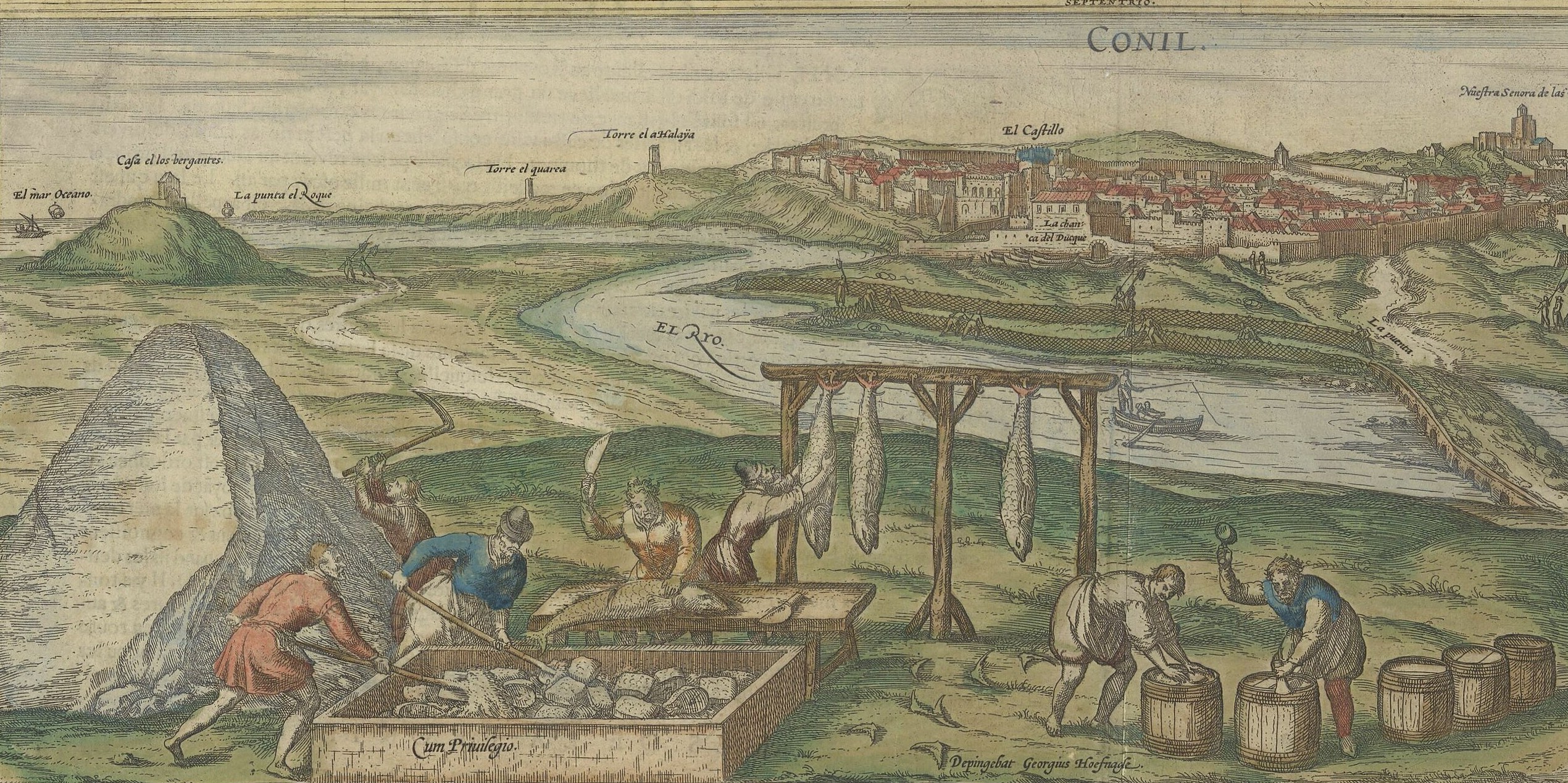
In 1564 the Fleming Joris Hoefnagel passed through and drew Conil — the drawing that heads this entry. In the foreground is neither castle nor church but work: a mountain of salt, cutting tables, tuna carcasses hung from a beam, barrels for salting. The Latin legend speaks for itself: Conil… tynnorum piscatione nobile — “famed for the taking of tunny”.
Half a century later Cervantes called the almadrabas of Zahara the end of the earth of the picaresque world — finibusterrae de la picaresca. Every spring the whole vagrant population of Andalusia streamed there: the fisheries had work for everyone, and it was not the custom to ask anyone where he came from.
IIWhat is there now
The almadraba is alive, and it is one of the few things on earth that still work the way they worked three thousand years ago.
Four remain: Barbate, Zahara de los Atunes, Conil and Tarifa. The second village carries the tuna in its very name — “Zahara of the Tunas”. The nets are set in spring, when the fish begin to pass, and taken up by early summer.
The trap is built like this. A leader net, the rabera, runs out from the shore; a second one braces it from outside. The fish, meeting the wall, runs along it and enters the cuadro — a square of four chambers: cámara, buche, bordonal and the last, the copo, which has a net floor. There is no way back: closing nets shut the entrance behind.
When enough fish have gathered in the copo, one man decides — the arráez, master of the almadraba. At his sign the boats close into a square and the floor of the copo is hauled up from the depths. The water boils with fish. This is the levantá, “the raising”, and fishing has perhaps no stronger spectacle.
Ashore the tuna is cut up in a manner of its own, the ronqueo. A long flexible knife runs along the backbone, and the sound of steel sliding over bone is like a snore — a ronquido. Hence the name. In May Barbate, Zahara and Conil hold the Tuna Route, the Ruta del Atún, and the ronqueo is shown in public.
And the fish came back, though not long ago that was hard to believe. By the turn of the century the eastern tuna stock was heading for collapse: quotas were set three times higher than the scientists advised. In 2006 the International Commission for the Conservation of Atlantic Tunas adopted a recovery plan: the quota was cut from 27,500 tonnes in 2007 to 13,400 in 2014, the minimum size raised, and spotting shoals from aircraft banned.
It worked. In 2021 the bluefin tuna was moved on the Red List from Endangered to Least Concern. For 2026–2028 the quota for the eastern stock was raised to 48,403 tonnes.
The almadraba stands apart in this story. The trap does not chase the fish: it stands still and takes only what swims into it. A seiner can take a shoal entire — the almadraba takes what passed along the shore.
IIIWhat is taken here
The bluefin tuna is the reason for everything, but the angler has it only for a while: to hold, to photograph in the water and to let go. More on that below, under the rules.
The rest of the Cádiz coast is one of the richest places in Spain for someone standing on a rock or going out in a boat.
Urta. The local pride, a red seabream with dark cross-bands; in Rota they cook it in a way that carries the town’s name. It keeps to rocks and is taken on crab and prawn.
Lubina, sea bass. Takes in the surf and at the mouths of bays, especially in broken water. The main fish for spinning from the shore.
Dorada and sargo. Inshore seabreams, wary and hard-mouthed. The dorada comes closer in towards summer.
Corvina. A meagre that grows to sizes hard to imagine for a fish of that name. A night fish of sandy beaches and river mouths.
From a boat, in open water, bonito and the small tunas that follow the bluefin, known here by names of their own: bonito, melva.
IVHow it is taken
Recreational fishing
Spain has arranged sea angling so that there is little paperwork, but none of it can be skipped. In order:
The licence is free but compulsory. Andalusia issues it, in four classes: from the shore, from a boat, collective for a boat, and for spearfishing. It is done online.
Since 20 March 2026 the catch must be declared in the PescaREC app. It is the fisheries ministry’s app, free, and it does not replace the licence but comes on top of it. At sea you need both at once.
Tuna is a separate matter. Before going after it you must file a pre-notice through the same PescaREC, and you may fish only catch-and-release, holding a specific authorisation requested in the same place. Recreational fishing’s share of the whole Spanish quota is some forty-one tonnes — for the entire country, and it is taken not for the table but for the record.
How tuna is fished for release. A boat with an experienced skipper, heavy tackle, trolling or live bait. The point here is not to catch but to release: the fish is not brought aboard, it is freed in the water, and the fight is kept short — a long fight kills a tuna as surely as a knife.
And above all, the wind. The strait lives by it. The easterly levante blows here for days on end, which is why Tarifa became the capital of kitesurfing. For the angler it means one thing: you plan by the wind forecast, not by the calendar.
The trade
The four almadrabas work to a quota carved out of Spain’s total. The season is short — the spring run — and the order of work is what it always was: the arráez, the boats, the nets, the levantá.
The state’s quota allocation for 2026–2028 makes specific provision for coastal communities — Algeciras, Barbate, Conil. For these places tuna is not an industry but a way of life.
International Commission for the Conservation of Atlantic Tunas (ICCAT) — the 2006 recovery plan for the eastern stock, quotas for 2007–2014 and for 2026–2028. · IUCN Red List — reassessment of the Atlantic bluefin tuna, 2021. · Government of Spain — allocation of the bluefin quota for 2026–2028. · Junta de Andalucía — the recreational sea-fishing licence. · Spanish Ministry of Agriculture, Fisheries and Food — the PescaREC app, compulsory catch declaration from 20 March 2026, rules for recreational tuna fishing. · The structure of the almadraba, the levantá and the ronqueo — from accounts of the fishery at Barbate and Conil. · The Medina Sidonia monopoly from 1445 — from the history of the fishery in the province of Cádiz. · Joris Hoefnagel, view of Conil, 1564, in Braun and Hogenberg’s Civitates Orbis Terrarum. · Miguel de Cervantes, La ilustre fregona, 1613.