IThe portrait
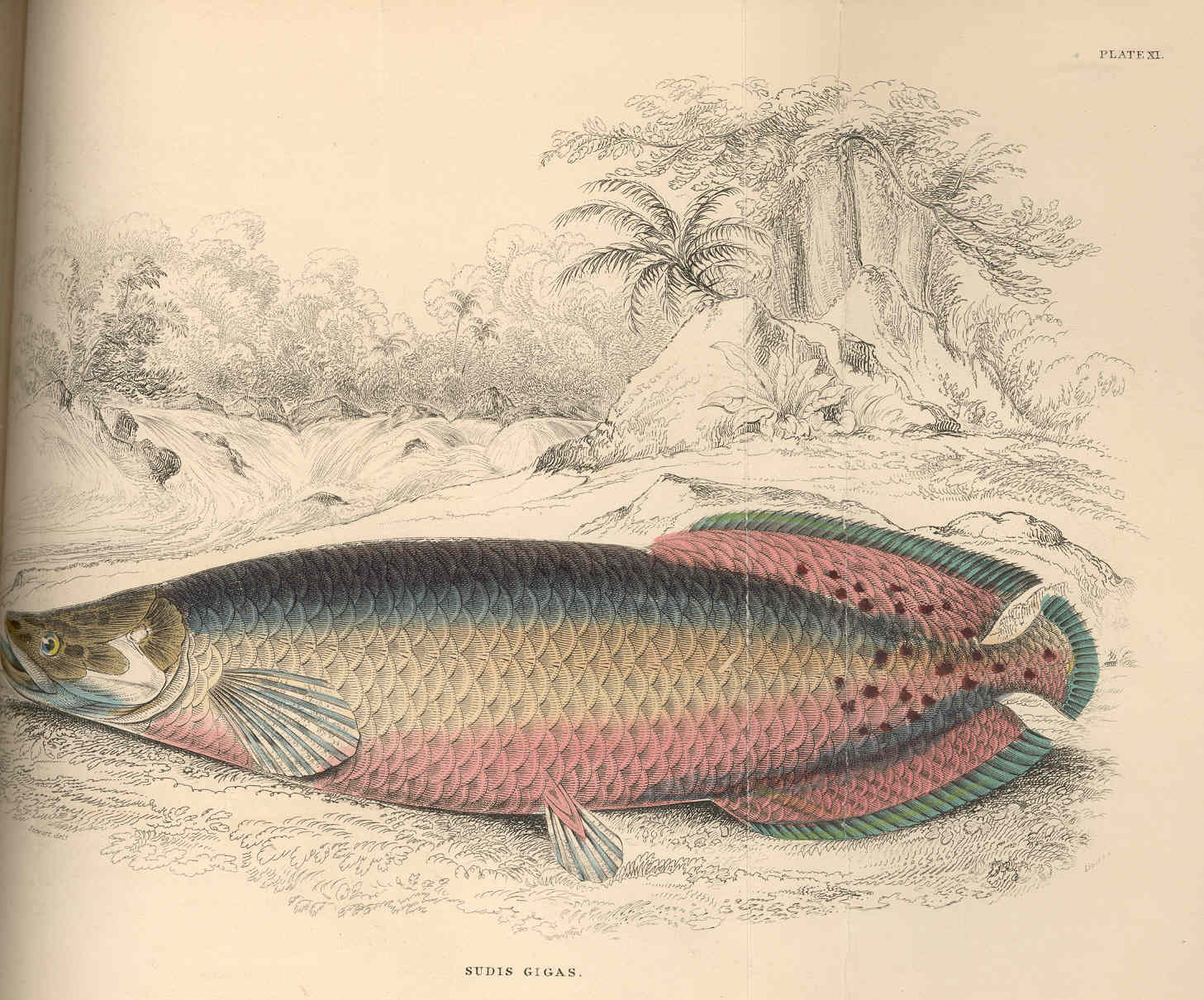
The arapaima looks like a log with eyes. The body is long, almost cylindrical, the head flat and bony, with a wide mouth. The dorsal and anal fins are set far back by the tail and, with the tail, make a sort of paddle — with which it drives itself off in a lunge.
The scales are large, and towards the tail each scale is edged in red. Hence its Brazilian name: pirarucu, from the Tupi words pira, “fish”, and urucu, the red dye from annatto seeds — “red fish”. The flesh can be red too.
Its scales are armour. A hard outer layer and a flexible inner one make them among the toughest in nature: piranha teeth do not bite through them. In the Amazon dried scales are used as nail files.
And its tongue is bone. Its whole family is named for it — the bony-tongues. The dried tongue of the arapaima, rough as a rasp, served in the Amazon as a grater: hard sticks of guaraná are ground on it to powder.
It usually grows to about two metres, sometimes three, and weighs up to two hundred kilograms. Above this entry it lies in Schomburgk’s engraving under an old name, Sudis gigas — plate XI, with rapids behind.
IIWhere she holds
drag to turn · ctrl + wheel to zoom · a mark is a water of the atlas — click to open it
The arapaima is a fish of the Amazon basin: Brazil, Peru, Colombia. It lives too in the rivers of Guyana and in the Araguaia–Tocantins basin. People carried it into Bolivia, where it became a catch for fishermen and an unknown threat to the native fish.
Its home is várzea, forest that stands in water for half the year. In the flood the arapaima goes out into the flooded forest, feeds there and spawns. In the dry season, when the water falls, it gathers in the lakes left between the channels — and there it can be counted.
The main thing about it: it breathes air. The arapaima’s swim bladder is built like a lung. Its gills hardly keep it alive on water alone, and every ten to twenty minutes the fish rises to the surface, gulps air with a sound and goes down. Keep it from rising and it drowns.
That is what made it so vulnerable: wherever it lies, it gives itself away with a breath. And that is what saved it — at Mamirauá the fishermen learned to count it by its breaths.
In recent years scientists have argued whether it is one species or several alike. The name Arapaima gigas holds in common use, but the genus may contain more species than was thought.
IIIHow she is taken
For the visiting angler
Rules first. In sport fishing the arapaima is released. An angler may not keep it: it belongs to the communities that count and protect it.
Where. In special programmes — in reserves and with communities, where catch-and-release is allowed and paid for. One such programme, for fly fishing, runs at Mamirauá, and its money goes to guarding the lakes.
When. From 1 December to 31 May arapaima may not be fished at all in the state of Amazonas. The best time is the dry season, September to November, when the fish have gathered in the lakes.
How. A fly rod with a heavy line and a big fly, or spinning with a big lure. The tackle is the heaviest freshwater tackle there is: the fish outweighs a man and, once hooked, leaves the water in a leap to its full length.
Where to look. By the breaths. The arapaima gives itself away by rising: a ring on the water, a sound, a dark back. The cast goes where it has just breathed — it has ten to twenty minutes before the next time.
And release it. The fish is held in the water and allowed to come up for a breath: dragged out and held, it suffocates like any air-breathing animal.
By the trade
Arapaima used to be harpooned from a canoe as it breathed and taken in nets, salted and dried like cod — “Amazon cod” was carried downriver. By the 1990s there was almost none left, and in 1996 fishing was banned throughout the state of Amazonas except in community waters where the fish are counted.
Now the fishery runs on a quota — up to thirty per cent of the adult fish counted — and the meat goes to market, the skin to boots. Arapaima is also farmed in ponds: in Brazil and Peru it is a growing industry.
IVSecrets of the craft
Count by the breaths. An experienced fisherman, after twenty minutes by a lake, will say how many adult fish are in it and how many young — by the sound and the rings. The whole rescue of the arapaima is built on that skill.
The father carries the children by his head. Arapaima build a nest in the shallows as the water begins to rise. When the fry hatch, the parents keep them by their heads: a special fluid is released from the head, and the fry stay in that cloud. Most often it is the male that leads the brood: the father’s dark head above a swarm of fry.
The tongue is a tool. The dried bony tongue of the arapaima still serves in the Amazon as a guaraná grater. It is the most unexpected thing a fish can give.
“Red” is not the colour of the body. The arapaima is grey-green. What is red is the edging of the scales towards the tail, and the flesh. The name was given for those.
Without air it dies. For a catch-and-release angler this is the essential knowledge: to hold an arapaima under water and not let it breathe is to drown it with your own hands.
VStories about her
The pirarucu has a legend of its own, and in it the fish is a man.
Among the Uaiá people lived a warrior named Pirarucu, son of the chief Pindarô, a kind and wise man. The son did not inherit his father’s kindness. He was strong and boastful, despised people and railed at the gods. One day, as Pirarucu was fishing on the river with the others, Tupã, the mightiest of the gods, ran out of patience. He sent storm, rain and lightning on the river, and the people on the bank saw Pirarucu, still alive, turned into a huge dark fish and carried down into the depths. From there he never came back.
So in the Amazon they explain why the river’s greatest fish rises to the surface: the warrior cannot stay under water — and every twenty minutes he comes up to gulp the air of the world he was driven out of.
That last part is no longer the legend but a naturalist’s reading of it. The legend speaks only of pride and punishment. But the coincidence is too fine to leave unsaid.
And a second story, a true one. The same fish that was nearly wiped out thirty years ago is counted today in the lakes of Mamirauá in the tens of thousands. It was saved not by a ban but by a count — and by the very people who fish it.
WWF Brazil, Smithsonian Institution — size, air breathing, properties of the scales. · L. Castello, “A Method to Count Pirarucu Arapaima gigas”, 2004; studies of arapaima air-breathing and counting by rises. · Studies of parental care — head secretions and the fry. · Government of Amazonas state — the closed season, 1 December to 31 May. · IBAMA — the 1996 ban and the management scheme from 1999. · Mongabay, 2023 — arapaima in Bolivia. · The Tupi origin of the name “pirarucu”. · The Brazilian legend of Pirarucu. · R. H. Schomburgk, The Natural History of the Fishes of Guiana, plate XI.