IThe portrait
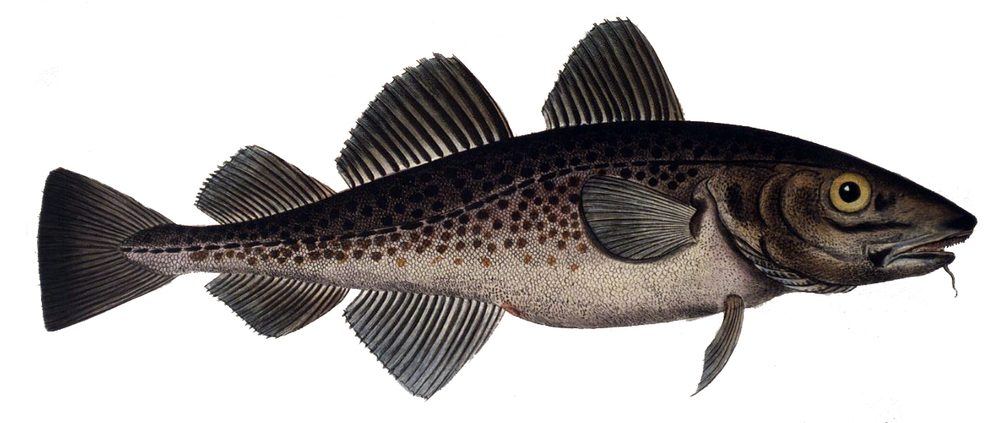
Cod is known by three marks, and the first of them is the barbel.
Beneath the lower jaw hangs a single whisker, short and thick, like a scrap of thread. With it she feels the bottom. No similar fish of the North Atlantic carries one: pollack has none at all, haddock barely a trace.
The second mark is the lateral line. On cod it is pale, almost white, and curves noticeably above the pectoral fin. On haddock, with which she is most often confused, the line is black, and above the pectoral fin sits a dark patch the fishermen call the thumbprint.
The third is the fins. There are three dorsals, and they stand apart without merging into a crest. There are two anals. The tail is cut almost square, as though trimmed with a knife.
The colouring is inconstant and depends on where the fish is holding. Over sand she is sandy; over kelp, rust-red and mottled; in deep water, grey-olive. The same fish taken off different ground looks like two different fish, and she should never be told by colour.
IIWhere she holds
drag to turn · ctrl + wheel to zoom · a mark is a water of the atlas — click to open it
Cod keeps to both shores of the North Atlantic: from the Bay of Biscay to Greenland, from North Carolina to Labrador, and throughout the Barents Sea.
She occupies depths from the waterline down to six hundred metres, but she is to be looked for by cold rather than by depth. This fish lives between one and a half degrees below zero and nineteen above, yet spawns only in cold water — from zero to six degrees, at fifty to two hundred metres. Above eight, spawning is already disrupted. Which is why the edge of her range has been creeping north these past years: warm water drives her off more surely than any gear.
She holds near the bottom and favours broken ground — drop-offs, rocky ridges, holes and the edges of banks. Over flat sand there is markedly less of her.
In winter and early spring she comes inshore and onto the banks to spawn, and that is when she is taken. The Lofoten skrei, the grown cod of the Barents Sea, runs to the Norwegian coast every January; the movement has not changed in a thousand years, and the life of those islands is still counted by it.
IIIHow she is taken
For the visiting angler
Cod is an uncomplicated fish and takes greedily, which is what makes her good for a newcomer. What matters here is not the tackle but the depth and the ground: find a drop-off or a rocky ridge and you have found the fish.
Vertical jigging. A heavy pilker of one hundred to three hundred grams is dropped to the bottom, lifted a metre or so and let fall. Cod takes on the drop. The method is nothing but the old handline, with the lead now made in a factory.
Bottom rig with bait. She takes capelin, herring, a piece of squid, sand eel. Nor does she scorn a strip cut from the flank of a cod already caught — she is omnivorous to the point of indiscriminate.
Handline. Line, lead, two or three hooks, an open boat. So it was done for four hundred years, and so it is still done in the recreational season. Tackle that time did not spoil.
By the trade
By longline — a groundline carrying hundreds of baited hooks, set and hauled over hours. By gillnet — a wall of mesh a fish enters and cannot back out of. By bottom trawl — a bag dragged over the ground that takes not only the fish but the ground she lives on.
Each method leaves its own mark on the catch, and a buyer in Bergen could once tell them apart by eye.
IVSecrets of the craft
She swallows whatever comes. Cod stomachs have yielded crabs, molluscs, young of her own kind, stones and plain rubbish. For the angler this means bait hardly needs choosing; for science it means the state of the whole seabed can be read from stomach contents.
One raised from depth can scarcely be released. The swim bladder expands on the way up and the fish can no longer go back down. Catch-and-release therefore does not work on cod: take what you will eat and put the gear away. This is not sentiment but plain arithmetic.
Her age is read from little stones. In a cod’s head lie the otoliths — ear bones that grow in layers like the rings on a cut tree. The years are counted from them. That is how it is known she can live twenty-five years — and how it is equally known that old cod is now all but absent from the catch: it has been taken out.
A large female is worth ten small ones. She sheds several million eggs, and hardier ones at that. Yet the fishery spent centuries selecting precisely the large fish — and undercut the stock more thoroughly than was reckoned.
Her present standing is reported differently, and this is worth knowing. The IUCN Red List carries cod as vulnerable, but that assessment dates from 1996 and the organisation itself notes it is due for revision. A European assessment of 2013 already places her among species of least concern. In other words there is no single answer: in some seas the stock has recovered, in others it holds at a quarter of what it was.
VStories about her
Split down the belly, salted and hung in the wind, cod keeps for years. That single fact paid for half the voyages sent out to find the rest of the world: a ship could sail for months on a cargo needing neither ice nor barrels. The stockfish taken down from the Lofoten racks in spring is the same article the Viking crews carried with them. The method has not changed; only the volumes have.
A fish that was enough for everyone was bound to seem inexhaustible. In 1883, opening the International Fisheries Exhibition in London, Thomas Henry Huxley — a biologist of the first rank, a man all Europe listened to — said from the platform:
I believe, then, that the cod fishery, the herring fishery, the pilchard fishery, the mackerel fishery, and probably all the great sea fisheries, are inexhaustible; that is to say, that nothing we do seriously affects the number of the fish.
Thomas Henry Huxley, Inaugural Address, International Fisheries Exhibition. London, 18 June 1883
One hundred and nine years later, on 2 July 1992, Canada closed the cod fishery on the Grand Banks. By that day the spawning biomass of northern cod had fallen by ninety-nine per cent, and thirty thousand people lost their work in a single morning.
So Huxley’s sentence now stands not as one scientist’s error but as a measure of how confidently it is possible to be wrong.
NOAA Fisheries and FishBase — maximum size, age, depths and temperature limits. · IUCN Red List — species status and the caveat on the age of the assessment. · T. H. Huxley, Inaugural Address, International Fisheries Exhibition, London, 1883 — public domain. · Fisheries and Oceans Canada — figures for the 1992 moratorium. · Mark Kurlansky, “Cod: A Biography of the Fish That Changed the World”, 1997 — for the history of the trade; cited, not reproduced.