IThe portrait
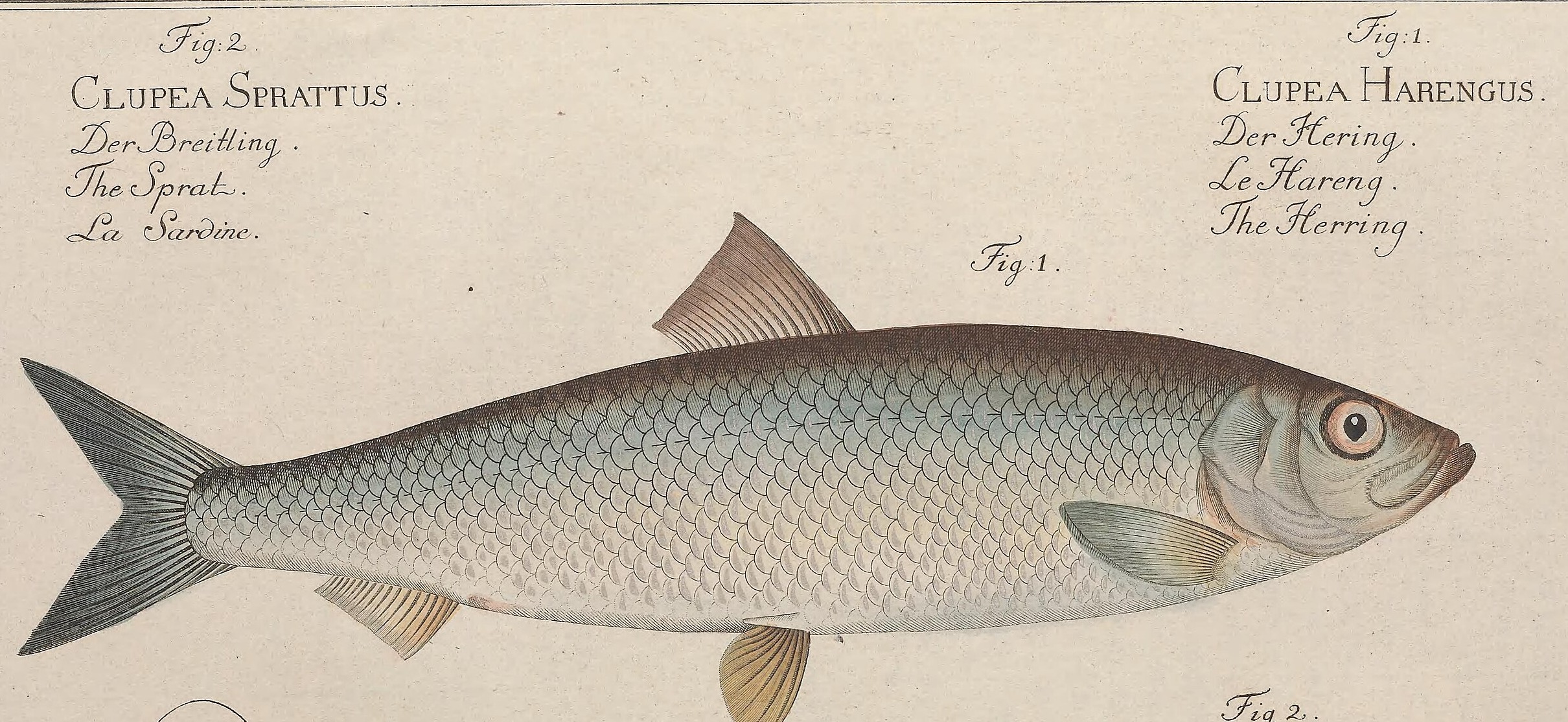
The herring is a small, slender fish flattened from the sides. The back is blue-green, the flanks and belly bright silver, the scales large and easily shed. There is a single fin in the middle of the back, the tail is deeply forked, and the lower jaw juts a little. A grown herring is rarely longer than thirty centimetres; the largest reach about forty-five.
One herring does not tell you what the fish is. A herring is always a shoal. Shoals can number billions of fish and stretch for kilometres. By day they keep to the depths; at night they rise to the surface after plankton — tiny crustaceans that the herring feeds on, straining the water through its gills.
And the shoal has a voice. In 2003 scientists noticed that herring let out bubbles of gas from the swim bladder, which sound like a short run of ticks. Other herring hear it — and it seems this is how a shoal keeps together in the dark. The scientists called the sound FRT, “fast repetitive ticks”, and in 2004 won an Ig Nobel Prize for the discovery.
Above the entry is plate 29 from Marcus Elieser Bloch’s natural history of fishes, 1785. The herring is labelled in three languages: “Der Hering — Le Hareng — The Herring”. Beside it on the same plate is the sprat.
IIWhere she holds
drag to turn · ctrl + wheel to zoom · a mark is a water of the atlas — click to open it
The Atlantic herring lives on both sides of the North Atlantic: from the Bay of Biscay and Britain to Norway, Iceland and the Barents Sea — and from Maine and Nova Scotia to Newfoundland and Greenland. It enters the Baltic too — and there, in the brackish water, it grows smaller and becomes the Baltic herring.
The herring is not one great shoal but many separate stocks, and each has its own order of life. Some spawn in spring, others in autumn, some off Norway, others off Scotland or in the Baltic. Herring lay their eggs on the bottom — on stones, gravel, weed — and the eggs stick fast.
In the Middle Ages one of the richest stocks came every autumn to the coast of Scania, in the south of present-day Sweden — and there the Scania herring market sprang up. The largest stock today is the Norwegian spring-spawning herring: it spawns along the Norwegian coast, including off Lofoten, and roams the whole Norwegian Sea.
IIIHow she is taken
For the visiting angler
Herring is not a trophy fish but one for pleasure and the table: when the shoal comes inshore, everyone fishes. First, the rules.
Where it is free. In Sweden hand-held fishing along the sea coast is free. In Norway sea fishing with a rod is free for residents and tourists, but there are limits on taking the catch out of the country. In Finland rod fishing comes under “everyman’s right”. Each country has its own sizes and seasons; check them before going out.
The feather string. The main herring tackle: a line with five to eight hooks, each with a feather or a shiny sleeve, a weight at the bottom. It is lowered from a pier or a boat and jigged — the herring snatch at the “flies”, and one drop can bring up several fish.
When. When the herring comes inshore — in spring along the Öresund and the Norwegian coast, in different places in different weeks. Local anglers know when “the herring is in” better than any guidebook.
Eat it fresh. Herring spoils fast. Keep the catch cold and salt it or fry it the same day — as they taught at the Scania market.
By the trade
Herring is one of the most-caught fish in the world. Today it is taken with purse seines and pelagic trawls — huge nets in the water column — and formerly with drift nets set overnight.
This fishery knows what happens when a fish is taken to the last. At the end of the 1960s the Norwegian stock collapsed, and for almost fifteen years it was barely fished. In 1977 the same trouble closed the North Sea herring fishery — for several years. Both stocks came back. Herring became one of the chief examples of a ban in time saving a fish.
The Dutch catch of the first summer herring — the “Hollandse Nieuwe” — is still met with a festival, and the first barrel is sold at auction.
IVSecrets of the craft
Look for birds and whales. Gulls circle and gannets dive over a herring shoal, and off Norway killer whales and humpbacks come for the herring. Where the birds are, the fish are.
Twilight. By day the shoal is deep; towards evening it rises. The best time from a pier is morning and evening.
Evenly, no snatching. Herring are lightly hooked and come off easily. Bring them in evenly, without snatching.
Loose scales mean a fresh fish. On a fresh herring the scales come off at a touch and the eye is clear and bulging. That is how they chose them at the fairs.
VStories about her
In Northern Europe they say the herring built cities. And it is hardly an exaggeration.
Catholic Europe fasted more than a hundred days a year, and on those days meat was forbidden but fish was allowed. Salt herring in a barrel kept for months and travelled anywhere. First the Hanse traded it from the Scania market; then, when the herring left the Baltic for the North Sea, the Dutch. Of Amsterdam it was said that it was built on herring bones.
The Dutch are also credited with what made their herring the best: gutting the fish on board, straight after the catch, with a special cut, and salting it in the barrel at once. The inventor is often named as a fourteenth-century fisherman, Willem Beukelszoon — though very likely it was done before him.
And in the north of Sweden Baltic herring is made into surströmming — herring left to ferment in barrel and tin for months. The tin is opened outdoors, traditionally at the end of summer: the smell is such that some airlines forbid it on board.
Herring was the fish everyone ate: kings and the poor, in fasts and at feasts. Perhaps that is why fewer tales are told of it than of salmon or sturgeon. Its story is not a legend but a ledger: barrels, tolls, wars and towns.
FishBase — Clupea harengus: size, range, spawning. · Wilson, Batty, Dill, 2003, Biology Letters — “Pacific and Atlantic herring produce burst pulse sounds”; the 2004 Ig Nobel Prize. · ICES and reviews of stock collapse and recovery: Norwegian spring-spawning herring (late 1960s), the North Sea closure from 1977. · Swedish Agency for Marine and Water Management — free hand-held fishing. · History of the Scania market and the Dutch herring trade. · M. E. Bloch, Ichtyologie, plate XXIX, 1785.