IThe portrait
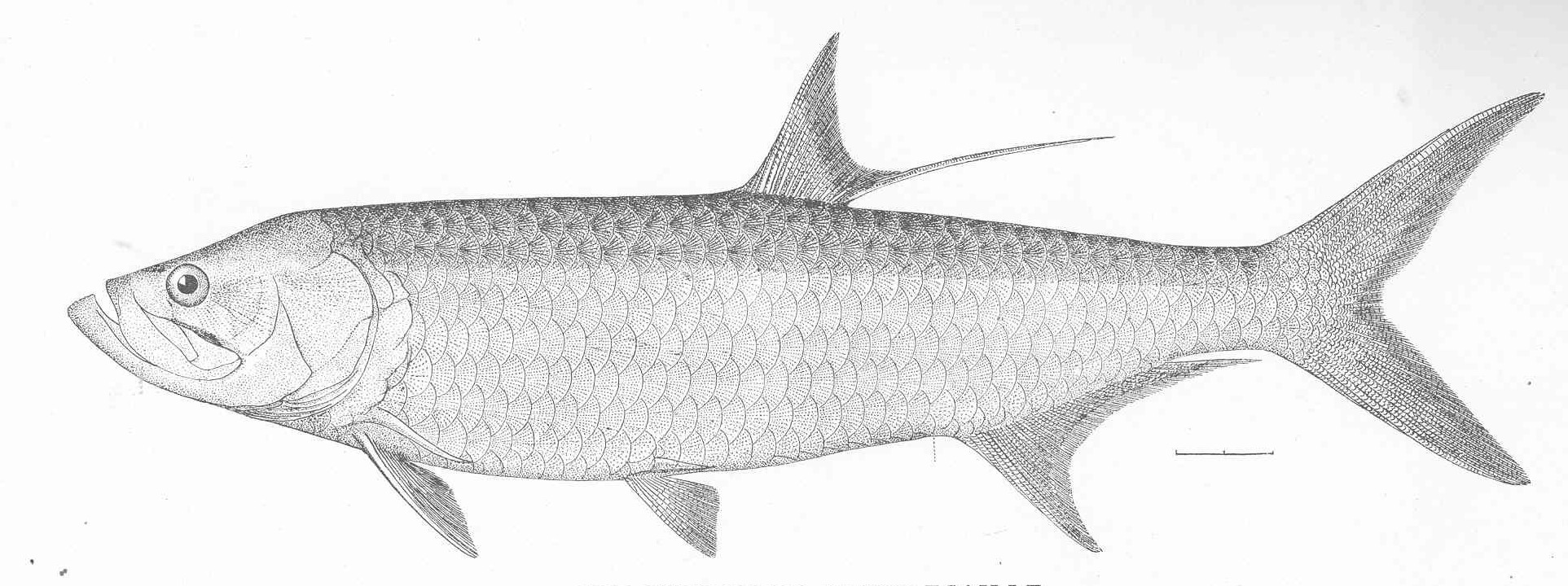
The tarpon cannot be mistaken for anything else. A long body flattened from the sides and clad in silver; a blunt head, a huge upturned mouth and a lower jaw that juts forward like a scoop. The eye is large — hence the scientific name, Megalops, “big-eyed”. There is a single short dorsal fin, and its last ray trails back in a long thread. The tail is deeply forked and powerful, like a tuna’s.
The scales are what people remember. They are large, thick and shine like polished metal; on a big fish a single scale can measure several centimetres — larger than the largest coin. French-speaking Louisiana called the tarpon grande écaille — “great scale”; the Spanish, sábalo; the English, the silver king.
It grows to two and a half metres and a hundred and sixty kilograms. The big ones are nearly always females: males are rarely heavier than a hundred pounds. The tarpon lives long, more than half a century, and matures late — so a stock, once beaten down, takes years to come back.
And it breathes air. The tarpon’s swim bladder is joined by a duct to the gullet and lined inside like a spongy lung. The fish rises to the surface, “rolls” — shows its back, gulps air and goes down. That is why the tarpon lives where other fish have nothing to breathe: in still mangrove creeks, in warm swampy pools that the sea reaches only on the big tides. The young grow up there.
Above the entry is a drawing by H. L. Todd from George Brown Goode’s American survey The Fisheries and Fishery Industries of the United States, 1884. The fish is labelled with its old name, Megalops thrissoides, and was drawn from a specimen caught in 1874 in New Jersey, far north of its usual waters. Every scale on it is laid in with dot and line.
IIWhere she holds
drag to turn · ctrl + wheel to zoom · a mark is a water of the atlas — click to open it
The tarpon is a fish of the warm Atlantic, on both its sides. In the west it lives from Virginia to Brazil: around Florida, throughout the Gulf of Mexico, in the Caribbean, off Venezuela and the Guianas; in summer single fish stray far to the north. In the east it lives off West Africa, from Senegal to Angola.
It is a fish of shores and mouths. The tarpon travels along the coast and goes into bays, lagoons, brackish and even fresh rivers and lakes; it has been caught in Lake Nicaragua and far up rivers. Adults wander: in spring a great run moves along Florida, in summer the fish go north, and towards winter they come back south.
The tarpon spawns offshore, far from land. What hatches from the egg is not a fry but a transparent ribbon — a leptocephalus larva, like an eel’s: tarpon and eel are distant kin. For about a month the ribbon drifts toward shore, then shrinks, turns into a small fish and goes into the mangroves, into those same stifling creeks where air comes to the rescue.
And the Pacific. More than eighty years ago the tarpon passed through the Panama Canal — through the locks and the freshwater Gatun Lake — and came out into the Pacific. Now it is caught off the Pacific coasts of Panama and Costa Rica, and in 2024 it was recorded off Peru.
Florida is the chief place of its fame: the Florida Keys with their bridges and flats, Boca Grande Pass on the west coast, where hundreds of fish gather every summer, and the Caloosahatchee River, at whose mouth the first tarpon was taken on rod and reel.
IIIHow she is taken
For the visiting angler
The tarpon is a rod fish, and it is fished for the fight, not for supper. First, the rules.
In Florida the tarpon is release only. A fish over forty inches must not be taken out of the water — not to weigh it, not for a photograph. One tarpon a year may be kept, and only with a special tag bought before going out — and only when pursuing a state or world record. Boca Grande Pass has its own state gear rules. Other countries have their own laws, and those are checked on the spot.
With live bait and crab. The surest way: a live mullet, a pinfish or a small crab on a circle hook. At night by the bridges the bait is drifted on the tide along the edge of the light; by day, in the passes and river mouths where the fish are moving.
Fly fishing on the flats. The hardest and most famous way. The guide poles the boat, the angler spots the tarpon by eye and lays the fly in its path, a metre or two ahead of the head. The fly rod is a heavy one, a 12-weight, with a big reel and a strong drag: the fish takes a hundred metres in one run.
Hooking it is hard. The tarpon’s mouth is bony, as if tiled, and a hook finds almost nothing to grip. The strike is hard and repeated. Out of ten takes only a few fish reach the boat — and that is counted as normal.
Bowing to the king. A hooked tarpon leaps out of the water, sometimes higher than a man, and shakes its head in the air. If the line is tight at that moment, the fish hangs its whole weight on it and tears the hook out or breaks the line. So when it jumps the rod is lowered toward the fish and slack is given. This is called “bowing to the king”.
And release it alive. A fight with a big tarpon lasts long, and a fish worn out after release can be easy prey for sharks. So it is fought quickly, on strong tackle, and released in the water, held head into the current until it swims off on its own.
By the trade
In the United States tarpon is not caught for sale: its flesh is bony and strong-smelling, and Americans never valued it. In Florida it is a rod-only fish.
But in West Africa and in Central and South America tarpon is eaten — flesh and roe, fresh, salted and smoked — and caught with nets and hooks. There it is a commercial fish, and that is part of why the IUCN assessed the species as vulnerable in 2019: it is being fished out in some places while it is carefully released in others.
IVSecrets of the craft
Watch where it breathes. The tarpon gives itself away: it rolls at the surface for air, showing its back and dorsal fin. Where they roll, there is the school.
The line between light and shadow. At night under a bridge the tarpon lies in the shadow and watches the lit water. A bait carried by the tide along that line works better than any other.
The fly goes in its path, not on its head. A fly landing on a tarpon’s nose frightens it. It is laid ahead, where the fish will be in a couple of seconds, and stripped so that it moves away from the tarpon like fleeing prey.
Don’t pull while it is in the air. Lower the rod — and raise it when the fish is back in the water. Easy to say, very hard to do the first time.
A shark nearby — finish it. If a shark follows a tarpon you are fighting, it is better to break the line close to the fish than to bring it to the boat half-dead.
VStories about her
Until 1885 the tarpon was thought to be a fish that could not be taken on rod and reel: too strong, too much of a leaper, with a mouth of bone. It was harpooned and netted, and sporting anglers watched the leaps from shore.
In March 1885 a New York angler, William H. Wood, went out at Punta Rassa, at the mouth of the Caloosahatchee River in south-west Florida, with a bamboo rod, an ordinary reel and a live mullet — and landed a tarpon. Accounts of its weight differ: ninety-three pounds or a hundred and seventeen. No matter: it was the first tarpon on rod and reel that the whole country heard of.
A tarpon fever began. Wealthy anglers from the North came to south-west Florida — for months, with guides and boats; hotels were built for them, and an empty coast became a resort. On Useppa Island the Izaak Walton Club was founded at the start of the twentieth century, and it had a custom of its own: a scale was taken from each tarpon caught, and on it were written the angler’s name, the date and the weight. Such scales, dry and silver, still lie in museums and old family albums. And on the west coast there is a town called Tarpon Springs, named, as local tradition has it, for the tarpon that leapt in its bayou.
Forty-odd years later Hemingway went out at night after tarpon in Key West harbour and boasted in a letter of a sixty-three-pounder.
The largest tarpon on rod and reel, though, was not caught in America. On 20 March 2003, off the island of Rubane in Guinea-Bissau, Max Domecq landed a fish of 286 pounds 9 ounces, ninety inches long. The record still stands — and anglers are sure that even bigger tarpon swim off Africa.
FishBase and species accounts of Megalops atlanticus — size to 2.5 m and 161 kg, lifespan, range on both sides of the Atlantic. · IUCN — Vulnerable, 2019 assessment. · Bonefish & Tarpon Trust — life cycle: offshore spawning, the leptocephalus larva, young in the mangroves. · Studies of air breathing in tarpon (the swim bladder as a lung, the duct to the gullet). · International Game Fish Association (IGFA) — Max Domecq’s world record, 20 March 2003, Rubane, Guinea-Bissau. · Florida Fish and Wildlife Conservation Commission (FWC) — release only, the forty-inch rule, the tarpon tag, Boca Grande Pass rules. · Museum of Florida History, “Lure of Florida Fishing” — W. H. Wood, 1885, the Izaak Walton Club on Useppa. · John F. Kennedy Presidential Library (Hemingway collection) — Key West tarpon, 1928. · G. B. Goode, The Fisheries and Fishery Industries of the United States, 1884, drawing by H. L. Todd.