IThe portrait
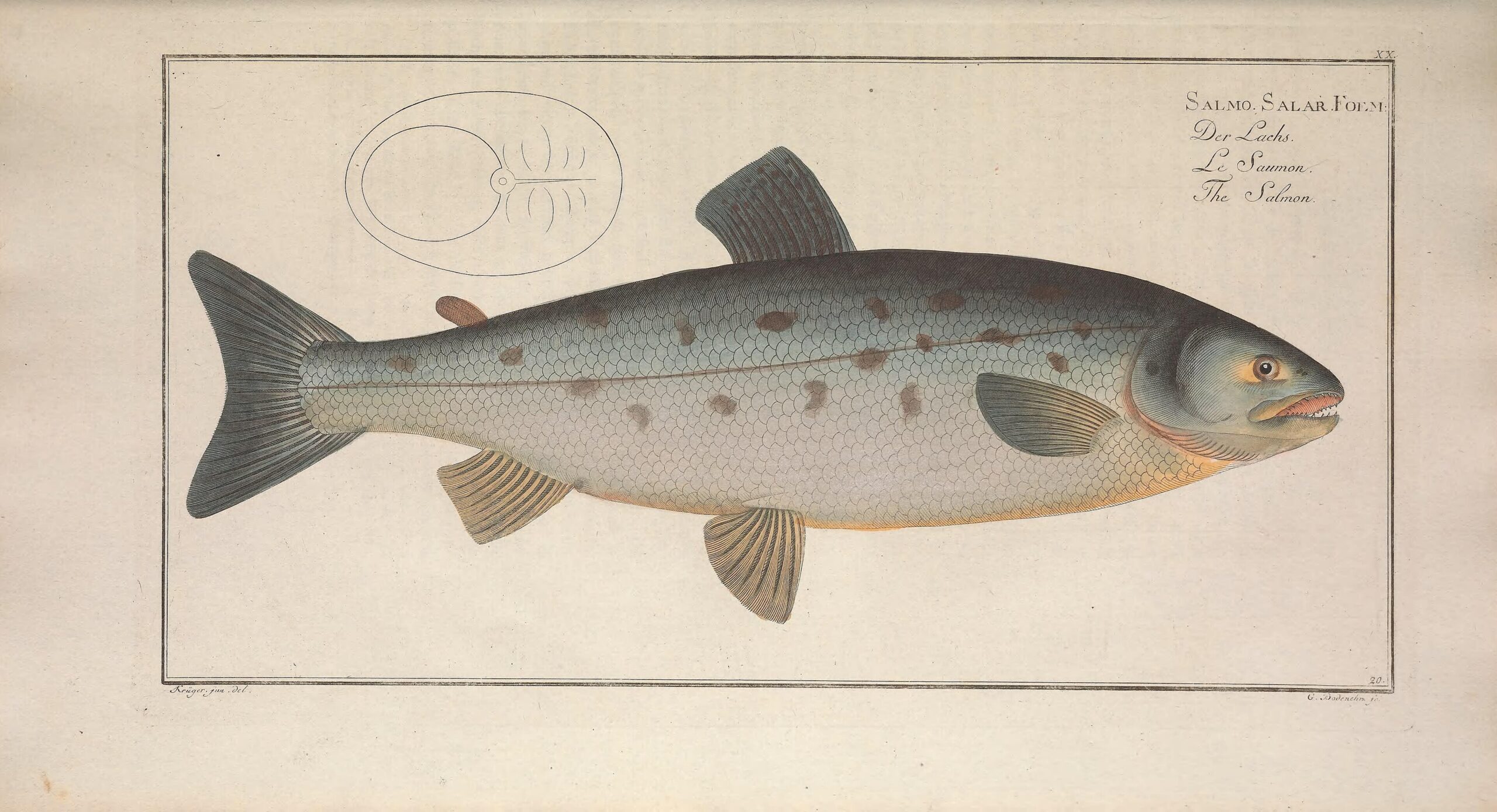
The Atlantic salmon is a silver fish, strong, with a small head. The back is dark, steel-blue, the flanks pale, and scattered over them are dark spots like little crosses — more above the lateral line than below. Between the dorsal fin and the tail, as in all salmon, sits a small adipose fin.
It is the fish you see in Bloch’s engraving above this entry: Salmo salar, “Der Lachs, Le Saumon, The Salmon”. That is how it comes out of the sea — clean, bright, silver.
In the river it changes. The longer a salmon lies in fresh water, the darker it grows: the silver goes, bronze and red come through. In males the lower jaw curls into a hook before spawning. The spent, dark, wasted fish was called in the North a lokh — and the word, by one account, went on to wander the whole country without the fish, as a word for a fool.
One mark tells a salmon from the sea trout, with which it is easily confused: the salmon’s tail stalk is slender, and a salmon can be held by it as by a handle. A sea trout would slip out of such a grip.
IIWhere she holds
drag to turn · ctrl + wheel to zoom · a mark is a water of the atlas — click to open it
The salmon is a fish of the North Atlantic. In Europe, the rivers from Portugal to the Pechora, the British Isles, Iceland, Scandinavia, the Baltic. In America, from New England to Labrador. It feeds at sea, off the Faroes and the coasts of Greenland.
And it comes home. The fish grown at sea finds the mouth of its own river — the very one where it hatched — and climbs it to spawn. It knows the way by the smell of the water. Unlike the Pacific salmon, the Atlantic salmon does not necessarily die after spawning: some fish drop back to sea and return again.
The young live in the river two to five years, longer in the North, then go to sea. There the salmon spends one to four winters — and on that number depends how it returns: after one winter, small; after three or four, huge.
In Russia these are the rivers of the Kola peninsula, Karelia and the Arkhangelsk North — the Ponoi, Varzuga, Umba, Kem, Onega, Northern Dvina, Mezen, Pechora. Its oldest home with us is the White Sea.
The Pomors told salmon apart by the time of the run and gave them different names. The zakroika runs from early June. The tinda is the summer fish, small, mostly males that have spent one winter at sea. The autumn salmon comes in late, winters in the river and spawns only the next autumn. And the lokh is the one that has already spawned.
IIIHow she is taken
For the visiting angler
Salmon is fished not where you like but where it is allowed. Rules first.
Only on licensed stretches and only by permit. Lures must be artificial: rod, spinning or fly. Many stretches are catch-and-release, the fish returned to the river alive. In Murmansk region a permit for the state fishery agency’s stretches costs from 280 roubles for locals to 1,800 for foreigners. Details of the rules are in the entry on the White Sea.
Fly fishing is the main method. A double-handed rod, a floating line, a salmon fly. The fly is cast across and slightly downstream and the current is allowed to swing it in an arc to your own bank. The salmon takes on the swing — often at the very end, as the fly turns.
Spinning. Where it is allowed — a wobbling spoon or a plug. For catch-and-release the treble is swapped for a single hook and the barb is flattened: the fish is less hurt and quicker to release.
Release it properly. Do not drag it onto the bank or lay it on stones. Hold it in the water, with wet hands, one under the belly and one round the tail stalk, head into the current — until it swims off by itself.
The best time is early summer, when the zakroika runs, and midsummer with the tinda. Each stretch has its own exact dates.
By the trade
Salmon used to be taken at the sea stations and in the rivers, which were barred with weirs. Today the wild salmon fishery in Russia is small and kept under strict account.
The salmon sold in shops is almost all raised in sea pens — in Norway and elsewhere. It is the same species but a different life: and scientists have long feared that fish escaping from the pens, and the parasites of the pens, harm the wild stocks.
IVSecrets of the craft
In the river the salmon does not eat. A fish come in from the sea lives on reserves built up in the ocean and takes no food the whole time it is in the river. Why it still grabs a fly — habit, irritation, a memory of the sea — nobody knows. The whole of salmon fishing rests on that riddle.
Hold it by the tail — but not a sea trout. The salmon’s slender tail stalk holds the hand like a handle. If the fish slips out, it is most likely a sea trout.
Its colour tells how long it has been out of the sea. Silver, with sea lice still on the skin — just in. Dark, bronze — it has lain in the river a long time. A fresh fish is livelier and takes more readily.
“Lokh” was a fish first. In Dahl’s dictionary a lokh is a salmon gone slack after spawning: dark, thin, sluggish. One view holds that contempt for such a fish passed on to people. Linguists disagree: the slang “lokh” may equally have come from the secret cant of the ofeni, the wandering pedlars.
Pink salmon is not salmon. The incomer from the Far East runs up the same rivers, and beginners confuse them. The pink has small scales, spots on the tail and, in males before spawning, a hump on the back.
VStories about her
The oldest story about the salmon is Irish, and it is about wisdom.
In the river Boyne lived a salmon that had eaten the nuts of the nine hazels growing over the Well of Wisdom. Whoever first tasted its flesh would know everything. For seven years the poet Finnegas fished for that salmon; he caught it and told his young pupil, Fionn mac Cumhaill, to cook it but not to taste it. Fionn cooked it, burned his thumb on the fish’s skin and put it in his mouth. From then on, to learn what he did not know, Fionn had only to bite his thumb.
The second story is about a record, and it is true. In 1928 the Norwegian Henrik Henriksen, a guide on the river Tana, which forms the border of Norway and Finland, landed a salmon of 35.89 kilograms. Almost a century has passed, millions fish for salmon — and the record stands.
And the third is ours. In the North the salmon was called the royal fish, and its names — zakroika, tinda, autumn, lokh — are a whole calendar by which the Pomors lived on the shore of the White Sea. From that calendar one word may well have gone out into the language of the whole country — but few now remember that it first meant a fish.
Murmansk branch of Glavrybvod — licensed stretches, permit prices, rules of recreational Atlantic salmon fishing. · V. I. Dahl, Explanatory Dictionary of the Living Great Russian Language — “lokh”, “tinda”. · Pomor names for salmon by run — from ichthyological and local-history accounts of the Kola and White Sea North. · International Game Fish Association and Guinness World Records — Henrik Henriksen’s record, river Tana, 1928. · The Fenian Cycle — the myth of the salmon of knowledge. · Marcus Elieser Bloch, Ichthyologie, plate XX, 1785.