IThe portrait
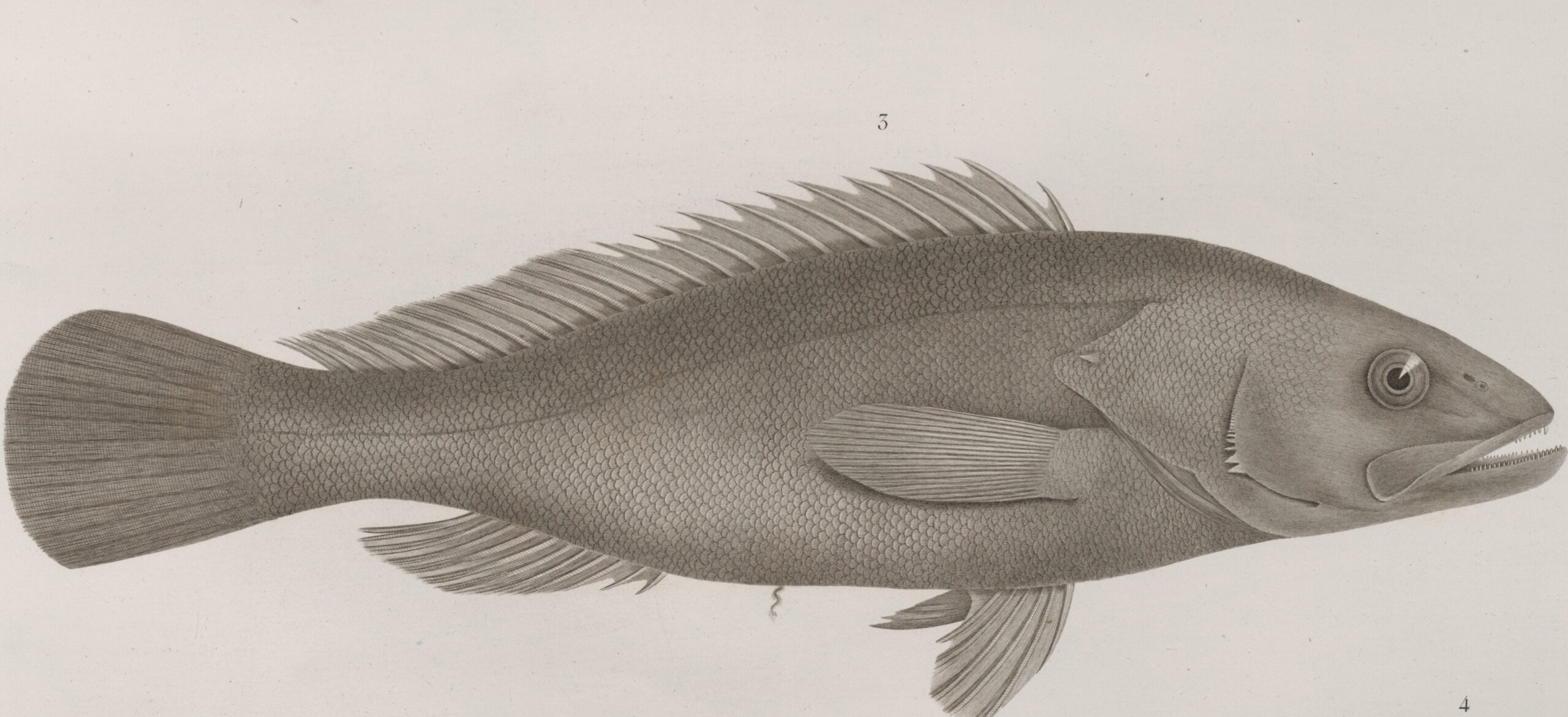
Thiof is its name in Senegal, in the Wolof language; scientifically it is the white grouper, a big bottom fish of the sea-bass family. The body is heavy, the head large, the mouth wide, with small sharp teeth. Its colour is grey-brown, bronze — hence the scientific name aeneus, “of bronze”. Young fish have two or three pale slanting stripes along the sides of the head.
It grows slowly, to over a metre long and up to twenty-five kilograms. And, like many groupers, it changes sex: it is born female, and when it becomes large and old it turns male. So all the males are the biggest fish. When the big ones are fished out, the sea is left with almost only females, and there is no one for them to spawn with.
Above the entry is a plate from the Description de l’Égypte, the great work of the scholars who went to Egypt with Napoleon. The fish was drawn from Egyptian specimens and described by Étienne Geoffroy Saint-Hilaire, who named it “Serran airain”, the bronze sea bass. The plate was printed in 1809. It was from this plate that the species entered science.
IIWhere she holds
drag to turn · ctrl + wheel to zoom · a mark is a water of the atlas — click to open it
The thiof lives along the eastern shores of the Atlantic — from the Mediterranean, where it keeps to the south and east, along all of West Africa to southern Angola.
Adult fish keep to depths of twenty to two hundred metres — by rocks, on stones, on muddy and sandy bottoms. The young grow up closer to shore, in river mouths and lagoons, where it is warm and shallow and food is plentiful.
Its best-known home is the coast of Senegal, and the great harbour here is Saint-Louis with its fishermen’s quarter, Guet Ndar. From here the pirogues go out to the rocky banks where the thiof lies by the bottom.
IIIHow she is taken
For the visiting angler
People go after thiof with Senegal’s boat operators — from Saint-Louis, Dakar and the coastal resorts. First the main thing.
Release it. The thiof is overfished, and every big fish is a future male, without whom spawning cannot happen. A big thiof is photographed and returned to the water.
How it is caught. With a vertical jig right by the bottom, over the rocks: the lure works up and down and the thiof strikes from below. With live bait — a small fish on a hook lowered to the stones. On heavy tackle: a hooked fish heads straight for a crevice, and if it is not stopped in the first seconds the line will chafe through on the rock.
From the deep. A fish brought up from great depth is hard to release: its swim bladder swells. So anglers who mean to release fish where it is shallower and bring the fish up slowly.
By the trade
In Senegal thiof is caught by pirogues and by trawlers. Pirogue fishermen take it on a handline — no rod, a heavy weight and several hooks — the way their grandfathers did. Trawlers take it with bottom trawls.
Scientists have counted the result: the catch is almost all young fish, and only hundredths of a per cent live to the size at which the species could be fished without harm to itself — about ninety-six centimetres. Thiof has become expensive, and more and more often other fish goes into the ceebu jën.
IVSecrets of the craft
Look for rock. The thiof lives by rocks and stony ridges on the bottom. There is no use looking for it over flat sand.
The first seconds. A hooked thiof heads straight down into a crevice. If you do not hold it at once, you will not get it out.
Stripes on the cheeks. A young thiof is known by pale slanting stripes on the head. With age they fade.
Big means male. In the thiof the males are the oldest and largest fish. A big thiof released is next year’s spawning.
VStories about her
The thiof’s great story is a kitchen story.
Ceebu jën, in Wolof “rice and fish”: rice cooked in a thick fish broth with tomato, with vegetables, and on top a piece of fish stuffed with herbs, pepper and garlic. It is not just a dish but Senegal itself on a plate: it is eaten at midday, by the whole family, from one big platter, by hand or with a spoon. In 2021 UNESCO inscribed ceebu jën on the list of the intangible heritage of humanity.
The best fish for it was always thought to be thiof. The story goes that the dish itself was invented in Saint-Louis by a cook from Guet Ndar named Penda Mbaye: she cooked the rice in a fish broth with tomato — and so the dish was born. There are almost no documents about her, but in Senegal her name is known.
Now the story takes a bitter turn. The fish that made the dish famous has become rare and dear. More and more often what goes into ceebu jën is not thiof but something cheaper. The fish that crowned the dish is slipping out of it — and that is a story with more truth in it than comfort.
FishBase — Epinephelus aeneus: size, depths, range, sex change. · IUCN Red List — Epinephelus aeneus, “near threatened”. · A 2013 study in the African Journal of Marine Science — overexploitation of the white grouper in Senegalese waters, the share of fish over 96 cm. · UNESCO, 2021 — “Ceebu jën, a culinary art of Senegal”. · The Penda Mbaye tradition — Senegalese press. · É. Geoffroy Saint-Hilaire, Description de l’Égypte, Poissons, plate 21, 1809.