IHistory
Mamirauá lies between two great rivers, the Solimões and the Japurá, near the town of Tefé, in the very middle of the Brazilian Amazon. It is várzea — forest that goes under water every year.
Here the water rises seven to fifteen metres and stays for up to half a year. The trees stand in the river to their crowns, lakes run together with channels, and a boat goes where six months ago there was a path. When the water leaves, the forest is forest again, and the fish gather in the lakes that remain.
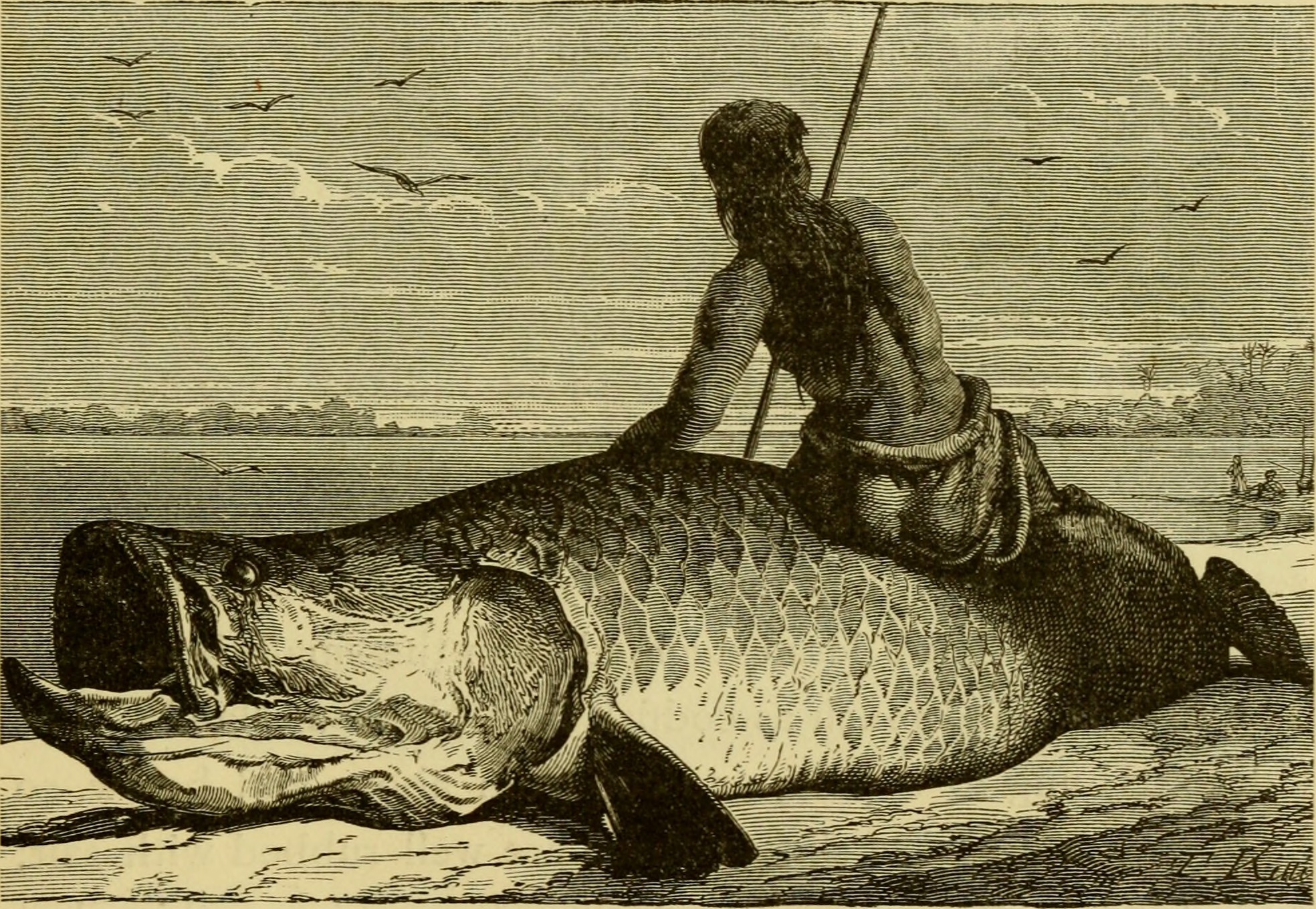
In those lakes lives the arapaima, called here pirarucu — one of the largest freshwater fishes in the world. And it has a weakness that nearly cost it its life: it breathes air, and every ten to twenty minutes it rises to the surface.
Fishermen always made use of this. They waited for the breath in a canoe with a harpoon. The flesh was salted and dried like cod — it was called “Amazon cod” — and carried downriver. By the 1990s there was almost no arapaima left in the Amazon.
In 1990 an ecological station was established here, and in 1996 it was turned into Brazil’s first sustainable development reserve — one where people are not moved out but stay, living on what is around them. It was the work of the primatologist José Márcio Ayres, who had begun by wanting to save the bald uakari, a red-faced monkey that lives only in these flooded forests.
In that same year, 1996, the federal environment agency, IBAMA, banned arapaima fishing throughout the state of Amazonas — except where it would be fished by rules. The rules were worked out here.
IIWhat is there now
The rules rest on the very weakness that nearly destroyed the fish. The arapaima is counted by its breaths.
In the dry season, when the fish stand in the lakes, fishermen sit by the water and for twenty minutes count the rises: by sound, by rings on the water, by the way a fish comes up to breathe. An experienced eye tells one fish from another and a young one from an adult. Scientists tested the method, and the fishermen’s count proved reliable.
The Mamirauá Institute gathers the figures and sends them to IBAMA, and IBAMA permits the taking of up to thirty per cent of the adult fish counted in a lake. Since 2 June 1999 the scheme has been public policy.
The result was such that for a long time nobody believed it. In eight years, from 1999 to 2006, the arapaima in the protected lakes became nine times as many — from about 2,200 to 20,650 fish. The quota grew tenfold, from 120 fish to 1,249, and the communities keeping the count grew from four to a hundred and eight.
Across Brazil, wherever the arapaima came to be fished the same way, its numbers rose from about two and a half thousand in 1999 to more than a hundred and seventy thousand in 2017.
It works because the lakes now belong to someone. A community guards its own lakes against outsiders’ boats, because every fish spared is its future quota. The skins of the fish caught are made into leather for boots, and that money too works for the fishery.
The whole story is like the one that happened to the bluefin tuna in the Atlantic: the fish was nearly fished out — and it came back when people began to count it.
IIIWhat is taken here
Arapaima is the main fish and the reason for everything else.
Tambaqui. A fish of the flooded forest that eats fruit. When the water stands under the canopy, the tambaqui gathers the falling nuts and seeds, crushes them with teeth rather like a man’s, and spreads the seeds through the forest. The forest is partly planted by a fish.
Aruanã. A narrow silver fish with barbels on its lower jaw, called the “water monkey”: it leaps out of the water and takes insects from the overhanging branches.
Tucunaré, the peacock bass — the predator of the lakes and the Amazon’s great sport fish. And piranhas, about which more legends have been told than they deserve.
IVHow it is taken
Recreational fishing
Mamirauá is not a place you come to with a rod on the off chance. These are other people’s lakes, and they are fished by agreement. In order:
In sport fishing the arapaima is release only. After long negotiations a fly-fishing programme was set up in the reserve, strictly limited and strictly catch-and-release. Its money goes to guarding the lakes. A recreational angler may not keep an arapaima.
Seasons. From 1 December to 31 May arapaima may not be fished at all in the state of Amazonas — it is the spawning time. The best time to fish is the dry season, September to November, when the water has gone and the fish have gathered in the lakes.
Getting there. From Tefé, by boat. The reserve has a floating lodge, Uakari Lodge — guests live on the water, and fishing, trips and fish-watching are arranged together with the communities.
Tackle for arapaima is heavy: the fish outweighs a man and leaves the water in a leap. More in the entry on the arapaima.
And the main thing. Papers, seasons and the rules of each stretch change, and they are known on the spot. Check all of it with the operator before the trip, not on the water.
The trade
The arapaima fishery at Mamirauá is communal and runs on a quota. Fish are taken in the dry season, in the lakes where the count was kept — by harpoon from a canoe and by net, exactly as many as are allowed. The meat goes to market, the skin to boots.
The communities’ real income is not the tonnes but the fact that the fish remain: the more of them are counted, the bigger next year’s quota.
Mamirauá Institute for Sustainable Development — history of the reserve, the counting method and the quota scheme. · IBAMA — the ban on arapaima fishing in Amazonas state (1996) and the approval of the management scheme (2 June 1999). · L. Castello, “A Method to Count Pirarucu Arapaima gigas: Fishers, Assessment, and Management”, 2004. · Results of management 1999–2006 — from the Mamirauá programme data. · Government of Amazonas state — the arapaima closed season, 1 December to 31 May. · The catch-and-release arapaima fly-fishing programme in the reserve. · Mongabay, 2026 — boots from pirarucu leather and the funding of the fishery. · Herbert H. Smith, Brazil, the Amazons and the Coast, 1879.