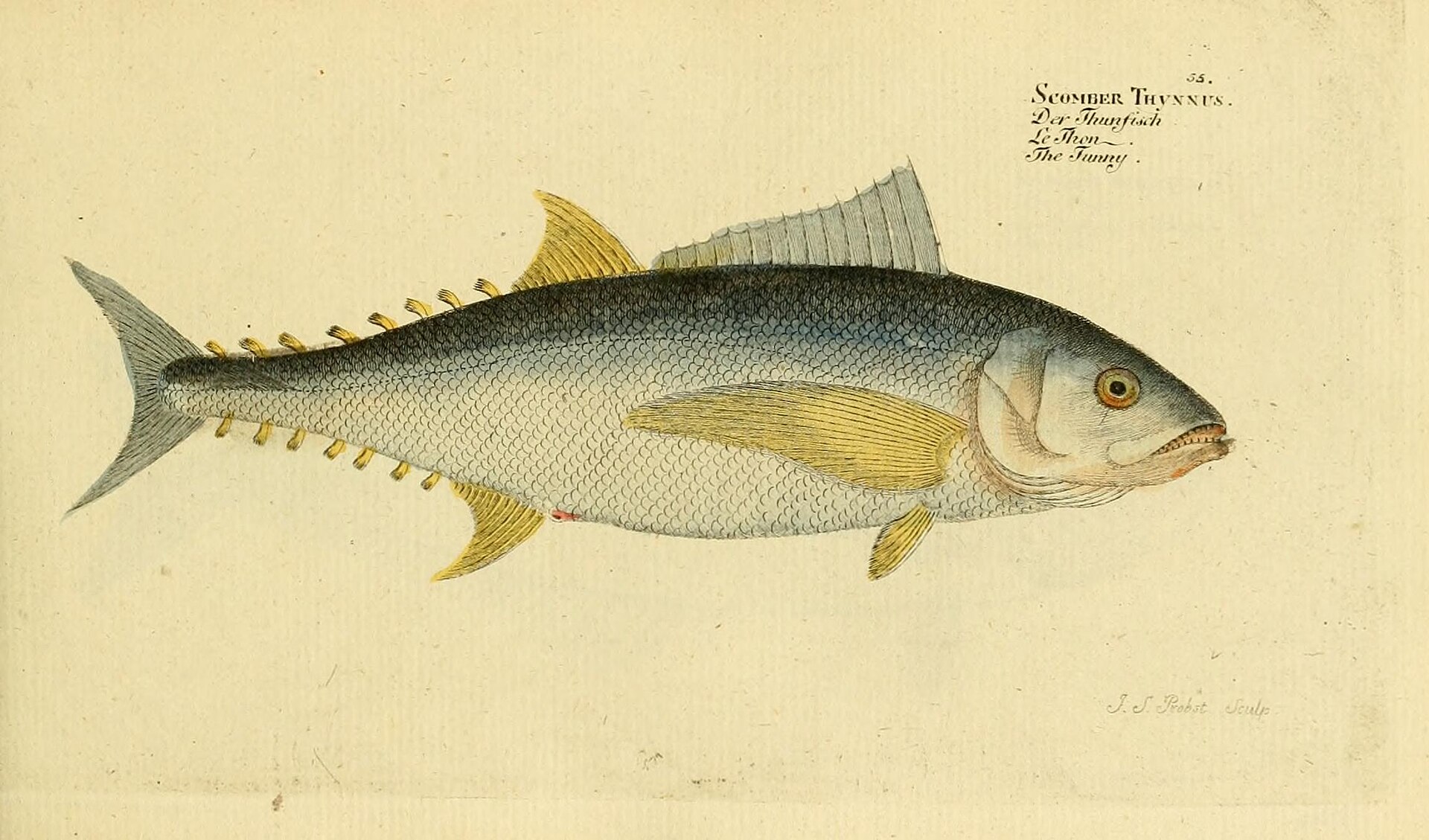
IThe portrait
The bluefin tuna is built like a shell, and that is not a pretty comparison but a description.
The body is a spindle, round in section, without a single needless bulge. The tail sits on a slender stalk with keels at the sides and is itself shaped like a sickle: such a tail does not paddle but cuts the water. On the move the fins fold into grooves in the body, like undercarriage, and the fish becomes as smooth as a torpedo.
The back is dark blue, almost black, the flanks and belly silver. From the second dorsal fin to the tail, and below from the anal fin, runs a row of small yellow finlets — they can be seen in Bloch’s engraving above this entry. Bloch named the fish Scomber thynnus, and the English caption on the same plate gives the old name — tunny.
Its pectoral fins are short. A small thing, but it is exactly how the bluefin is told from the long-finned albacore.
And the main thing, which cannot be seen from outside: the bluefin has warm blood. Not all of it — but its swimming muscles are warmer than the water around, and markedly so. Blood coming cold from the gills passes through a mesh of vessels, the rete mirabile, and takes up heat from the blood going back. The heat does not leak into the sea; it stays in the muscles.
Everything else follows from this: that it goes into cold waters as far as Norway and Canada, where other tunas have no business, and that its flesh is dark red, like that of a land animal.
It grows to three metres and more. The largest ever taken on rod and line weighed 679 kilograms.
IIWhere she holds
drag to turn · ctrl + wheel to zoom · a mark is a water of the atlas — click to open it
The bluefin is a fish of the whole North Atlantic: from the Gulf of Mexico and the Caribbean to Newfoundland, across the ocean to Norway and Iceland, along Europe and Africa to the Canaries. And the Mediterranean, entire.
It has two stocks, and they do not mix where it matters. The western spawns in the Gulf of Mexico, in spring. The eastern spawns in the Mediterranean, in early summer, in warm water around the Balearics and further east. To feed, both go out into the common Atlantic, and there they can no longer be told apart.
Every spring the eastern tuna go to spawn through Gibraltar, along the Spanish shore — and on that road, for three thousand years, has stood the almadraba.
It crosses the ocean end to end. Tags put on fish off one shore of the Atlantic have been found off the other, and that is an ordinary thing, not a record.
Over the last fifteen years it has come back to where it had vanished from for half a century: the British Isles, Ireland, Norway. For those shores it was no smaller an event than the return of a whale.
An important reservation. In the Pacific lives another bluefin, Thunnus orientalis — a relative, but a separate species. The Japanese tuna from Ōma that fetches record prices is that one, not ours.
IIIHow she is taken
For the visiting angler
Rules first, because with the bluefin they matter more than tackle. Almost everywhere in Europe the angler may have it only to release — and only by special permit.
Spain. A pre-notice through the PescaREC app before going out, catch-and-release only, under a separate authorisation requested in the same place. Details are in the entry on the almadraba.
Ireland. Recreational tuna fishing is formally prohibited, but since 2019 the Tuna CHART programme has run: authorised charter skippers catch, tag and release the fish, and the angler aboard takes part.
Britain. The first recreational catch-and-release season opened in 2024, under permits.
Now, how. The main method is trolling. Behind the boat runs a daisy chain: several lure-fish in a row that play a small shoal. The tuna strikes the last one. A spreader bar is used too — the same little shoal, only spread sideways. Tuna is also taken on live bait and on chunked fish, drawing it up to the boat.
The tackle is the heaviest an angler ever uses: a powerful reel, thick line, a harness or a fighting chair. The record 679-kilogram fish was taken by Ken Fraser on 26 October 1979 off Nova Scotia — on a daisy chain of mackerel. The record stands to this day.
And the main thing — release it alive. A big fish is not lifted aboard or hauled by the tail: it is freed in the water. The fight is kept short. A long fight kills a tuna as surely as a knife — only later, and out of sight.
By the trade
The trade takes bluefin by purse seine in the Mediterranean, by longline on the open ocean, by rod from boats, and by almadraba off the Spanish shore. Some of the tuna caught alive are not killed at once but fattened in floating pens — a Mediterranean industry of its own.
All of this rests on the quota, and the quota is the heart of the story. At the start of the century it was set three times higher than the scientists advised, and the stock was heading for collapse. The 2006 recovery plan cut it from 27,500 tonnes to 13,400 by 2014, raised the minimum size of fish that may be landed, and banned spotting shoals from aircraft. The stock rose, and for 2026–2028 the eastern quota was set at 48,403 tonnes.
IVSecrets of the craft
Look at the pectoral fin. A young bluefin is easily mistaken for albacore or yellowfin. The albacore has long pectorals like sabres; the yellowfin has a drawn-out second dorsal and anal fin. On the bluefin everything is short and compact — a fish with nothing to spare.
Blue by the back, not by the fins. The name misleads: its fins are dark, and the finlets along the tail are yellow. Only the back is blue, and only on a living fish; out of the water the colour fades within minutes.
Red flesh comes from warm blood. A muscle that works without rest and holds its heat is rich in myoglobin, and so the bluefin’s flesh is dark, like beef. A cold-blooded fish has nothing of the sort.
Size is protected. The recovery plan raised the minimum landing size, and small tuna may not be taken anywhere the commission’s rules apply. It is one of the reasons the fish came back.
Do not argue with it longer than you must. A tuna does not give up — it dies on the move. For catch-and-release this is the essential knowledge: the shorter the fight, the better the fish’s chance of swimming away alive.
VStories about her
Two stories are told about the bluefin, and both are true.
The first is about the record. On 26 October 1979 Ken Fraser went out off Nova Scotia and took, on a daisy chain of mackerel, a tuna of 679 kilograms. Almost half a century has passed, tackle has improved, anglers have multiplied — and the record stands. Fraser died in 2025, and his fish remained the biggest.
The second is about how the fish was nearly lost. At the turn of the century the eastern tuna was fished as if it were endless: quotas three times the scientific advice, aircraft over the sea, pens swallowing thousands of tonnes of live fish. The scientists warned of collapse, and collapse was close.
And then something happened that rarely happens in fisheries. The commission listened. The quota was halved, small fish were protected, the aircraft withdrawn — and the stock rose. In 2021 the Red List moved the bluefin from Endangered to Least Concern. It is one of the few stories where nearly everything had already been lost — and was not.
Compare the Grand Banks: there they did not stop taking the cod in time, and the fishery was closed for thirty-two years. Here they stopped.
And a third story, a short one. In January 2019, at Tokyo’s Toyosu market, 333.6 million yen was paid for a single 278-kilogram tuna. It was the Pacific relative, from Ōma — but the price shows what people will pay for a fish whose fate ours very nearly shared.
International Commission for the Conservation of Atlantic Tunas (ICCAT) — the 2006 recovery plan, quotas for 2007–2014, the eastern quota for 2026–2028. · IUCN Red List — reassessment of the Atlantic bluefin tuna, 2021. · International Game Fish Association (IGFA) — Ken Fraser’s world record, 26 October 1979. · Inland Fisheries Ireland — the Tuna CHART programme. · UK Government — catch-and-release recreational tuna fishing under permits. · Spanish Ministry of Agriculture, Fisheries and Food — PescaREC and permits for recreational tuna fishing. · Toyosu market auction, January 2019 — from press reports. · Marcus Elieser Bloch, Ichthyologie, plate 55.