IHistory
Just before the ocean, the Senegal River does not enter it at once. A narrow sand spit, the Langue de Barbarie — “the Barbary tongue” — pushes it south, and the river runs for dozens of kilometres along the sea, separated from it by a strip of sand a few hundred metres wide.
In 1659 the French built a trading post on an island in mid-river, right by the mouth, and called it Saint-Louis. It was the first French settlement in West Africa. It grew on trade — in gum arabic, gold and people — became the capital of the colony of Senegal and then of all French West Africa; in 1902 the capital moved to Dakar. The island is joined to the mainland by the Faidherbe Bridge, of iron, 1897. Since 2000 the old town has been a UNESCO World Heritage site.
Across from the island, on the spit between river and ocean, lies Guet Ndar — the fishermen’s quarter, by local repute one of the most crowded neighbourhoods in Africa. It stands on less than a square kilometre of land, and nearly everything in it is fishermen, their families and their boats. The people of Guet Ndar have fished the ocean for as long as the town has stood.
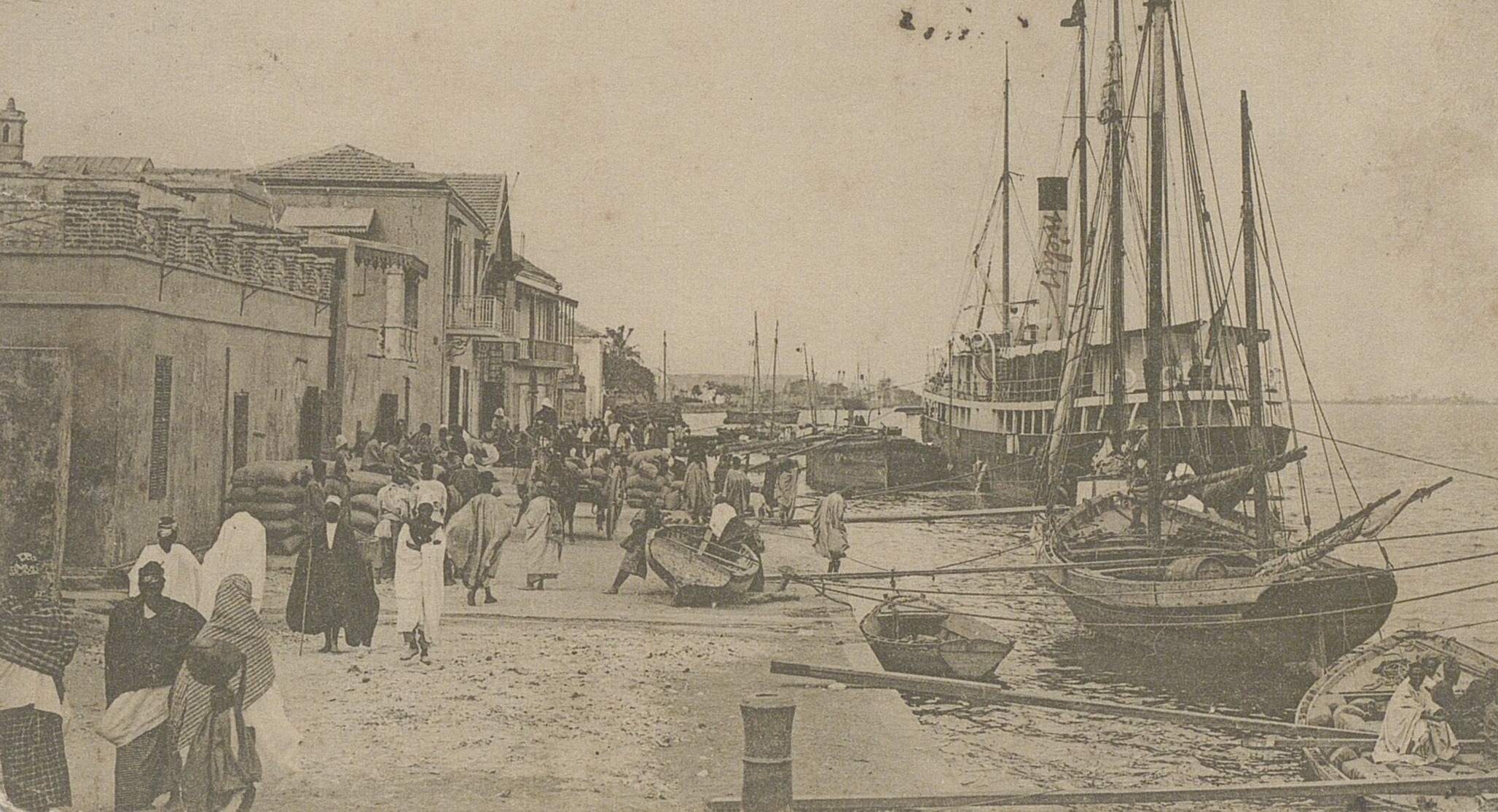
Above the entry is Saint-Louis on a postcard by Edmond Fortier, 1906: the quay where the river mail steamer has come in. Sacks and a crowd on the quay, schooners and boats at the moorings. In those years boats went hundreds of kilometres up the Senegal into the continent.
And one story of the air. On 12 May 1930 Jean Mermoz’s seaplane took off from the river at Saint-Louis and, some twenty hours later, came down at Natal in Brazil: the first time mail was carried across the South Atlantic.
IIWhat is there now
Every morning hundreds of pirogues come out onto the beach at Guet Ndar — long wooden boats painted in bright colours, with names, pennants and sayings on their sides. They are pushed into the surf, catch a wave and head out to sea. In the evening they return, and the catch is sorted right on the sand: some for market, some to be dried and smoked.
The breach. In October 2003 the town feared a flood: the river was rising, and the water could not get away to the distant mouth fast enough. So a channel four metres wide was dug through the spit opposite Saint-Louis — to let the river drain into the ocean faster. Within a few years the ocean had widened it to hundreds of metres, and the southern end of the spit was torn from the mainland. The new mouth became a trap: pirogues overturn in the surf at the breach, and fishermen speak of three hundred and seventy-five dead and more.
The advancing ocean. Waves eat at the spit from the sea side as well. Some of Guet Ndar’s houses by the shore have been washed away, families are being moved to the mainland, and the fishermen hold on to the shore, because their work is here.
Foreign waters. Fish have grown fewer off their own coast, and the people of Guet Ndar go north, into Mauritanian waters. Fishing there is allowed only under licences agreed between the two countries: at the start of 2024 the fishermen of Guet Ndar were handed five hundred such licences. Disputes over border violations have happened more than once.
Thiof. The coast’s great fish, the white grouper, is overfished: the catch is almost all young fish, and the big breeders have nearly gone.
IIIWhat is taken here
Thiof — the white grouper, king of the Senegalese table and of ceebu jën.
Sardinella — a small schooling fish, the biggest by weight in the pirogues’ catch; taken with purse seines and smoked.
Jacks and bluefish — strong predators of the surf and the river mouth, fish for sport.
Croakers and sea breams — bottom fish for the handline.
And in the river itself, behind the island — tilapia and catfish.
IVHow it is taken
Recreational fishing
Sport fishing in Senegal works through boat operators — in Saint-Louis, Dakar and at the coastal resorts. In order:
With whom. In Saint-Louis you go out to sea with an operator or agree with a Guet Ndar fisherman to go in his pirogue. The operator knows what papers are needed and watches the weather.
The breach is no place for an outing. Going out to sea through the new mouth is dangerous even for local pirogues. Cross it only with someone who does it every day.
What is caught. Jacks and bluefish — in the surf and at the mouth, on spoons and poppers. Bottom fish — with a handline over the rocks. Thiof — on a jig and on live bait by the stones.
Release the thiof. It is an overfished species, and every big fish counts. If a large one is caught — photograph it and put it back.
The trade
Guet Ndar’s fishery is small-scale but huge: thousands of fishermen, hundreds of pirogues, handlines, gill nets and purse seines. The fish are sold on the beach, dried, smoked and carried inland.
Alongside them work industrial trawlers — domestic and foreign, under licence. Pirogue and trawler compete for the same fish, and the thiof was the first to feel it.
UNESCO — the historic centre of Saint-Louis (2000); “Ceebu jën, a culinary art of Senegal” (2021). · Studies of the Langue de Barbarie breach since 2003; Guet Ndar fishermen’s figures for the dead. · Senegal’s fisheries ministry — Mauritanian licences for Guet Ndar fishermen, January 2024. · A 2013 study in the African Journal of Marine Science — overexploitation of the white grouper in Senegalese waters. · History of the Aéropostale — Jean Mermoz’s flight Saint-Louis to Natal, 12–13 May 1930. · The Faidherbe Bridge, 1897. · Postcard by E. Fortier, 1906.